10 Interesting (To Me) Stats For This Week - November 19, 2024
We are back with 10 Interesting (To Me) Stats. Last week’s column looked entirely at defencemen, so this week we are shifting to forwards. Data is from Natural Stat Trick, tracking from AllThreeZones, viz from HockeyViz and Evolving Hockey, and other sources mentioned accordingly.
Donato? More like, WHOA-nato (I’m so sorry)
Market share has a lot of applications, but here we’ll discuss what percentage of a team’s shots a particular player is taking when he’s on the ice. With shot shares from defencemen rising, it’s importantly to acknowledge which forwards are shooting the puck more than their line mates.
One name that sticks out is Chicago’s Ryan Donato. Among 354 forwards with at least 150 total minutes played, Donato is fourth by share of team shot attempts when he’s on the ice:
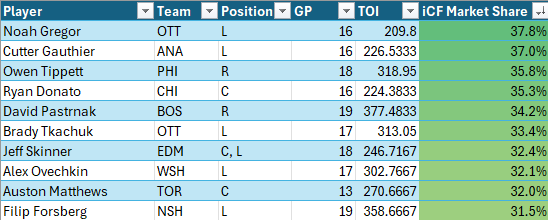
Interestingly, in 78 minutes next to Connor Bedard, that number is still 32.1%. If Donato keeps shooting as much as he is, 25 goals is very much on the table.
Kotkaniemi Code
The story in Carolina is clearly Martin Nečas, but his centre Jesperi Kotkaniemi has been there every step of the way with 11 points in 17 games. The bad news is that Kotkaniemi leads all forwards with seven secondary assists at 5-on-5, and he’s getting 63.6% of his points from secondary assists, the second-highest rate in the league (minimum of 150 minutes and five points):
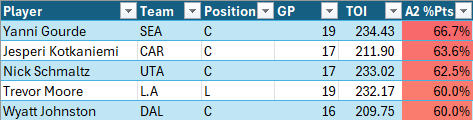
Those secondary assists will dry up, but he’s due for positive shooting percentage regression as well as a bit of power play production. We should note he started last season very well (12 points in 12 games) before falling off as the season wore on. A good start, but we need to see this level of play from him continue through March and April.
William Eklund Missing
Blocked shots are high, fewer shot attempts are turning into shots on goal, and that has been a huge problem for San Jose’s William Eklund. Overall, he is averaging 13.4 attempts per 60 minutes, which is a career-high. However, he’s landing only 35.6% of those attempts on net, so his 60-minute shot rate is 8% lower this season (4.72) than last season (5.14).
The interesting part is from where he’s missing. Look at all the orange dots, showing missed shots, from between the faceoff dots and below the hash marks:
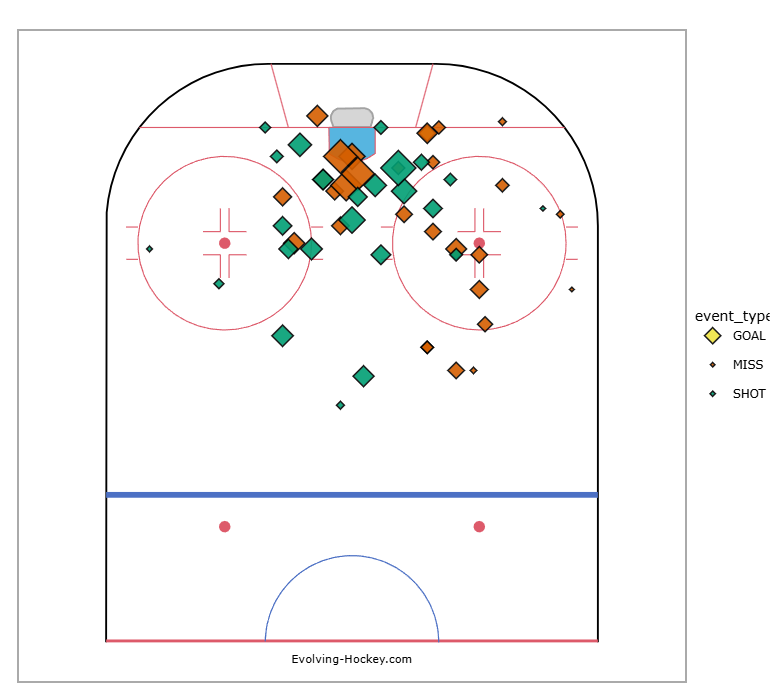
We would have to go back and look at each individual shot attempt, but my guess if he can keep up those shot locations, he’ll start hitting the net a lot more often, and his goal total will rise sharply.
David Pastrnak’s Expected Goals Decline
In Boston’s historic 2022-23 regular season, David Pastrňák managed 1.09 expected goals per 60 minutes at 5-on-5 (per HockeyViz). Last season, that number was 1.07. So far this season, he sits at 0.81. One reason for that is where he’s shooting from. Look at all the distance shots from just inside the blue line:
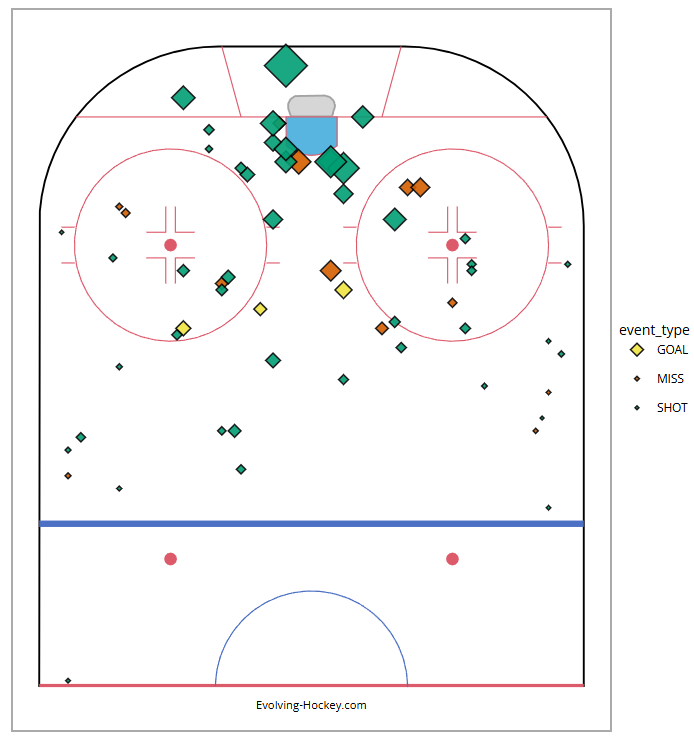
In fact, per Frozen Tools, 23.2% of Pastrňák’s total shots have come from further than 45 feet; last season, that number was 14.5%. Why this is happening is another matter entirely, but it’s not really surprising his 5-on-5 goal rate is the lowest of his career and his all-strengths goal rate is the lowest it’s been since 2015-16.
Nathan MacKinnon’s Elite Assist Rate
MacKinnon’s overall points/60 rate is 4.71, the highest of his career and sixth in the league. However, his goals/60 rate is 1.0, which is his lowest in eight years. A lot of his production is his assist rate, which is 30% higher than his previous career-best mark.
This seems to be an intentional shift in his play. As good as he is, MacKinnon is not an efficient shooter, posting six straight seasons under 13% shooting, with a three-year average in the middle of the league’s forwards. AllThreeZones tracking (which is only 70 minutes right now, so grain of salt and all that) has MacKinnon with four-year highs by scoring chance assists per 60 minutes at 5-on-5 (SCA/60, or rate of passes leading to teammate scoring chances) and by high-danger passes per 60 minutes (either from behind the net or across the slot), and it’s not even close:
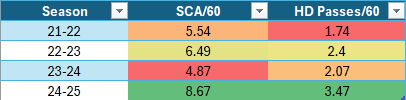
We will wait for a bigger sample, and the team is now healthy, so we’ll see where this goes, but it’s a notable style change early in the season.
Sean Monahan and Kirill Marchenko in the 60/60 club
MoneyPuck has eight lines with at least 100 minutes played at 5-on-5 that have at least a 60% expected goal share and 60% actual goal share. Only six are top-6 lines, and one of them belongs to the Columbus Blue Jackets:
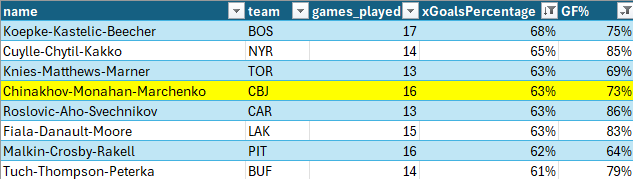
What is interesting about that is that in 83 minutes without Yegor Chinakov on that top line, the Monahan/Marchenko duo still has a 57.6% goal share at 61.2% expected goal share. And those strong numbers persist whether they have Zach Werenski on the blue line or one of the depth pairs. Through six weeks, Monahan and Marchenko have been one of the best 5-on-5 forward duos in the league.
Evangelista, Exit 11
It has been a good start to the season for young Luke Evangelista, especially in the defensive end. HockeyViz has him with an expected goals against rate at 5-on-5 of 2.29 against a team average of 2.49 (five actual goals against in 210 minutes). That great work in the defensive end is partly due to Nashville exiting the defensive zone on three-quarters of Evangelista’s touches (with much higher involvement than the name ahead of him):

We don’t want to read too much into three tracked games, but he was 15% better than Nashville’s team average last season by this measure. That he’s excelling again is not a surprise, and continued defensive excellence will keep him in the lineup and provide the team with positive depth, unlike their offseason additions.
Dallas’s Third Top Scoring Line
Dallas got a great performance from their Matt Duchene-Tyler Seguin-Mason Marchment line in 2023-24, and that has persisted in 2024-25: that trio is up to 117 minutes together at 5-on-5 with a 69.6% goal share. Compared to last season, the expected goal share has improved from 51.3% to 55.3%:
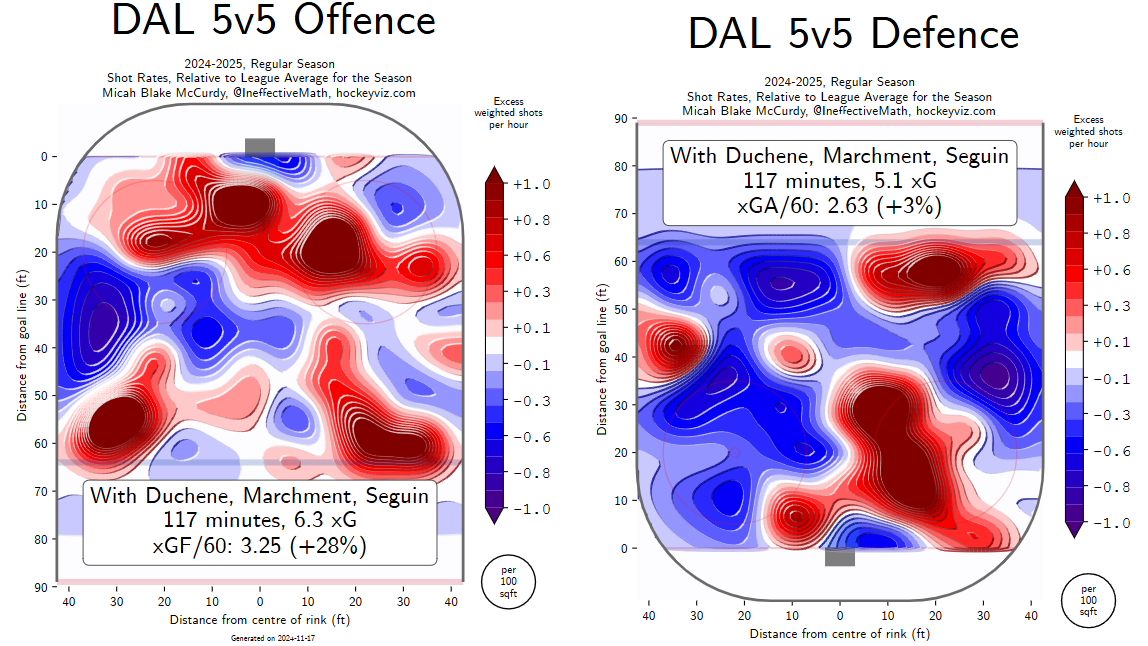
Dallas is shooting 10.3% with this trio on the ice, and that feels like a reasonable mark. There have been some slow starts among Stars forwards, but not from these guys.
Ottawa’s Goal Gaud(ette)
Ottawa has completed 20% of their season and their 5-on-5 goals/60 leader is Adam Gaudette? He is also in the 98th percentile of the league by goals per 60 minutes at 5-on-5. That seems good.
Gaudette obviously won’t keep shooting 25% at 5-on-5, so the goals will decline, but it’s notable that Ottawa is driving the play at both ends with he and Zack MacEwen on the ice, and they have outscored the opposition by a 5-4 margin:
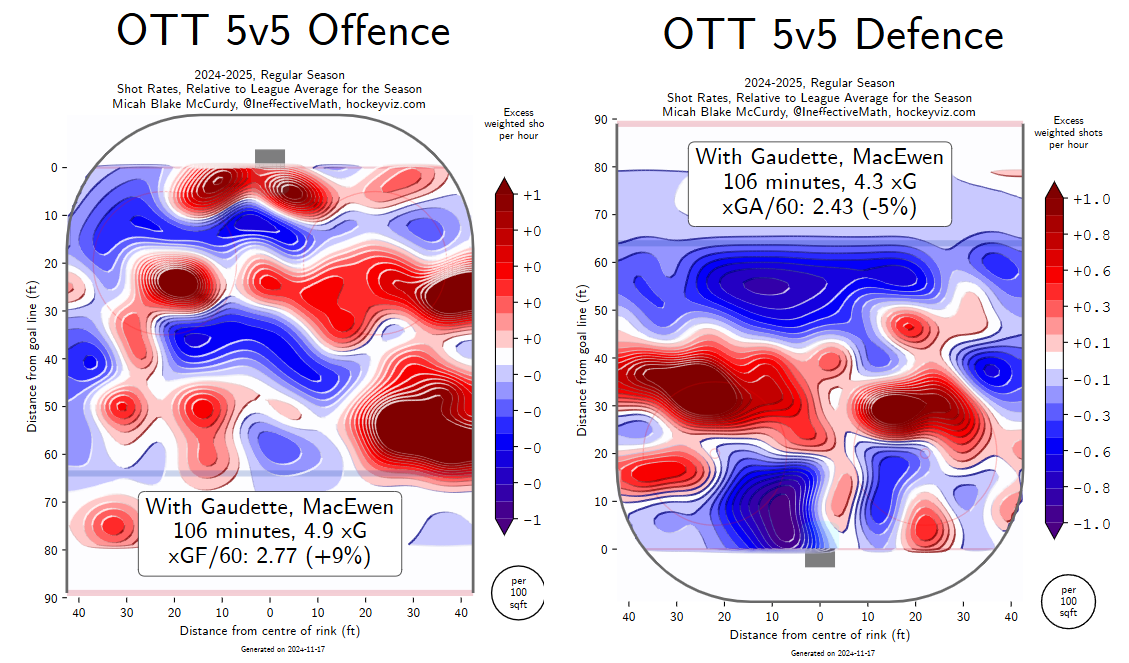
A good fourth line isn’t enough to lift a team to the playoffs by itself, but the Senators had a 46.4% goal share with their top forwards off the ice at 5-on-5 in the prior two seasons. This improvement is a positive impact, and in a tight playoff race, it may be the difference between a Wild Card entry and planning a vacation for late April.
Team Passing
There still isn’t a pile of data tracked by AllThreeZones yet (including no games from Columbus), but it’s worth pointing out which teams are focusing on high-danger offence at 5-on-5 and which are not.
So far this season, teams are averaging 1.13 high-danger passes per 60 minutes at 5-on-5, and 40% of passes leading to shots are classified as ‘low-to-high’, or to the blue line for a distance shot. Eight teams are averaging more than 1.13 high-danger passes/60 and fewer than 40% of passes going to the blue line:
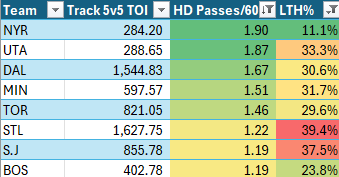
It is a bit surprising to see Boston, San Jose, and St. Louis, given their general issues scoring, but it’s clear what their approaches are. San Jose is particularly interesting given the rebuild status of their team. Let’s see where they stand at the end of the season.
Until next week. (Next week’s column is likely to be sent Monday morning because of a busy Monday schedule.)