10 Interesting (To Me) Stats For This Week - September 16
Welcome back for another week of ’10 Interesting Stats’. Last week, we looked at common characteristics in playoff teams from the last four years. One thing a lot of playoff teams have in common is that their respective defence groups failed at exiting the defensive zone a lot less frequently than the non-playoff teams. It got me thinking: which defencemen are the most responsible with the puck? So, let’s look at that, limiting our sample to defencemen with 1000 minutes at 5-on-5 across the last two seasons (215 players).
We are using 5-on-5 player data from Evolving Hockey and 5-on-5 tracking data from AllThreeZones across the last two seasons. We are going to look at four things:
· Giveaway Percentage: Adding a defenceman’s total takeaways and giveaways, then dividing that total by only their giveaways to see what share of their changes in puck possession both for and against are turnovers.
· Botched Retrieval Percentage: How often they botch a defensive zone retrieval.
· Failed Exit Percentage: What percentage of their zone exits fail.
· All Percentage: Adding those three percentages together.
Briefly, here is what we need to know:
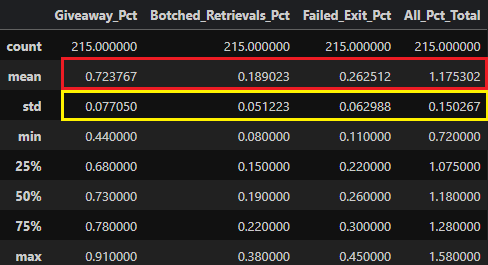
· In the picture below, the red box is the average percentage for each category among all defencemen.
· The yellow box is the first standard deviation away from each respective average. For example, the failed zone exit percentage average is 0.2625, or about 26.3%. The standard deviation is 0.0627, or about 6.3%. That means players outside the first standard deviation have a failed zone exit higher than 32.6% (26.3 + 6.3) or lower than 20% (26.3 – 6.3). Same goes for the other stats. The players outside those standard deviations are extremely good/bad at puck maintenance.
Hope this is clear. Let’s look at some names.
1 – The Sheriff
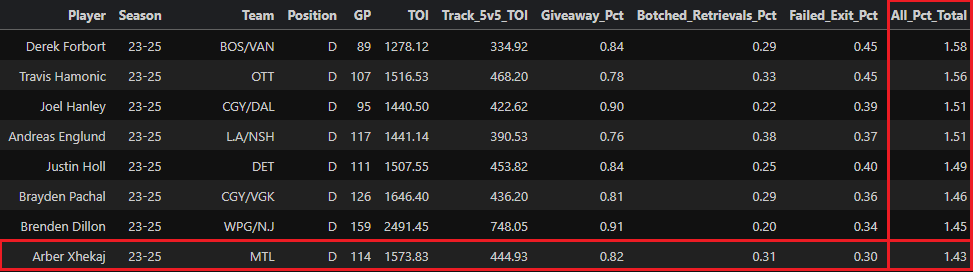
Arber Xhekaj brings a set of skills to the Montreal blue line, but it’s not necessarily good puck-moving skills as his combined percentage of our three categories is one of the 10 worst marks among all blue liners:
Montreal is now firmly in the ‘make playoffs’ portion of the rebuild, and the trade for Noah Dobson gives them five defencemen who are going to be lineup regulars. The last spot is between Xhekaj and Jayden Struble, and Struble is coming off a very good season. If Xhekaj wants to stay in the lineup, he cannot be a turnover machine on a blue line that now has enough options to leave him in the press box when everyone is healthy.
2 – New Opportunity
With Alex Pietrangelo’s injury, others on the Vegas blue line will need to step up, and one of them is Zach Whitecloud. He was a key part of their Stanley Cup win a couple of years ago but has since only been slightly better than Xhekaj at managing the puck:

Despite this, Whitecloud is still very good in front of his own net so it’s not a big drag on the team defensively. The problem is the turnovers limit the team offensively, so all the good work he’s doing in his own zone is erased by the fact that the team struggles offensively when he’s on the ice. If he’s able to bring a bit more balance on this front, he can be an excellent defensive defenceman.
3 – I Get It Now
There are some areas of the profile of Boston blue line Mason Lohrei that make him look like their puck-moving stalwart of the future. There are others, though, that make it obvious why coaches have been hesitant to trust him and his only jumps in ice time have come when the Bruins have been slammed by injuries. Namely, his failed zone exits and botched retrievals are far too high:

This is a player who should be given some grace. He has just 118 NHL games, has just one full season to his name, and stands 6’5. If he can clean up this area of his game, with his puck-moving skills elsewhere, he can be a high-impact blue liner for the Bruins. But this does need to improve, because even at his size, these high turnover rates will wear out his welcome with any coaching staff.
4 – Grown Man Named Dougie
If there is a defenceman Lohrei should look to as someone who he should try to emulate, it’s Dougie Hamilton, because they are both big blue liners (Hamilton is listed at 6’6) who rarely hit and also have similar problems with turnovers:

The difference between them is that Hamilton can create both off the rush and cycle while generating a lot of shots, and Lohrei does neither of those things. Hamilton is below-average defensively, but more than makes up for it on offence – Lohrei does not. But if we’re wondering why, at least up until 2024-25, coaches have been fine with giving Hamilton top-pair minutes despite the defensive issues, that is why.
5 – Buffal-Oh No
One of my beliefs is that the additions of Conor Timmins and Michael Kesselring to Buffalo’s blue line will stabilize their second/third pairs, and give the team a deep blue line they can rely on for the first time since at least the early 2010s. Nothing is a guarantee, though, as both Timmins and Kesselring have their all-percentage total a standard deviation worse than the league average over the last two years:

They get there in different ways – Timmins via giveaways and retrievals, Kesselring by failed zone exits – but the result is the same. Despite these numbers, the defensive results by goals against have been good for both, but the true test will be if those results can hold up in Buffalo.
6 – Of Course
At the other end of the spectrum are players who are excellent at managing the puck. Given his reputation around the league, it should come as no surprise that the player with the lowest total turnover percentage is Carolina’s Jaccob Slavin:

Over the last two years, Slavin has averaged 2.31 takeaways per 60 minutes at all strengths, and no other defenceman in the league is higher than 2.0. He doesn’t only manage the puck exceptionally when he has it, but he’s tremendous at forcing opposition turnovers when he doesn’t.
7 – Leave Adam Alone
Slavin has the lowest total percentage on the board. In second place is a former Norris Trophy winner who got slagged by some writers and fans for his performance in 2024-25, though I’m not sure why:

There are questions around whether Fox could have some lingering knee issues, so hopefully a full offseason of training can help get him to his highest level. Even with some knee issues, he was still great, and that he manages the puck so well for a guy that is so involved all over the ice helps make him elite.
8 – Still Great
Here at ’10 Interesting Stats’, we are big Thomas Harley enthusiasts. That shouldn’t overshadow just how good Miro Heiskanen is, though, because he’s one of the best at puck management:
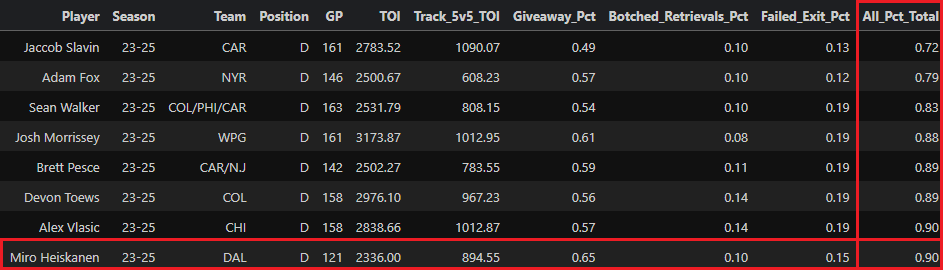
Heiskanen doesn’t have the same offensive skills as Harley, but he is good at getting the puck out, great at transitioning up the ice, and rarely commits turnovers. That is part of the combination that makes him among the best in the world at his position.
9 – Fresh Start
Speaking of New York Rangers defencemen getting slagged, K’Andre Miller was acquired by Carolina from the Rangers over the summer. My guess is Miller’s performance takes a big step on a team that is filled with talent from top to bottom, especially considering his total turnover percentage is virtually identical to that of Heiskanen’s:

Like Timmins and Kesselring earlier, Miller and Heiskanen get there in different ways, as Miller is much better at takeaways but has more failed zone exits. Regardless, he’s a good puck manager who forces the play and is now on a team that attacks and forechecks relentlessly. This seems like a great fit for him that will maximize his strengths.
10 – Dear John
Utah defenceman Marino had back surgery early in the 2024-25 season and returned three months later. He played just 35 games after returning but had very good on-ice results at 5-on-5. It probably shouldn’t be a big surprise as he’s an excellent puck manager:

Growth from Utah’s young skaters is crucial to them making a playoff push, but Marino and Sean Durzi being healthy and their usual selves will go a long way to making the Mammoth a well-rounded roster.
Until next week.