10 Interesting (To Me) Stats For This Week - July 29
Welcome back to another week of ’10 Stats’. There is no over-arching theme this week as we just throw a bunch of under-cooked spaghetti at the wall and see what sticks. Let’s not waste time and get right into it.
Player data is from Evolving Hockey and other sources are credited as necessary.
1 – Changes
Looking ahead to the 2025-26 season, it’s always important to keep track of where the league environment stands. We have to stay current with changes across the league in a variety of areas that affects player performance and production, and a clear area of change has been the league-wide shooting percentage. Over the last 10 full 82-game seasons going back to 2013-14 (excluding the shortened 2019-20 and 2020-21 campaigns), the league-wide shooting percentage has increased each season, and the largest relative jump came between 2023-24 and 2024-25:
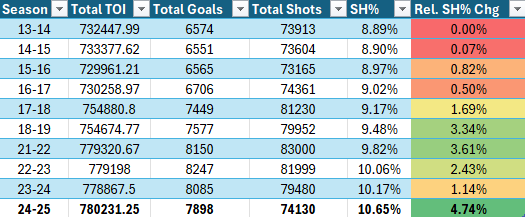
For an example of how important that shooting percentage change is: the three seasons from 2021-2024 saw an average of 10.01% shooting, and that was 10.65% this past year. That improvement in the three-year shooting percentage led to an extra 475 goals (!) than there otherwise would have been. Increasing shooting percentages should force us to update our baselines and what individual levels constitute Rebound or Regression candidates.
2 – Tomorrow’s Dream
Now that we know shooting percentages are continually rising, the question is why that is happening. Continual, large-scale changes like this always have several factors of influence but to get down to a basic level, it’s crucial to note where the change is coming from. While defencemen have seen their shooting percentages rise for five straight years, their biggest increase came from 2021-22 to 2022-23. They had a very small relative rise last year that likely isn’t much different from normal variance:
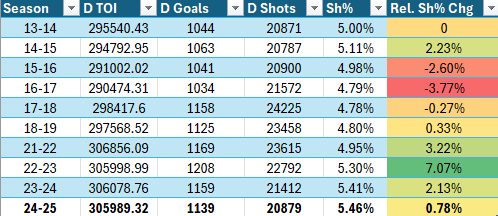
On the whole, defencemen shooting efficiency was much higher than 7-8 years ago, but after that huge percentage jump two years prior, things have stabilized. It is a wonder if they see a substantial jump this coming year or not. Anyone got a crystal ball?
3 – Who Are You?
If the league saw a sizeable jump in shooting percentage relative to the year prior, and the increase from defencemen was minimal, it really cuts down on which group of players are responsible shooting percentage increase; I don’t remember there being dozens of goalie goals in 2024-25. That leaves the forwards, and yeah, they saw a massive increase in 2024-25 compared to 2023-24:
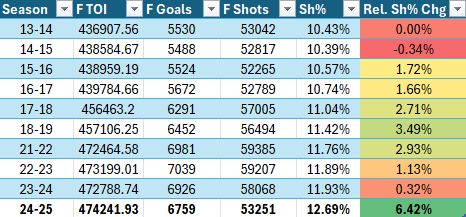
It is interesting that forwards saw improvements in each of the prior three years, but that improvement was getting smaller with each passing season… until 2024-25. It seems very unlikely that they see another similar jump this coming campaign, but history tells us a stark decline is unlikely, so we may need to greatly adjust our shooting expectations from forwards.
4 – Slow Down
Jackson Blake signed an eight-year extension in Carolina. It carries a $5.625M annual cap hit, per PuckPedia, that starts in the 2025-26 season. The nature of the contract aside, Blake is an interesting case as a rookie. In the Stokastic Discord, Zigger77 pointed out that Blake had very strong defensive metrics. In fear of repeating myself, what I mentioned in the Discord was that HockeyViz has Blake’s line mates with near-uniform improvements defensively when he was on the ice with him than without him (red boxes below blue boxes means worse defensively without Blake):
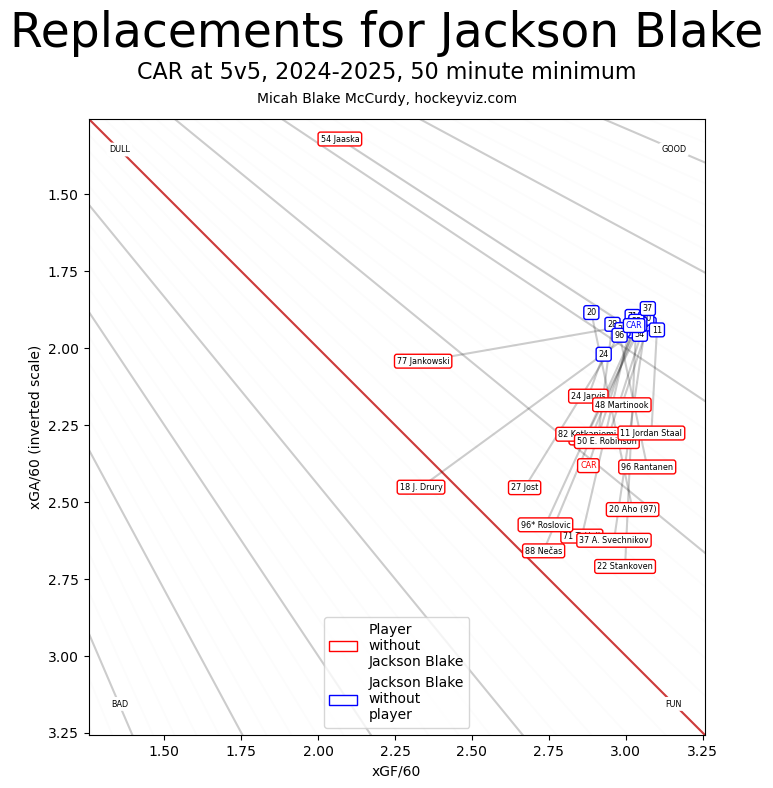
It is just one season, and just a rookie season at that, but the fact that he was able to impact nearly every single of his line mates positively would indicate that this is indeed a pretty good defensive forward, which is especially impressive as a 21-year-old rookie.
5 – Miracle Man
Staying with Blake for a minute, it’s worth going back through the years to see which rookie seasons are comparable to the one he just had. The short answer is that the list of comparables is very small. Looking at impacts on both expected goals for and against at even strength, overall expected goals impact, and goal differential, there is one winger since 2013-14 whose name pops up:

While Mantha has had a successful NHL career, he has zero seasons with more than 25 goals and zero seasons with at least 50 points. His expected goals impacts have also significantly out-paced his actual goals impacts since that rookie year, and it’s goal impact that wins or loses games. Blake looks like he has a very bright future, but his great rookie season is not a guarantee of superstardom.
6 – Alive
For the second half of this article, we’re going to look at players who had an improved second half last year. Not exactly the second half – we’re looking up to the Four Nations break in February and then from the break to the end of the season – but you get the idea. For this, we’re looking at improvements in rate of individual shot attempts (iCF/60) and expected goals (ixG/60), limiting to players with 500 minutes in the ‘first half’ and 200 minutes in the ‘second half’.
First off is one of the newest Anaheim Ducks in Ryan Poehling. After the Four Nations break, Poehling had eight goals in 25 games, and though shooting nearly 27% certainly helps, he saw the largest relative ixG/60 increase and the 11th-largest iCF/60 improvement:

Two of those eight goals scored down the stretch were on the power play, and it’s unlikely he gets much of PPTOI in Anaheim. Nonetheless, he’s good defensively and if he can contribute offensively like this in a bottom-6 role, he’ll be a genuine difference-maker for the Ducks.
7 – Lightning Strikes
The second-largest ixG/60 increase after the Four Nations break after Poehling, though with not as large a change in iCF/60, came from a young Columbus forward:

While part of the rise is that half the games Adam Fantilli played in that second-half sample were without Sean Monahan, half of them still had Monahan in the lineup. Even after Monahan returned, Fantilli’s ixG/60 and iCF/60 rates stayed higher than earlier in the season. In any situation, Fantilli really turned it on down the stretch and that is a great sign. An additional fun fact: since 2007, he has the third-highest goal rate at 5-on-5 for any forward to play at least 125 regular season games by the end of their age-20 season. The other two are Auston Matthews (who is way ahead of everyone else) and Wyatt Johnston (who is much closer).
8 – Bloodbath in Paradise
It is no secret Andrei Kuzmenko went on a tear once he got traded to Los Angeles with 23 points in 28 games between the regular season and playoffs. While not all the games in the post-break sample were in Los Angeles – about a half-dozen with Philadelphia – like the other two players named already, he had huge increases in both iCF/60 and ixG/60:

Kuzmenko still needs to shoot the puck a lot more because that 12.15 iCF/60 rate in the second half would still be that of a third-liner, and it’s why he can shoot over 16% across the last two years but still have an 82-game goal-scoring rate under 20 goals in that span. Regardless, holding onto these improvements and being an impactful player on the power play is enough.
9 – Killer of Giants
Toronto forward Nick Robertson has his arbitration date this weekend, so it’s worth pointing out what Robertson did down the stretch last year. Not only did he have the largest improvement in iCF/60, but that translated to an even larger increase in ixG/60:

Over the last two years, Robertson has scored 1.18 goals per 60 minutes at 5-on-5, which is in the 96th percentile of the league, and that was even better after the Four Nations break last year (1.55). He is turning 24 years old in September, so it’s worth wondering if he’s a hidden-gem goal scorer on the cusp of a breakout.
10 – Revelation
St. Louis forward Alexei Toropchenko saw the fourth-largest increase in iCF/60 down the stretch, and that helped him be 1 of 19 forwards in the sample to increase their ixG/60 rate by at least 50%:

Toropchenko has typically been solid defensively as a depth option but has struggled offensively. He now has over three full seasons of NHL games under his belt, so maybe he’s turning a corner on the offensive side. If he is turning that corner, he is now an impact forward in the bottom-6 that can help replace the loss of Zachary Bolduc.
Until next week.