10 Interesting (To Me) Stats For This Week - December 10
We are back with another ’10 Stats’ column and today we are going to spend some time focusing on unheralded players off to great starts, a couple with poor starts, and a few ‘snubs’ Four Nations Cup rosters.
Player data is from Natural Stat Trick and Evolving Hockey, tracking data is from AllThreeZones, and viz from HockeyViz.
1. Great Scott
St. Louis defenceman Scott Perunovich has long had high offensive upside – 42 points in 39 AHL games between 2021-22 and 2022-23 – but a slew of injuries stalled his progression.
Things turned in 2023-24 as he had the highest 5-on-5 on-ice goals-for rate of St. Louis’s seven regular defencemen and was their only defenceman to be better than plus-1 by 5-on-5 goal differential (plus-4, 32-28). He missed a month with a lower-body injury, but things were trending up.
That trend has continued so far in 2024-25. He again leads their blue line in on-ice goal rate at 5-on-5, and is second in goal differential to Philip Broberg. He is also making the team better both offensively and defensively by expected goals rate (bottom-left is bad, top-right is good):
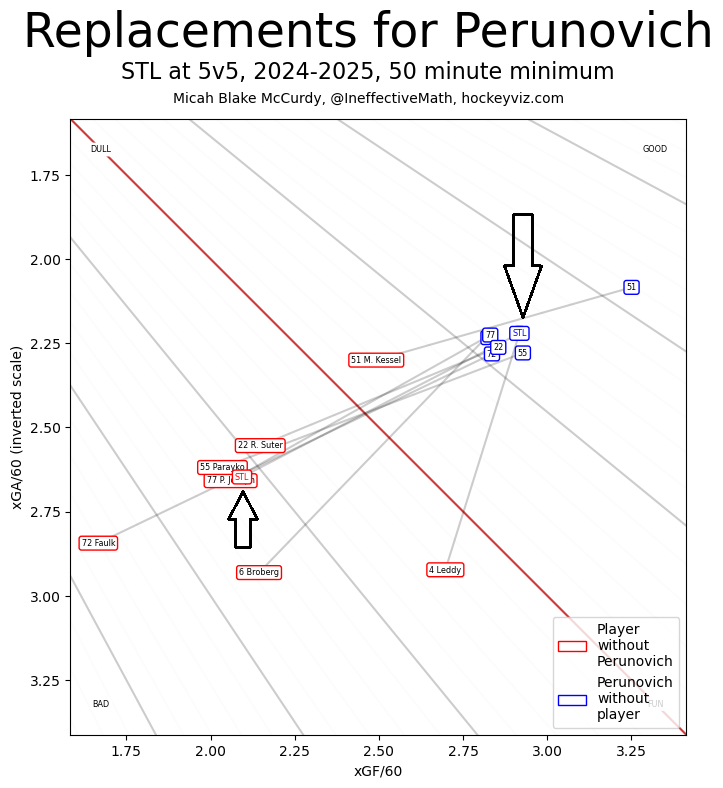
It has taken a long time, but after a good two-thirds of a season last year, and a good start this year, things are coming together for Perunovich.
2. Smooth Play
Staying in St. Louis, centre Robert Thomas was left off Team Canada’s Four Nations roster. That is despite the fact that over the last 2.5 seasons, his team-relative goal share at 5-on-5, and team-relative expected goal share, is among some of the top forwards in the league:
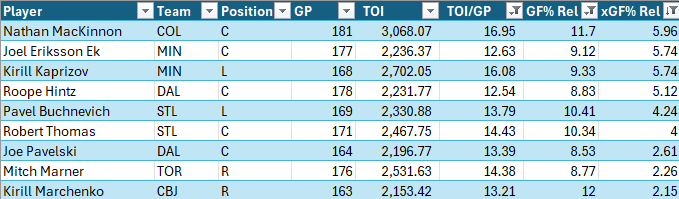
It is notable that Pavel Buchnevich, a frequent line mate, is there as well, and they are much better together than when apart. I do wonder if that doesn’t say more about the surrounding cast in St. Louis than Thomas himself. (And shout out Kirill Marchenko!)
3. Enter Sand(in)man
The NHL’s leader among defencemen by Evolving Hockey’s Goals Above Replacement measure – factoring in offensive/defensive contributions, penalties drawn/taken, special teams play, and so on – is not who we’d think it is:

We can’t get ahead of ourselves here for a 27-game sample after a rollercoaster career to this point, but Rasmus Sandin is driving good defensive results for all his defence partners, and has long had good tracking data. Maybe he’s starting to put it all together, which wouldn’t be unheard of for a 24-year-old.
4. The Engine
Miro Heiskanen (rightly) gets a lot of attention when it comes to Dallas’s blue line, but Thomas Harley is having another great season, driving all his partners to both better expected goals against and expected goals for rates. It continues an unbelievable start to his career as he is among the leaders by both goals above replacement/60, and expected goals above replacement/60, over the last 2.5 seasons:
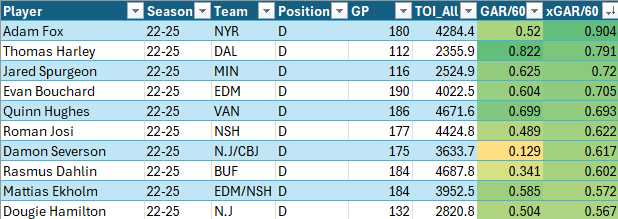
Harley was also left off USA’s Four Nations Cup roster, and it feels like that’s the last time that will happen.
5. Not Too Chabby
When looking up the stats for Harley, I noticed Thomas Chabot’s name near the top of the GAR/60 list (sixth overall) since the start of the 2022-23 season. Let’s go back even further.
Chabot’s rookie season was 2017-18. Since that season, there have been 146 defencemen to play at least 6000 minutes. Chabot ranks ninth among those defencemen by goals above replacement per 60 minutes, and ahead of names like Victor Hedman, Roman Josi, and Miro Heiskanen (and remember that Chabot led Ottawa’s defencemen by ice time per game for five straight years):
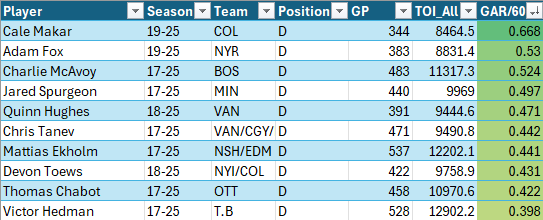
It is a wonder what his reputation would be if he were drafted to a team like Colorado, New Jersey, Florida, Carolina, Boston, or Dallas (all of whom passed on him in the first round of the 2015 Draft) instead of Ottawa.
6. Andrae The Giant
Emil Andrae’s first game of the season for Philadelphia came on October 27th, and since that point, he’s 87th percentile by goal share relative to his team at 5-on-5, and 97th percentile by expected goal share relative to his team at 5-on-5, among all regular defencemen. Not rookie defencemen; all defencemen.
When looking at his tracking data, one thing sticks out: he’s denying the blue line a lot. The league average for defencemen stopping zone entries at the blue line is 8.5%. The Flyers, as a team, are much better than that at 11.2%. Andrae? He is at 12.5%, and comparing well to a highly-touted young defenceman elsewhere:

He has to keep doing this for a lot more than 18 games, but it’s hard to have a better start to an NHL career, and being good defensively will keep him out of his coach’s doghouse.
7. Fant Praise
Things have not been rosy for Adam Fantilli this year. His goals/60 rate at 5-on-5 is down 34% from his rookie campaign, his shots/60 are down 29%, and his individual expected goals rate has nearly halved. The team just is not generating much when he’s on the ice, and certainly not much quality.
When looking into why this is, it seems as if Fantilli is not playing the same way the rest of the team is. The tracking data is limited so far, but Fantilli has created much more off the rush than most other Columbus forwards:
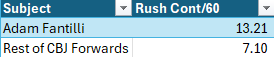
The only other player close to him is Kent Johnson, which might be why Johnson has spent over half his 5-on-5 minutes with Fantilli. Regardless, something needs to change one way or another because Fantilli needs to be on the same page as his teammates if he wants to succeed.
8. This Is Italian-American Discrimination
Pittsburgh’s Philip Tomasino missed Saturday’s game with an injury, but he was off to a great start with three goals, four points, and 16 shots in five games. It shouldn’t be much of a surprise given his first three seasons saw him lift Michael McCarron, his most common line mate, to much better 5-on-5 results than McCarron had elsewhere:

He also had very good results in a limited sample with Luke Evangelista over the last couple of years. This feels like Nashville giving up on a young player despite much better results than some guys who seem bullet-proof like Colton Sissons and Cole Smith. At least Nashville doesn’t have a very recent example of doing exactly this. Unrelatedly, Eeli Tolvanen’s 5-on-5 goal rate with Seattle since arriving is higher than every regular Nashville forward not named Filip Forsberg.
9. HELP!
Tracking data has 25 forwards with at least 100 tracked minutes while averaging at least 2.0 high-danger passes per 60 minutes at 5-on-5. There are two forwards among those 25 whose team is scoring under 2.0 goals per 60 minutes:

The other 23 forwards average around 3.0 goals-for per 60 minutes at 5-on-5.
Joel Farabee scored on Sunday, so we’ll see how things go from here. Connor Bedard is doing a lot of good things under the hood, but the roster is what it is, and pointing the finger at him in any way is greatly losing sight of the plot.
10. It’s Not All Bad
Conversely, it should be highlighted that not the entire Chicago roster is struggling. The fourth-line duo of Patrick Maroon and Lukas Reichel is not only scoring 2.8 goals per 60 minutes at 5-on-5 (the team average is 1.9), but they are actually above the league average by expected goals-for per 60 minutes at 5-on-5:
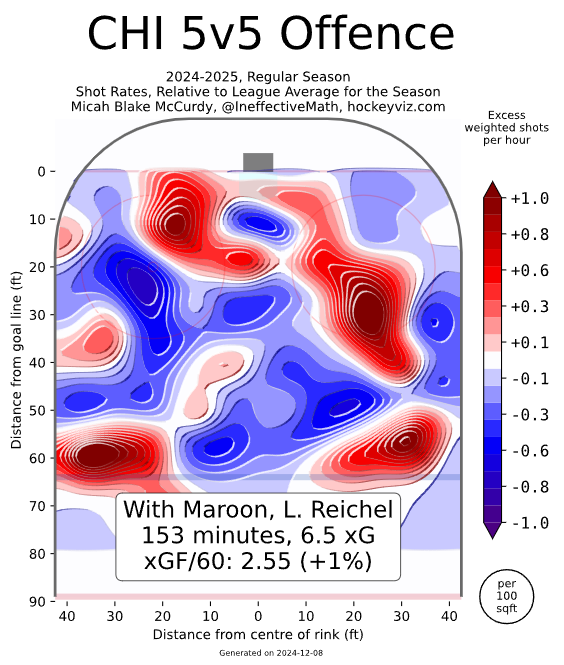
Maroon has legitimately great playmaking numbers, per the tracking data, while Reichel has been great on zone entries. It is much more important that Reichel’s development keeps progressing upward, but this is a good sign, and a small ray of light in an otherwise bleak Chicago season.
Until next week.