10 Interesting (To Me) Stats For This Week - February 25
Welcome back for another week of ’10 Interesting Stats’ and this time around we’re looking at the offence of a few key defencemen, the defensive responsibilities of some key centremen, a burgeoning young forward in Seattle, and more.
Unless otherwise noted, player data from Natural Stat Trick, player tracking from AllThreeZones, and viz from HockeyViz. All data as of the afternoon of Monday, February 24th.
1 – The Bowen Zone
Back in November, we talked about Buffalo defenceman Bowen Byram’s start of his season. He was getting a bit lucky, and there was some troubling puck-moving data under the hood. It is worth updating that now.
On the season, Byram has the second-lowest expected goals against rate at 5-on-5 among all regular Buffalo defencemen, and the second-lowest goals against rate. One improvement since earlier in the season, and over his seasons in Colorado, is his zone exit failure percentage, which is exactly what it sounds like. It was a problem with the Avalanche, but has been much better this season with the Sabres, and that’s while being responsible for more exits overall:
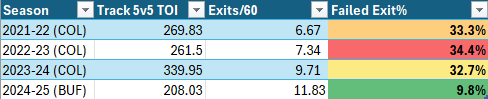
Byram’s numbers are much better when he has Rasmus Dahlin as a defence partner than when he doesn’t, and that matters. Overall, though, it has been a nice rebound for him with Buffalo.
2 – Pan’s Labyrinth
It has been a curious season from Artemi Panarin, who is carrying his lowest point-per-game rate since 2017-18 with Columbus. A big reason seems to be how Panarin is faring offensively without Adam Fox on the ice.
On the left is Panarin on the ice at 5-on-5 with the superstar defenceman on the blue line, on the right is Panarin on the ice without Fox:
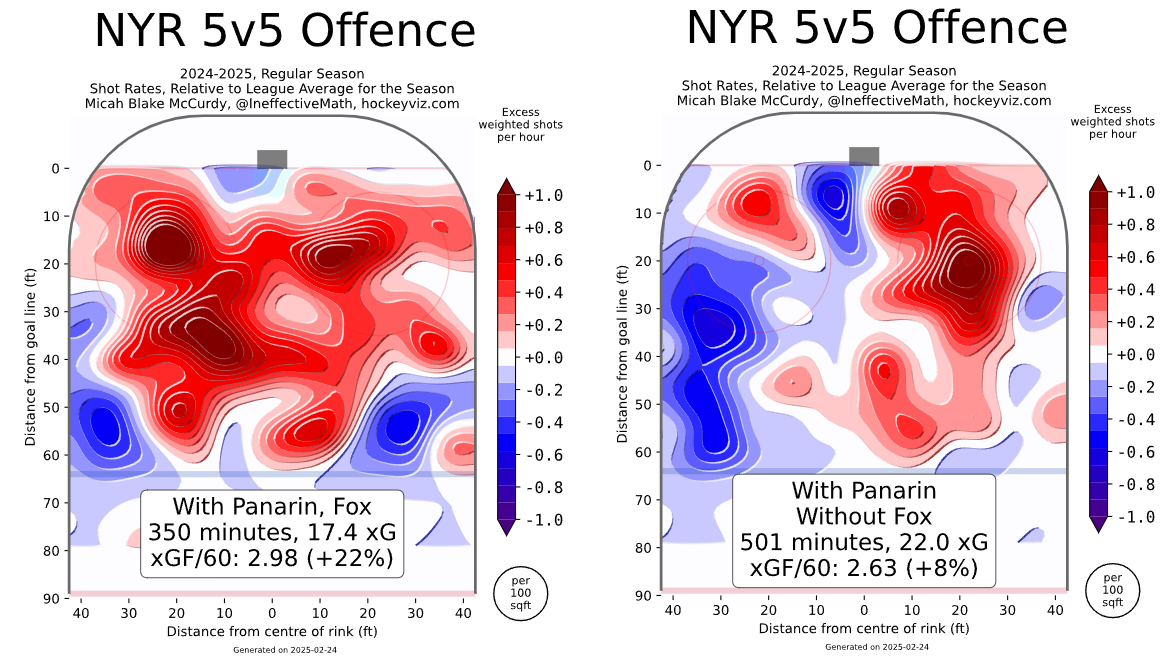
The Rangers are scoring 24% more at 5-on-5 when Panarin has Fox on the ice with him than without. There are other indicators of a decline from Panarin – namely some playmaking data – but New York is struggling to score unless Fox is on the ice, and it’s something that permeates their lineup, including their stars.
3 – His Last Name Means “The Comb”
One of the breakouts this season is Anaheim defenceman Jackson LaCombe, who sits with 1.37 points per 60 minutes at 5-on-5, tied for 13th among regular defencemen (minimum of 600 minutes). Oddly enough, he is tied with Vegas defenceman Shea Theodore. It is curious that Theodore is the player LaCombe is tied with because over the last two seasons LaCombe and Theodore match very well by rates of scoring chance assists (helpers on teammate chances, or SCA), scoring chance contributions (those assists plus individual scoring chances, or SCC), offence created off the rush, and offence created off the cycle:

We will see how the next eight weeks go, but LaCombe has been impressive for the Ducks and, outside of the goalies, is perhaps the biggest reason why they’re even in spitting distance of a playoff spot.
4 – No Doughty About It
For full transparency, Los Angeles defenceman Drew Doughty would not have been my injury replacement pick for Team Canada at the Four Nations Faceoff. He did play extremely well, though, posting three games between a 60-75% expected goal share (per MoneyPuck), with his fourth game at 49%. When playing against the best in the world, that’s pretty good.
After a rough first couple of games returning from injury, Doughty’s play in the NHL has also been very stellar. In his last five games with the Kings, he leads their blue line by expected goal share at 5-on-5 and has the second-best goal differential (per Evolving Hockey):
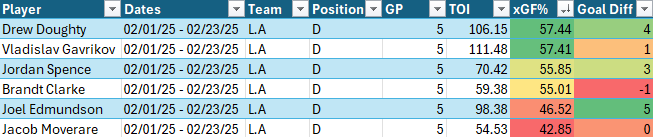
It is just five games, so it’s nothing to make any sweeping statements over, but added to his performance with Team Canada, and it’s been a very good month for the 35-year-old.
5 – Brady (no)Tka-luck
The website Evolving Hockey has 10 forwards with at least 500 minutes played at 5-on-5 this season who’ve also managed at least 1.1 individual expected goals per 60 minutes. Nine of those forwards have combined for 104 goals in 6318 minutes of 5-on-5 play. The 10th forward – Brady Tkachuk – has been considerably less efficient offensively:
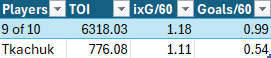
Tkachuk isn’t an efficient shooter, generally speaking, averaging 8.94% shooting at 5-on-5 across the prior three seasons and never exceeding 10%. But he also never finished below 8% in any of those three seasons and is currently at 4.46% in 2024-25. Ottawa has their issues scoring at 5-on-5 this year, and Tkachuk is part of that, but if that regresses positively over the next couple of months, it’ll go a long way to pushing the Senators into the playoffs.
6 – Ruff Plays Fetch
Not long ago, someone mentioned to me that they thought one reason why Dylan Cozens might be struggling defensively is that Buffalo coach Lindy Ruff makes his centres retrieve the puck in the defensive zone a lot. I thought I would look into that, and that is indeed the case, as the tracking data has Buffalo centres leading the league by defensive zone retrievals per 60 minutes at 5-on-5 while also having the highest rate of retrievals leading to exits:
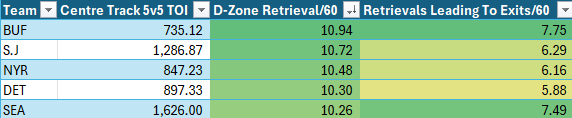
It isn’t affecting Cozens much, as his rate this season (10.9 retrievals/60 minutes) isn’t far off his average over the previous two seasons (10.7 retrievals/60). Tage Thompson, though, is retrieving the puck 33% more often at 5-on-5 than he normally does, which makes the fact that he leads the league by goals/60 minutes at 5-on-5 even more impressive.
7 – Bar-rier To Exit
Looking at that retrieval data made me wonder if anyone was going in the other direction. One player that stood out is New York Islanders forward Mathew Barzal. Starting with Game 1 of the 2022-23 season and going up until coach Patrick Roy was hired in January of 2024, and then Barzal under Roy, there has been a significant decline in Barzal’s defensive zone responsibilities i.e. retrievals:

The curious part here is that Barzal’s defensive zone retrieval rate has declined 18% under Patrick Roy, but his points per 60 minutes at 5-on-5 has declined along with it at nearly 22%. Maybe there is something to having your more talented forwards (Barzal or Thompson) be responsible for getting the puck moving up the ice out of the defensive zone rather than relying on less-gifted defencemen.
8 - Benny Pucks
One last note on retrievals here. When looking for some comparable forwards over the last three years, Seattle forward Matty Beniers stood out. He is heavily used in the defensive zone to retrieve pucks and when looking at that, how often those retrievals lead to exits by the team, and how often the players exit the zone themselves, one name stood out next to Beniers:

Aleksander Barkov has turned into one of the best two-way forwards in the league over the last half-decade (or more), but he struggled offensively early in his career despite strong defensive play (sound familiar?). By Barkov’s fourth season, he established himself as a burgeoning two-way star, and it’s a wonder of Beniers doesn’t take a similar step next year.
9 – The Other Robertson
Toronto forward Nicholas Robertson scored a pair of goals on Sunday night. Since the start of the 2023-24 campaign, he has 24 goals in 105 games, which isn’t great on the surface but he’s also done that averaging under 12 minutes a night. Robertson has the calling card of a goal scorer, and he does seem to be finding chemistry with Max Domi, who is usually a good playmaker. Their complementary play is obvious when looking at how often each makes a high-danger pass at 5-on-5 (across the slot or from behind the net) and how often each gets a shot from such a pass:

The tracking samples aren’t big yet, and will likely regress either way in both categories, but given that one is a shooter and one is a passer, their general directions make sense. Doing this in the playoffs is a lot different than doing it in the regular season, but it’s some nice scoring depth for the Leafs.
10 – Someone Nudge The Nuge
Edmonton forward Ryan Nugent-Hopkins is having a particularly miserable season. His points per 60 minutes at 5-on-5 (1.22) is the second-worst mark among regular Oilers forwards and a borderline fourth-line rate across the league. Everything from shots to shot attempts to individual expected goals is down from his three-year average, as is his expected goals impacts. When looking at the tracking data, all his declines make sense as we see drops in assists on teammate scoring chances and offence off the rush to go with an absolute crash in offence created off the cycle/forecheck:

Players have down seasons and rebound, but that Nugent-Hopkins has produced like a borderline fourth-line player while playing half his 5-on-5 minute with Connor McDavid is beyond concerning. He has two months to figure it out because they can’t afford to have him be a drag on this team as they try to push for a Stanley Cup.
Until next week.