10 Interesting (To Me) Stats For This Week - May 19, 2026
Welcome back to another week of ’10 Interesting (To Me) Stats’! This week, we’re poking around to see if we can find veteran forwards adding a playmaking dimension to their game. We only need to look at recent seasons for players like Nathan MacKinnon and David Pastrňák doing this exact thing.
To do this, we’re using tracking data from All Three Zones and comparing the 2025-26 season to the combined totals from the 2023-24 and 2024-25 campaigns. We concerned with three stats:
· Primary Shot Assists (PSA): a pass leading to a teammate’s shot
· Scoring Chance Assists (SCA): a pass leading to a teammate’s scoring chance
· High-Danger Pass (HDP): passes across the slot (seam passes) or passes from behind the net to the slot
We will focus more on PSA and SCA because the totals of HDP can be low and vary significantly from year to year.
We are limiting the sample to forwards with at least 200 tracked minutes in both 2023-24 and 2024-25, and 175 minutes in 2025-26, all at 5-on-5. It gives us 128 forwards.
The red and blue dotted lines in the graphs are the average change of the forwards in our sample.
1 – Ryan O’Reilly (Nashville Predators)
In a season where Ryan O’Reilly’s first assist rate at 5-on-5 increased by nearly 60% when compared to the prior two seasons, it isn’t much of a surprise that he posted a top-5 increase in all three playmaking stats, leading by improved scoring chance assist rate:
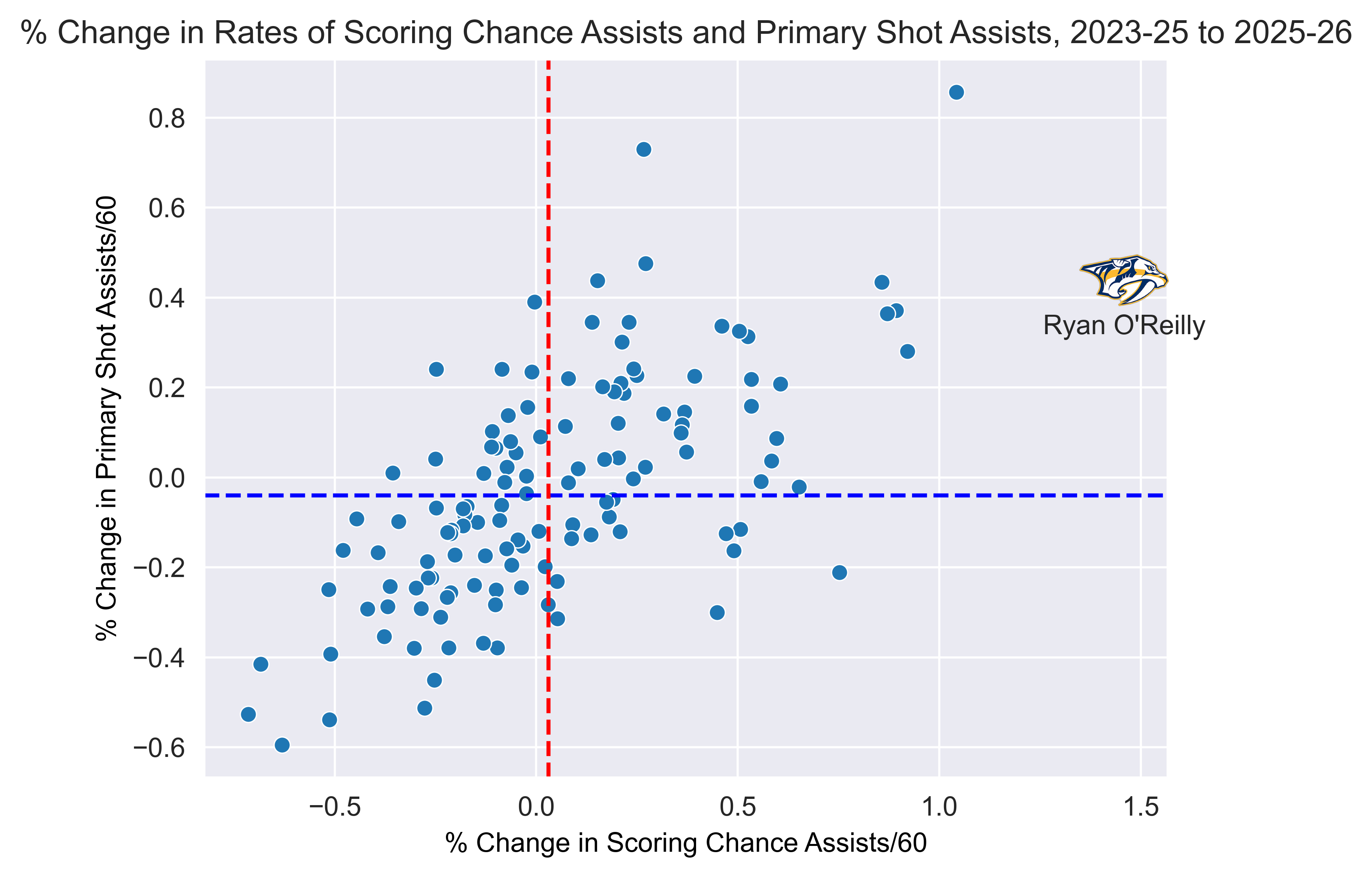
It is notable that frequent line mate Luke Evangelista also saw positive increases, and he’s been a good playmaker in his young career. Nevertheless, O’Reilly found the back of the net more often and found his teammates much more often for goals of their own. Maybe this is a one-off, but if not, this is something that can extend O’Reilly’s career and maintain offensive impact in future seasons.
2 – Andrew Copp (Detroit Red Wings)
Another veteran centre with top-5 across-the-board playmaking improvements was Copp. When we think of how good Detroit’s second line was this season, that he had these improvements make sense:
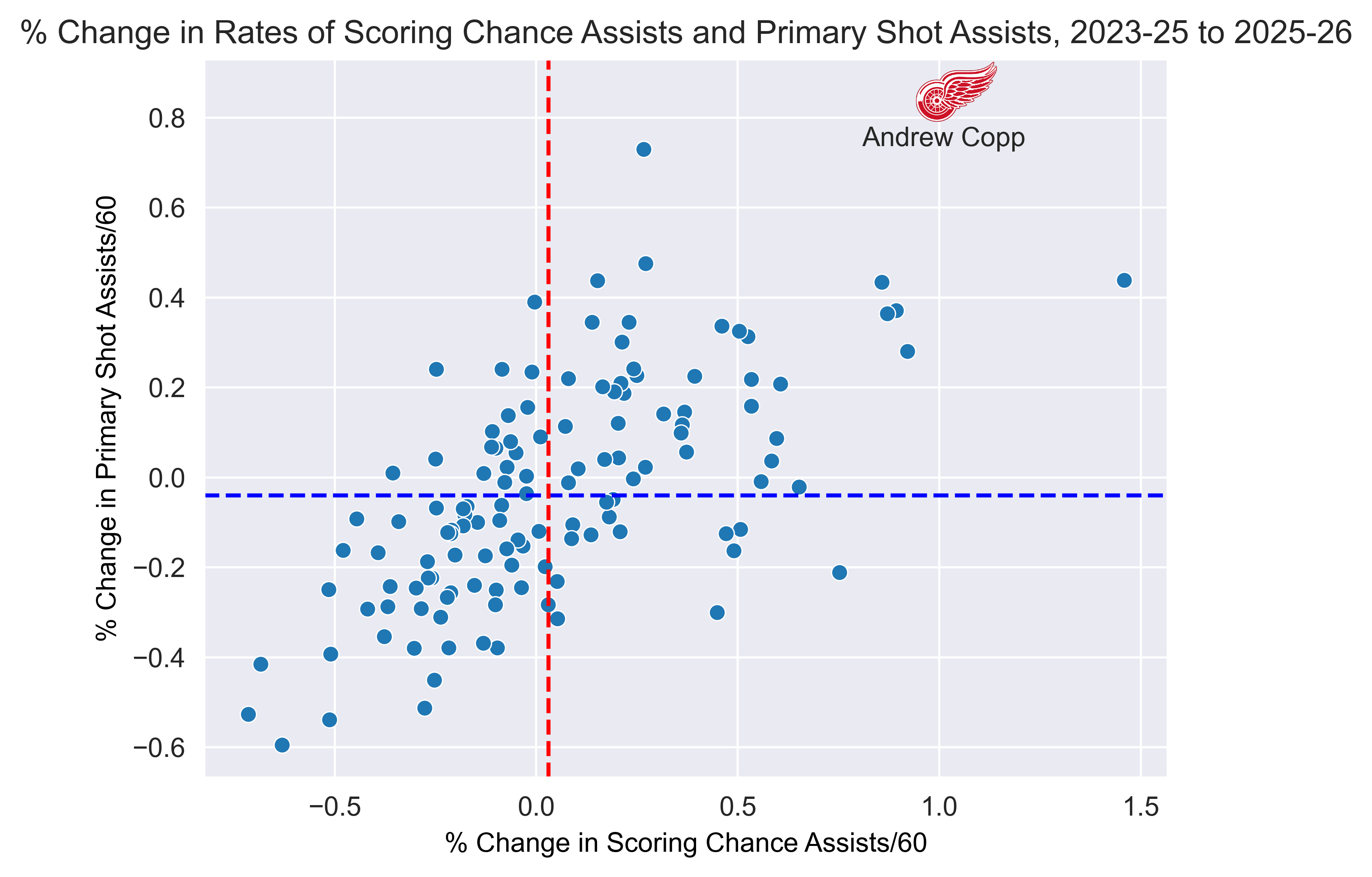
Unlike O’Reilly, Copp saw a decline in goal scoring at 5-on-5, but if he’s helping elevate the scoring of line mates like Alex DeBrincat, the Red Wings will probably take that trade-off. If he can maintain solid defensive play while elevating his wingers, then Copp helps plug the second-line centre hole that the Red Wings have had for much of the post-Zetterberg era.
3 – Anders Lee (New York Islanders)
One thing that stood out was several Islanders forwards saw big improvements in their SCA rates, and it’s a wonder how much a healthy Mathew Barzal and supernova Matthew Schaefer helped. Either way, we’ll highlight Lee’s playmaking rise:
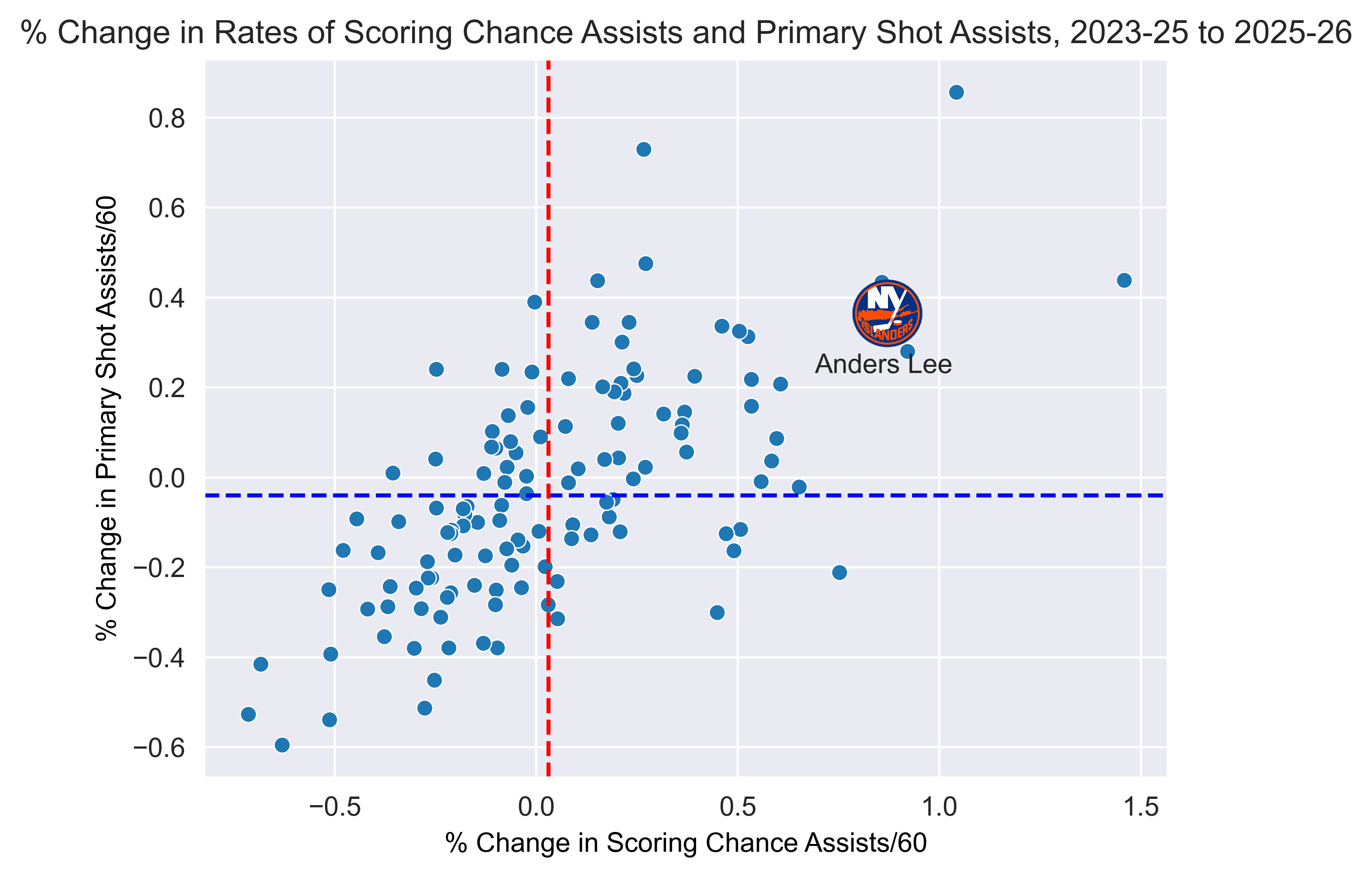
Lee managed 0.8 first assists/60 minutes at 5-on-5, the highest of his career and more than double his two-year rate. It came at the expense of a lot of goals, but he also saw a huge drop in shooting percentage. If that shooting percentage can rebound and he keeps up this level of playmaking, he becomes a different offensive player than he’s ever been.
4 – Timo Meier (New Jersey Devils)
Meier has never been known as a distributor – his first two full seasons in New Jersey saw him average 0.44 first assists per 60 minutes at 5-on-5, a bottom-25% rate among regular forwards. That increased slightly in 2025-26, and shows up when looking at his improvements in PSA and SCA measures:
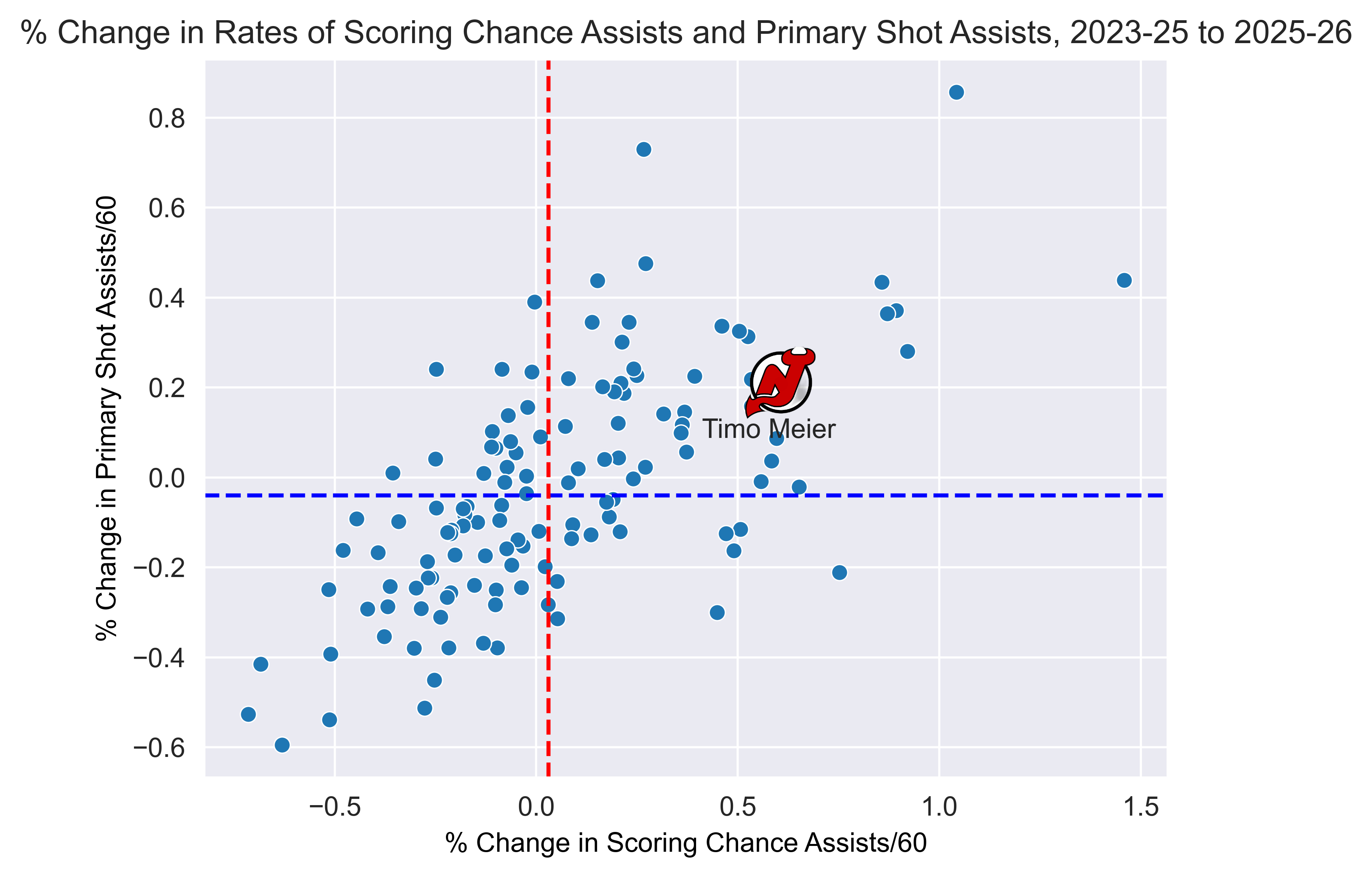
It was only a slight increase in his primary assist rate, but it’s impressive when we consider that New Jersey had a 20% decline in 5-on-5 scoring with Meier on the ice. It wasn’t just him – the Devils saw a 19% decline in 5-on-5 scoring compared the prior two seasons. That team decline makes Meier’s small improvement impressive, and would make him a more dangerous offensive weapon next season, presuming a rebound from the team around him.
5 – Nazem Kadri (Calgary Flames/Colorado Avalanche)
The interesting part here is that the vast majority of Kadri’s tracked sample came from Calgary because he wasn’t traded until the Trade Deadline in March. That is why Kadri improving his SCA rate by over 50% and his PSA rate by over 25% is meaningful:
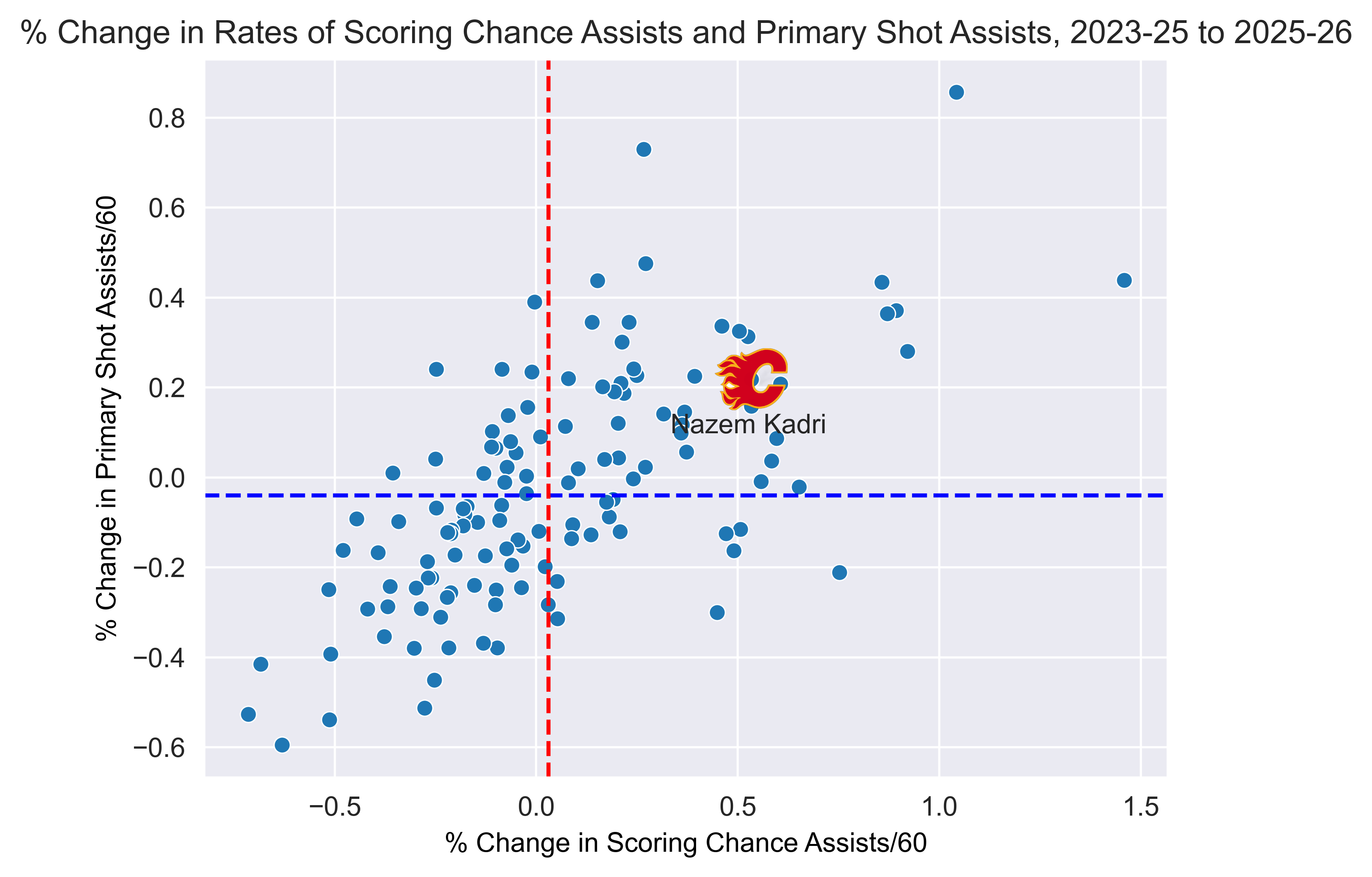
Kadri’s shot attempt rate declined by 14%, but it seems as if he was trading shots to improve the scoring of his line mates. His overall assist rate did decline slightly anyway, but it’s hard to blame him too much when skating for a Flames team that was one of the worst offensive rosters in the league. It will be interesting to see if he can repeat this in Colorado, because he could help boost the scoring of depth forwards like Ross Colton and Logan O’Connor.
6 – Charlie Coyle (Columbus Blue Jackets)
Behind Copp, Coyle had the second-largest improvement in his PSA rate, but also saw a sizeable jump in his SCA rate:
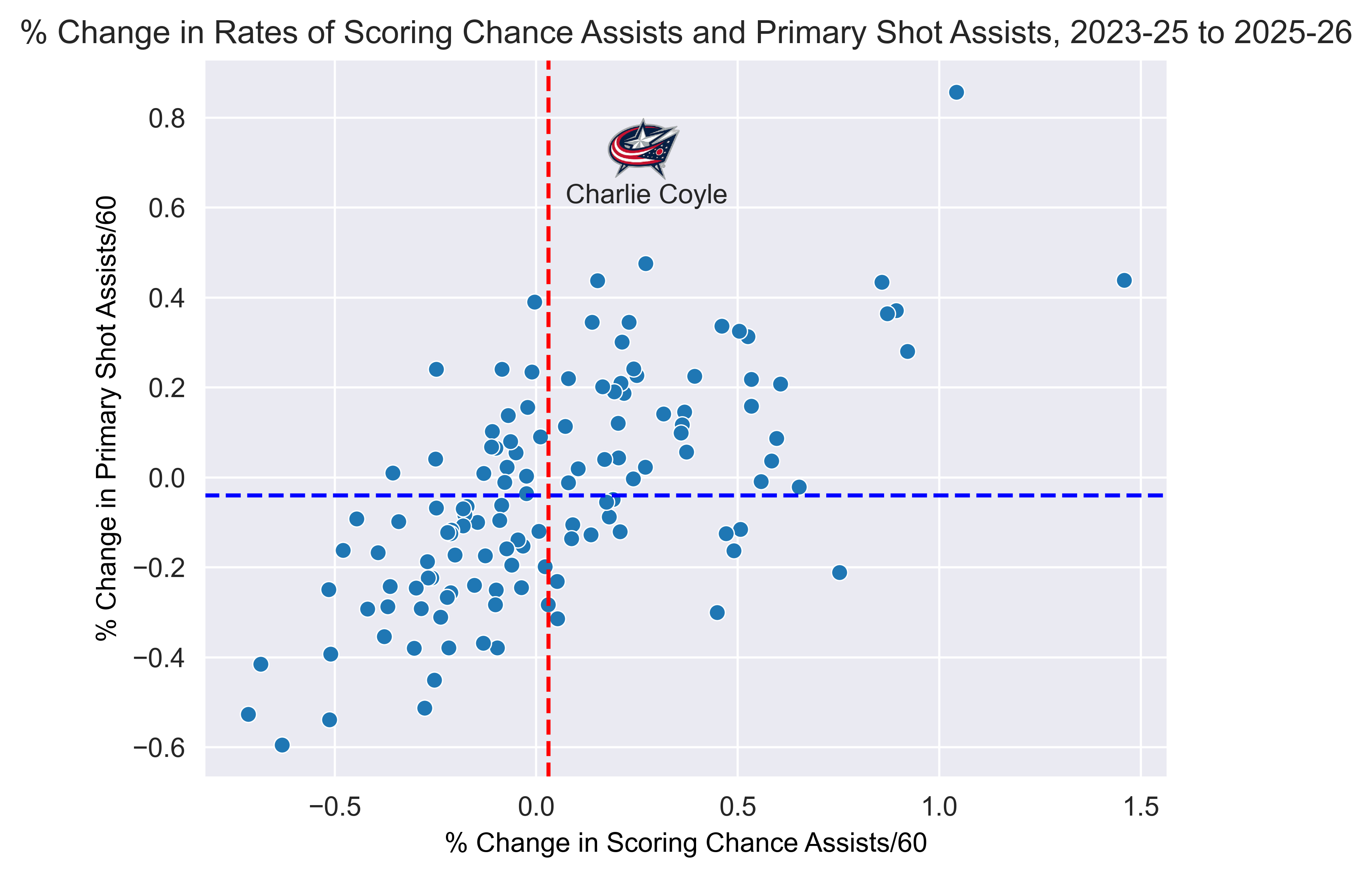
There is a good reason why Coyle’s rate of first assists (1.09) more than doubled when compared to the prior two seasons (0.49). Overall, it led to a 5-on-5 assist rate that jumped by 75% as he turned into a great depth offensive asset for the Blue Jackets, which is probably why he eventually earned a top PP role, too. Maybe he doesn’t stay quite at this level, but anything close to this improvement makes Coyle a genuinely threatening playmaker for Columbus.
7 – Mason McTavish (Anaheim Ducks)
McTavish is on the younger side from others on this list, but heading into 2025-26, he had 229 regular season games to his name. He saw a drop in goal scoring this season, but it may have been because he was looking for his teammates more often than usual:
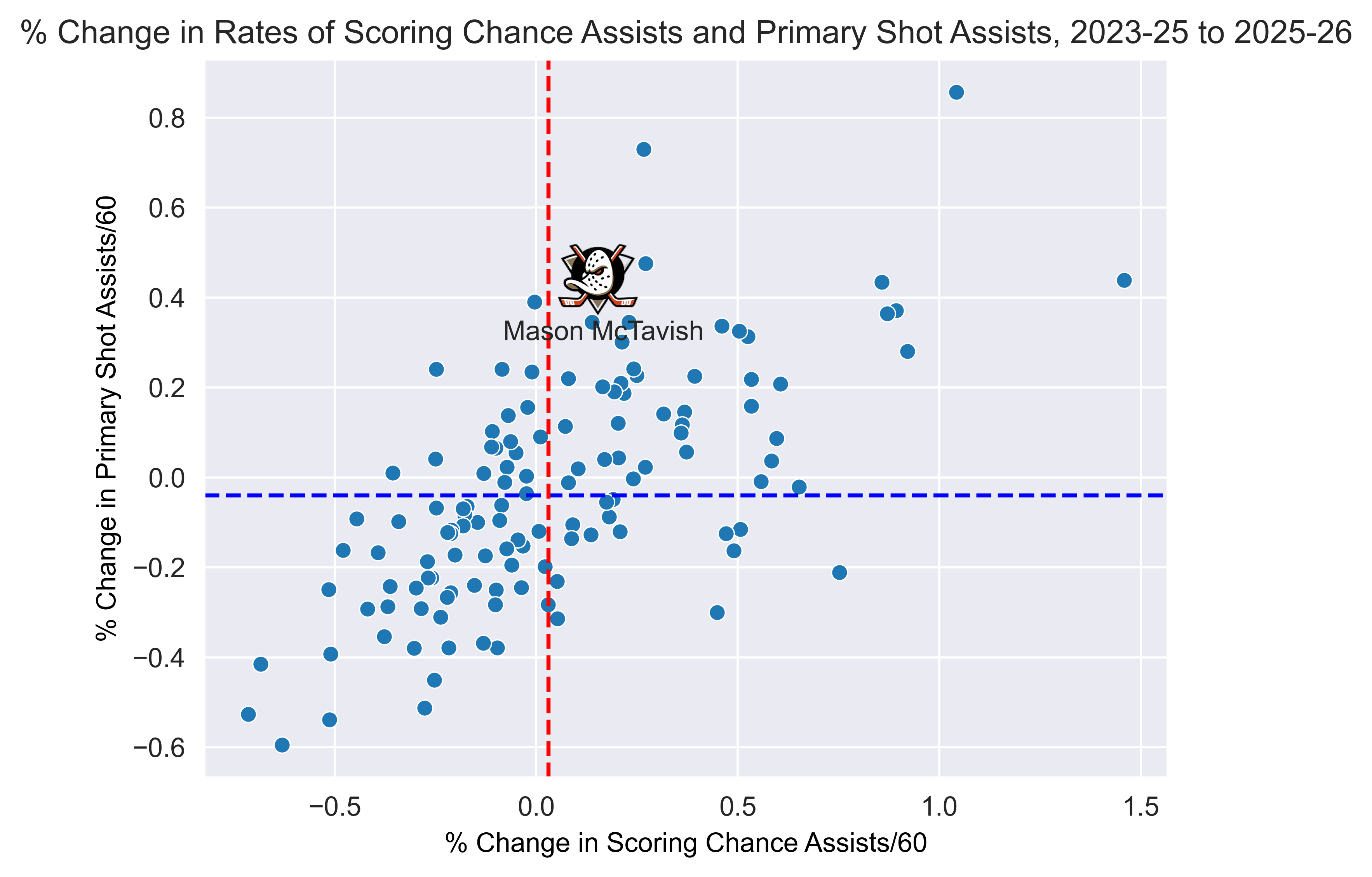
It is notable that his increase in PSA (+44%) was considerably larger than his increase in SCA (+15%). He did slightly improve his first assist rate, and if he is trying to add more passing to his profile, there is hopefully another jump in his assists on scoring chances next season. He would then become much more than just a pure shooter, and that’s something that can thrive in a secondary role behind Anaheim’s top stars.
8 – Kyle Connor (Winnipeg Jets)
Connor was another forward who saw a massive jump in his first assist rate at 5-on-5 when compared to the prior two seasons (+85%). When we see how much Mark Scheifele’s 5-on-5 goal scoring rate increased (+45%), Connor’s playmaking improvements make sense:
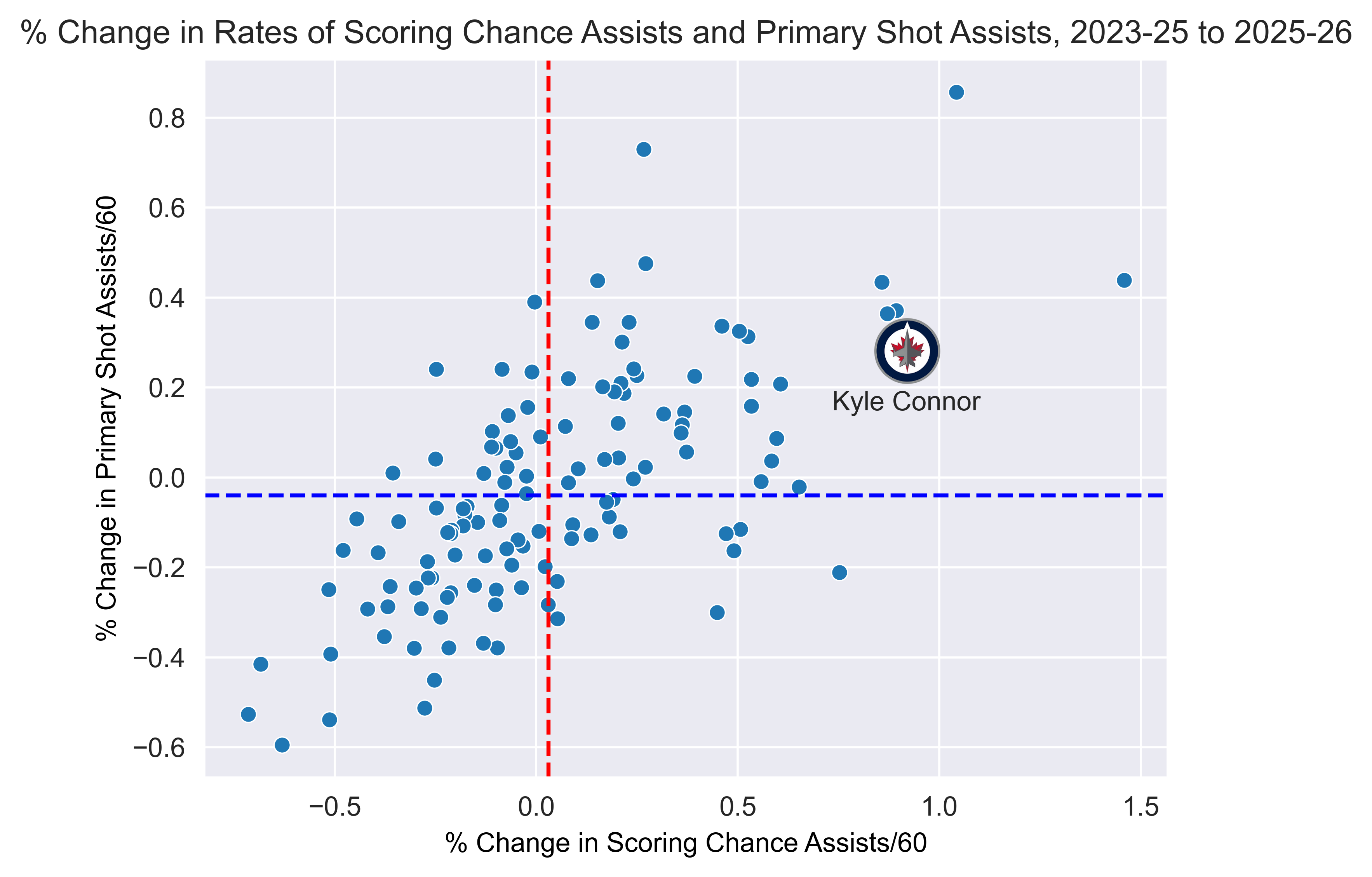
This is an interesting wrinkle for the Winnipeg top line. It has typically been Scheifele feeding pucks to Connor, but this turned into a two-way street in 2025-26, which should make them harder to defend. That Connor did this without sacrificing much goal scoring (only two fewer goals at 5-on-5) makes that top duo much more dangerous every time they step on the ice.
9 – Adrian Kempe (Los Angeles Kings)
We haven’t mentioned high-danger passes because of the small samples, but what Kempe did this season stands out. He saw a sizeable increase in his rate of scoring chance assists, but his high-danger pass rate absolutely plummeted because he didn’t have a single tracked high-danger pass. No, really:
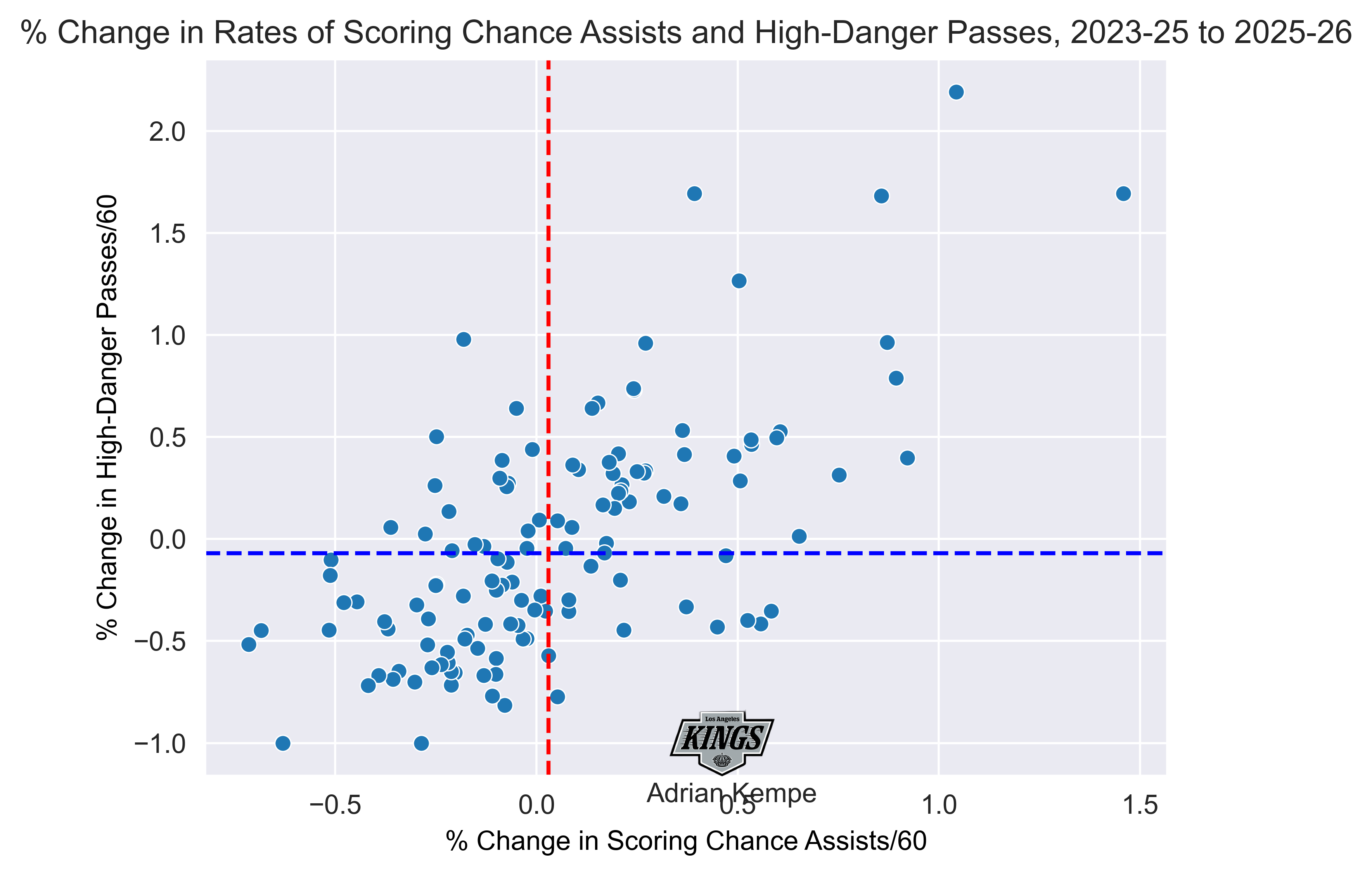
In 231 tracked minutes, Kempe didn’t have one completed seam or behind-the-net pass. The average in our sample of forwards was about 1.1 every 60 minutes. The only other forwards in the sample without an HDP were Lars Eller and Ondrej Palat. Alrighty, then.
10 – Drake Batherson (Ottawa Senators)
We will mention one player’s improvement in high-danger pass, and it’s Batherson because from 2023-25, Ottawa was tied for the sixth-worst goal scoring rate at 5-on-5. A lot of that was because of a lack of creativity in the offensive zone – Ottawa forwards had the third-worst rate of high-danger passes across the prior two seasons. So, the fact that Batherson had big leaps in his rates of SCA and HDP is notable:
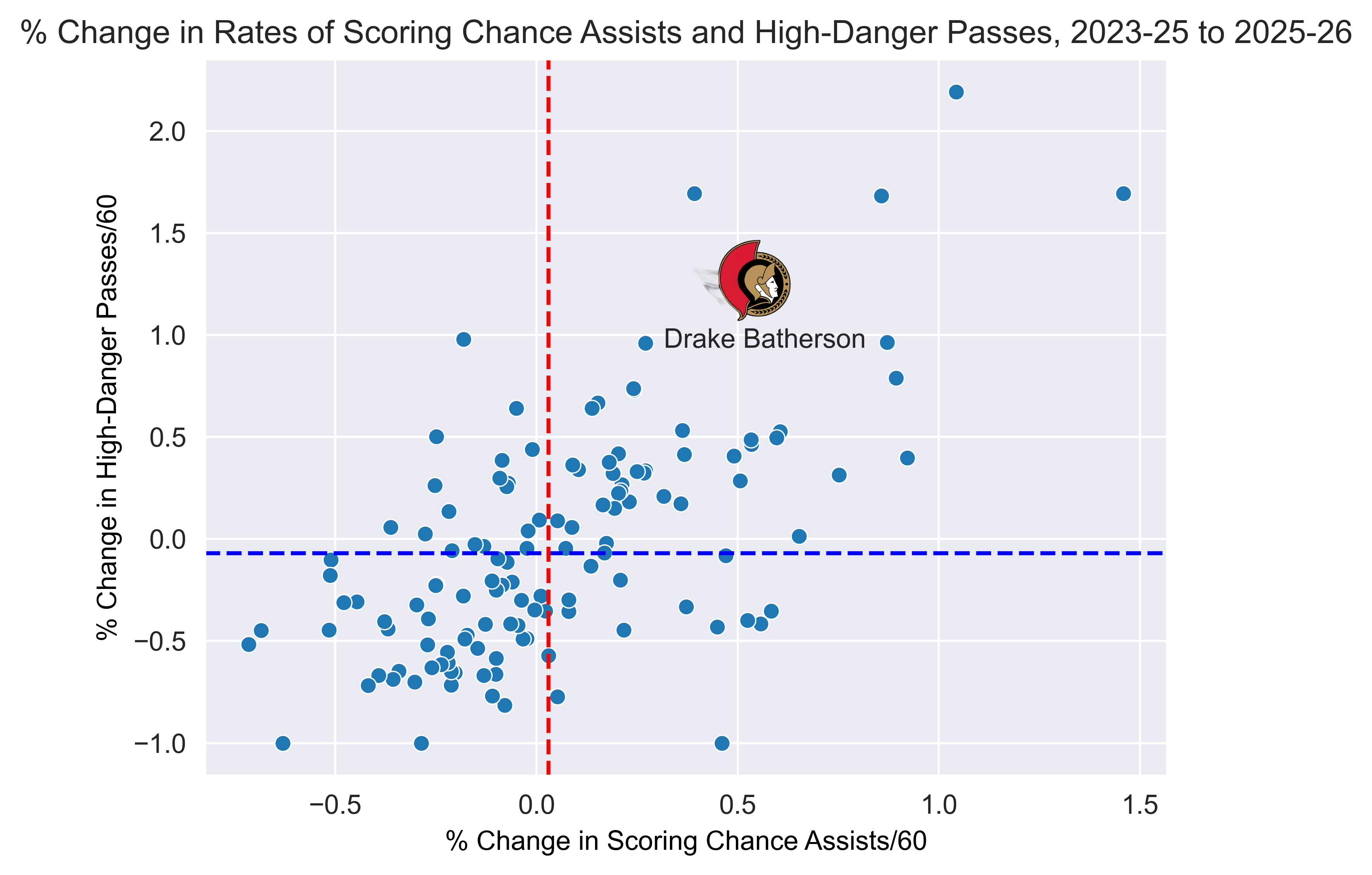
Ottawa’s rate of high-danger passes didn’t improve a lot (28th in the league, up from 30th), but a number of their top forwards – Batherson, Dylan Cozens, Tim Stützle – all had above-average-to-great leaps in HDP rates. Ottawa was a top-10 team by 5-on-5 goal scoring, and it seems a big reason is a few of their key forwards were looking for their teammates in more dangerous shooting positions. It gives this team a whole other offensive dimension.
Until next week.