10 Interesting (To Me) Stats For This Week - October 28
Today brings us three weeks into the NHL season, so we are over 10% of the way through. While the data is not fully settled yet – that will take another month or so – we can highlight some individual and league-wide trends to keep an eye on. Let’s look at that using data from Evolving Hockey. All data is current as of the morning of October 27th, 2025.
1 – Just Call Him ‘Tage’
Through his first nine games, Buffalo Sabres forward Tage Thompson has put up a whopping 30.8 shot attempts per 60 minutes. While he is generally a heavy volume shooter anyway, it’s worth pointing out that at this point of the season last year, that rate was under 25 attempts per 60 minutes at 5-on-5. It was one of the higher rates in the league, but this year he really is in a tier of his own:
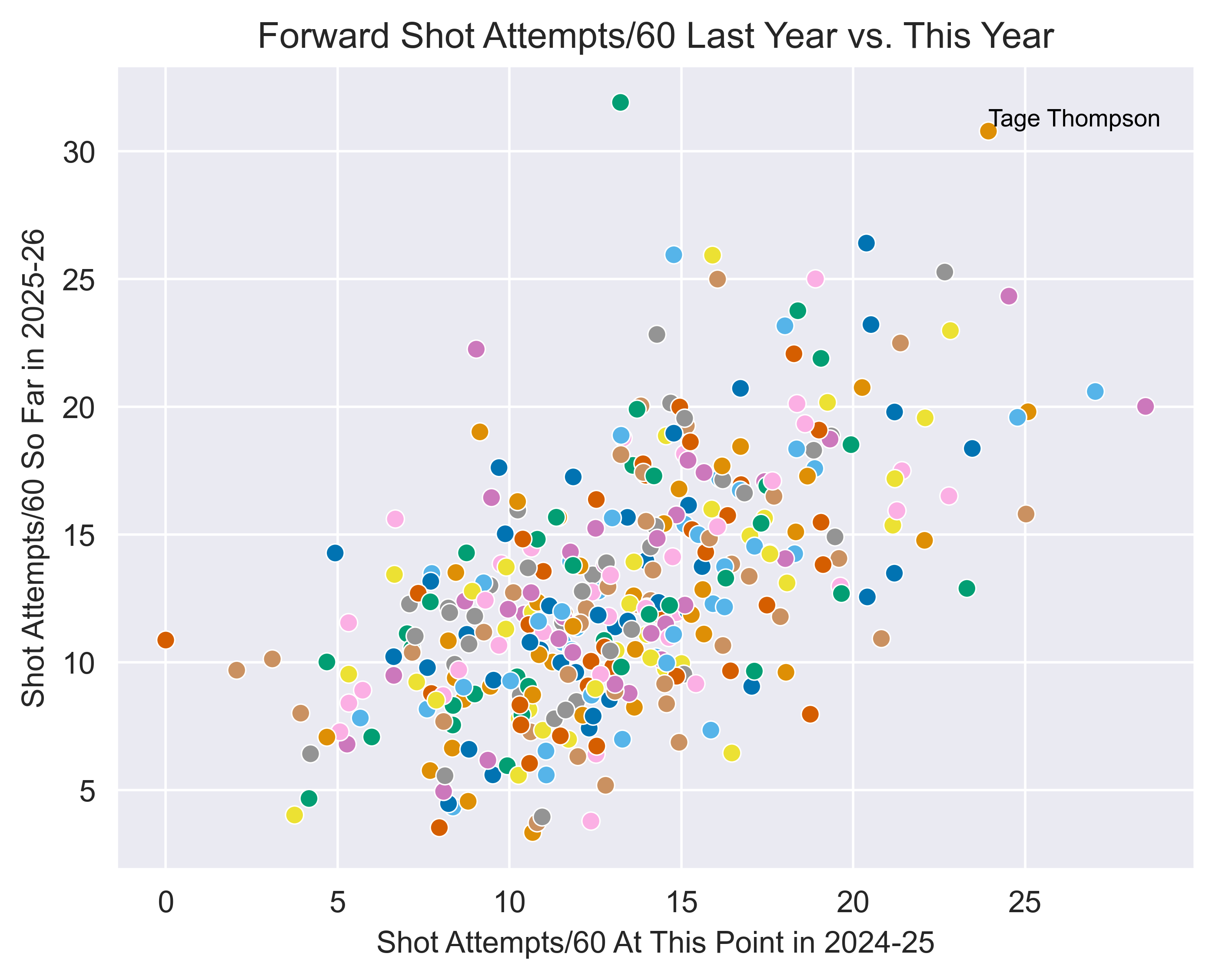
The only player with a higher shot rate is Cole Schwindt, and he’s been excluded because he’s only played one game. Tage got off to a slow start, being held pointless in his first two games, but now has four goals and eight points in his last seven games. Zach Benson being healthy has been a boost to that top line, and if Tage can keep shooting the puck anywhere near as much as he has already, he is a good bet to crack the 40-goal plateau for the third time in four seasons.
2 – The Real Deal?
A couple of weeks ago, this column looked at Shane Pinto’s hot start for the Ottawa Senators. Now, he is up to a preposterous eight goals in nine games, though the caveat here is he’s shooting 26.7% (his prior three-year average was 12.6%). Despite the elevated shot percentage, he is shooting a lot more than he was at this point in time last year, going from under 10 attempts per 60 minutes to nearly 20 attempts per 60 minutes:
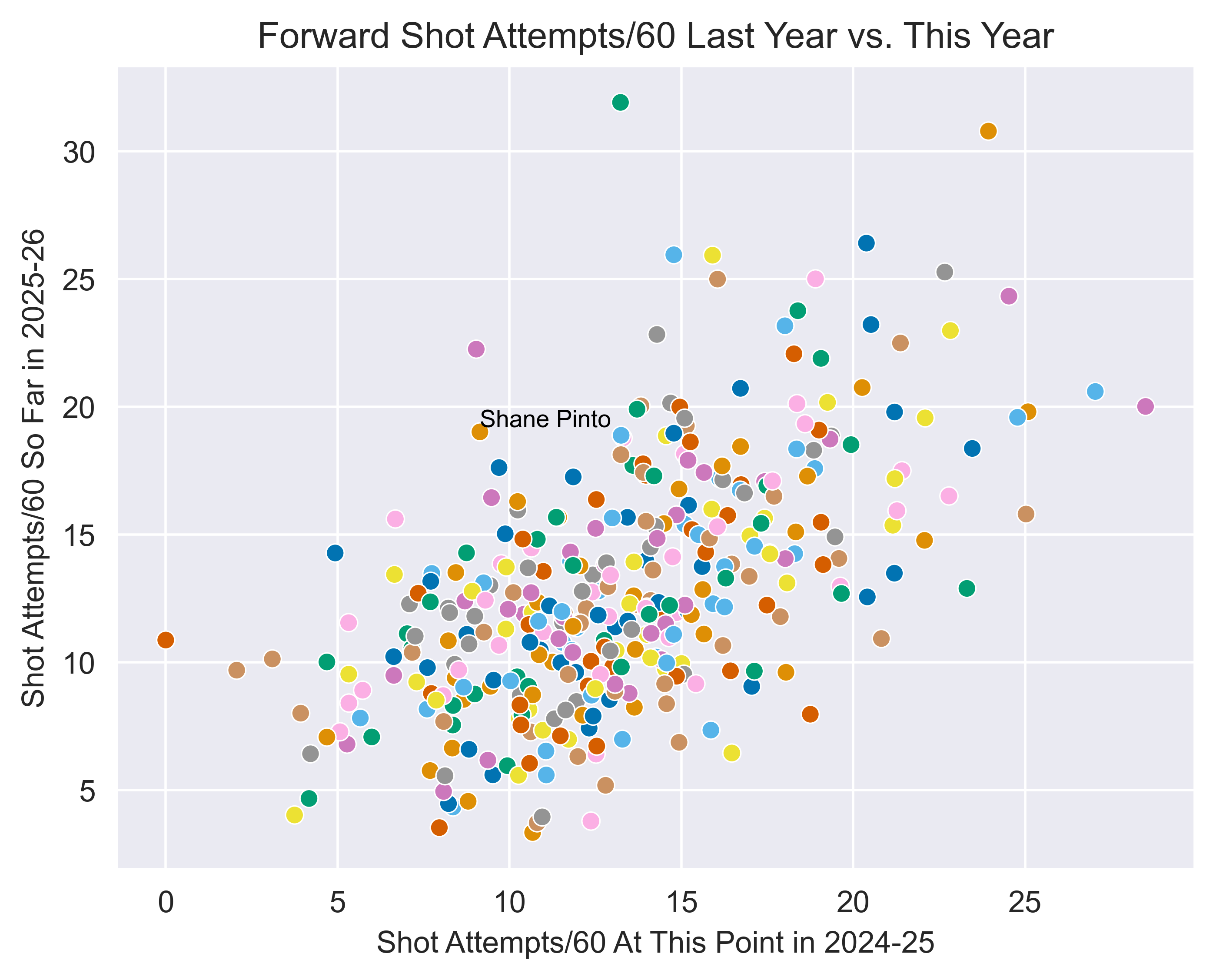
The key here is that with this shot volume, it’ll soften the landing of his shooting percentage regression; at this rate, even if he shoots 12% the rest of the way, he would still score upwards of 30 goals over the balance of the season. We have to see how the next month goes, but Pinto is now past the 200-game plateau for his career, turns 25 years old in November, and scored at a second-line rate from 2022-2025. Now that he’s in his prime, he may just be reaching his potential, and that is a huge deal for the Sens.
3 – Nothing Gold Can Stay
The Vegas Golden Knights are off to a very good 5-1-3 start and their top-6 forward group looks as elite as any (provided they’re all healthy). It isn’t all roses, though, as William Karlsson has seen a sizeable decline in shot rate going from over 22.5 per 60 minutes at this point last year to under 13.0 per 60 minutes so far this year:
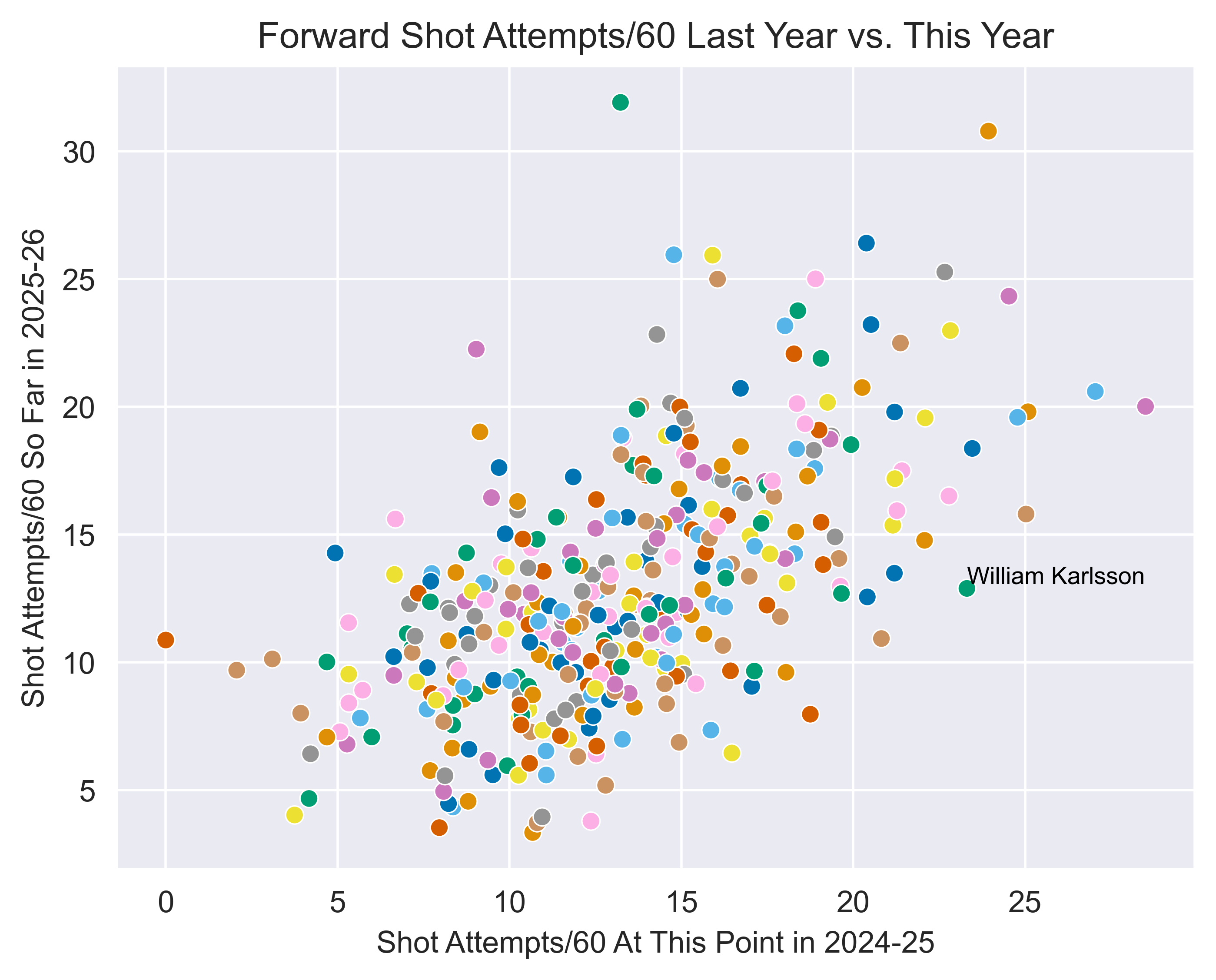
It is worth noting that when his shot volume was this low back in 2022-23, he scored just 14 goals in 82 games. Karlsson is very good defensively so he brings other valuable skills besides just putting the puck in the net, but this is a worrying start because he likely won’t keep shooting 20% and when that regresses his goal rate will plummet.
4 – Prince Albert
The Detroit Red Wings’ third defence pair of Albert Johansson and Jacob Bernard-Docker has been stellar to start with a shot-attempt share over 58% and expected goal share over 65%. Despite less ice time, Johansson’s rate of shots per game sits at 1.11, up from 0.79 from his entire 2024-25 season. When looking at this point of the 2024-25 campaign, Johansson has gone from under 5.0 shot attempts/60 to nearly 12.5:
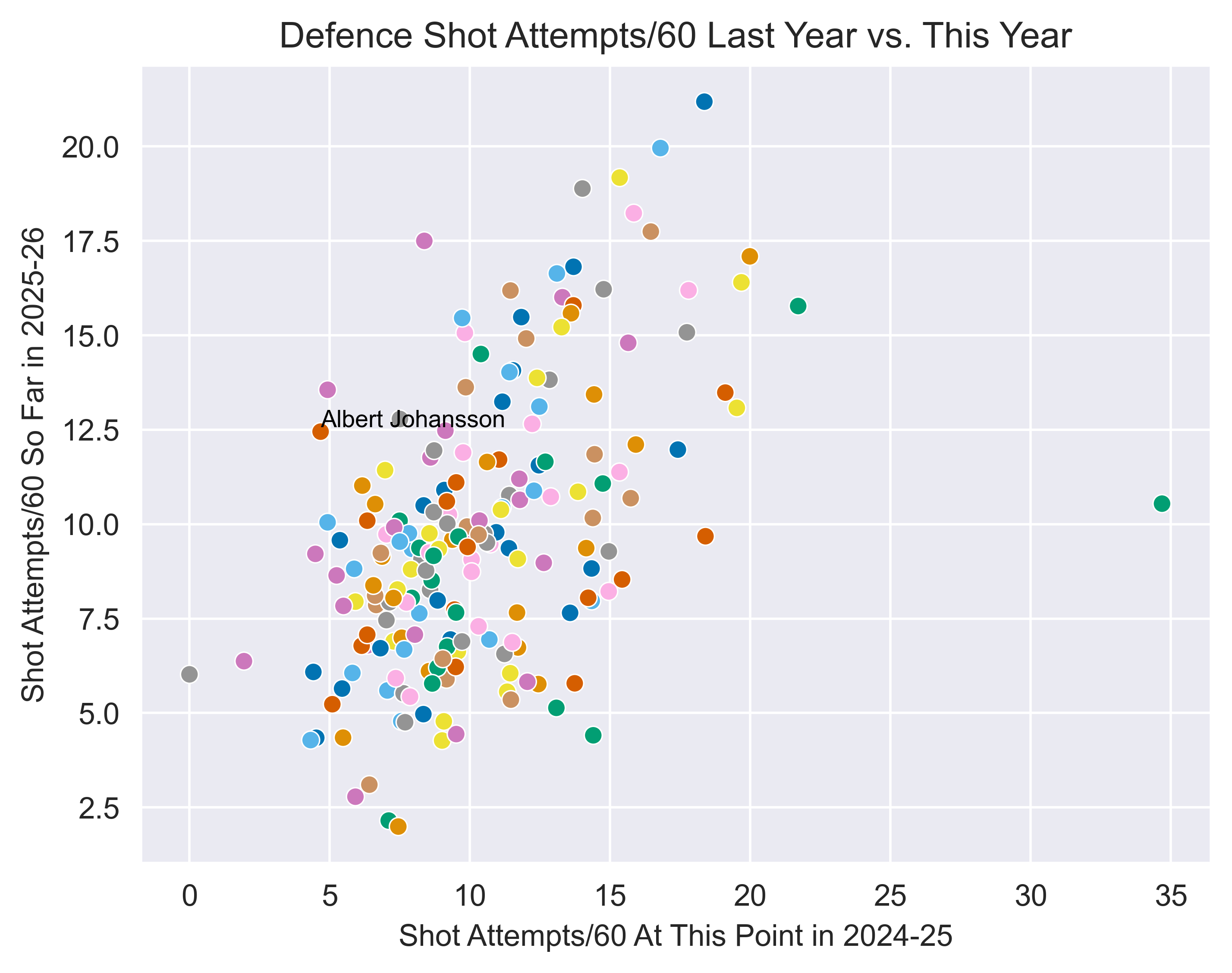
Skating 15 minutes a game means his raw shot and point totals won’t look very good but not only are he and JBD giving the Wings good on-ice results, it is helping Johansson be productive offensively. More of this from him gives Detroit a reliable third pair that they haven’t had in… many years.
5 – Quinn Jet Grounded?
Vancouver Canucks defenceman Quinn Hughes had shown elevated shot volume his previous couple of seasons, making him a true dual threat defenceman. That volume has taken a hit to start this season as he sits with 15.8 attempts per 60 minutes at all strengths, down from roughly 22.5 attempts per 60 minutes at the same point in time in October of 2024:
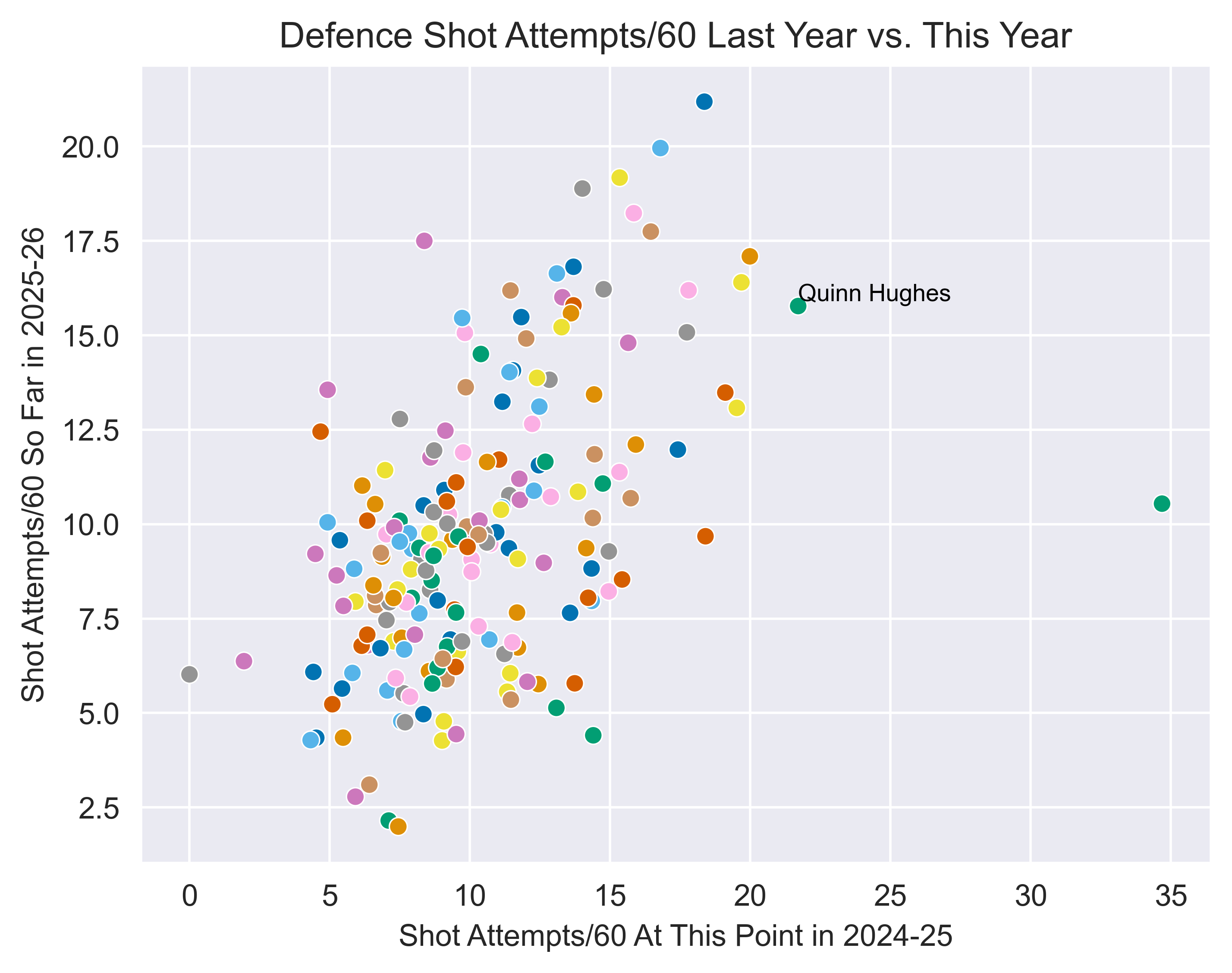
The concern here is that the team is taking fewer shot attempts with him on the ice and he’s taking a lower share of the shots (over 28% last year and under 22% this year). They might want him taking fewer shots and looking for forwards instead, or maybe this is just some noise in a three-week sample and he’ll take off in the next month or so. Either way, this is something to keep an eye on over the coming weeks.
6 – Defensive Changes
My intuition was that defencemen are less involved in some key fantasy hockey stats than at this point last year. The reality is that is both true and false. Below is a histogram that shows combined shots, points, and blocks per 60 minutes at all strengths at this point in each of the last two seasons. The orange/brown bars are this year, and the blue bars are last year:
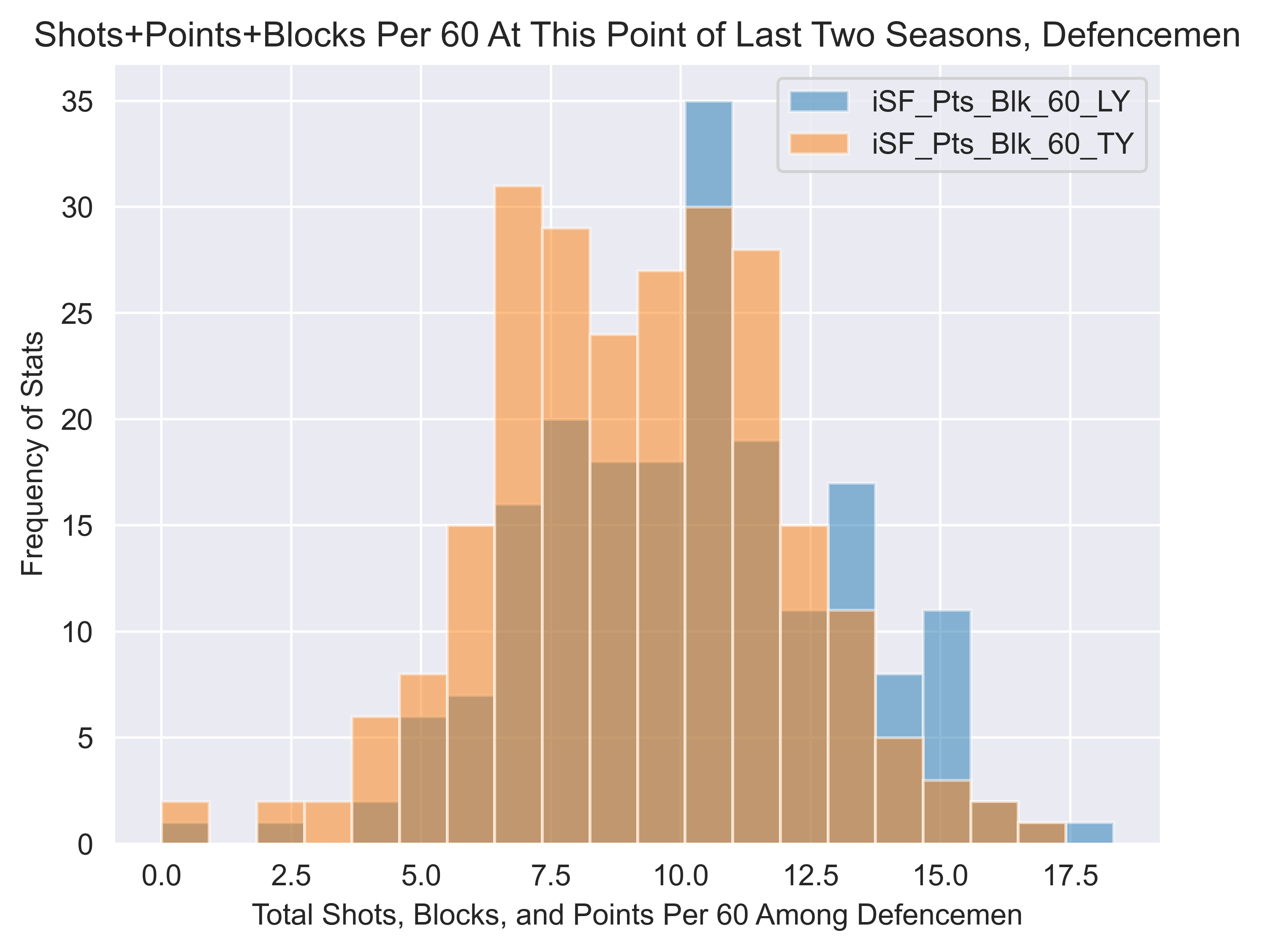
Notice how in the middle part, it’s mostly the brown/orange bars far ahead of the blue ones, but to the right the blue bars often exceed the brown/orange ones. That means the middle-class of defencemen are putting up more relevant fantasy stats but the high-end defencemen are often falling short of what they did last year. Good news for the middle-of-the-road guys, and not-so-good news for the upper-class options.
7 – That’s Rad
Tampa Bay has been getting good production from its blue line and while Victor Hedman is a big part of that, so is Darren Raddysh. When looking at his improvement in shots+points+blocks per 60 minutes compared to this point last season, he has gone from just over 5.0 in 2024-25 to nearly 12.5 in 2025-26:
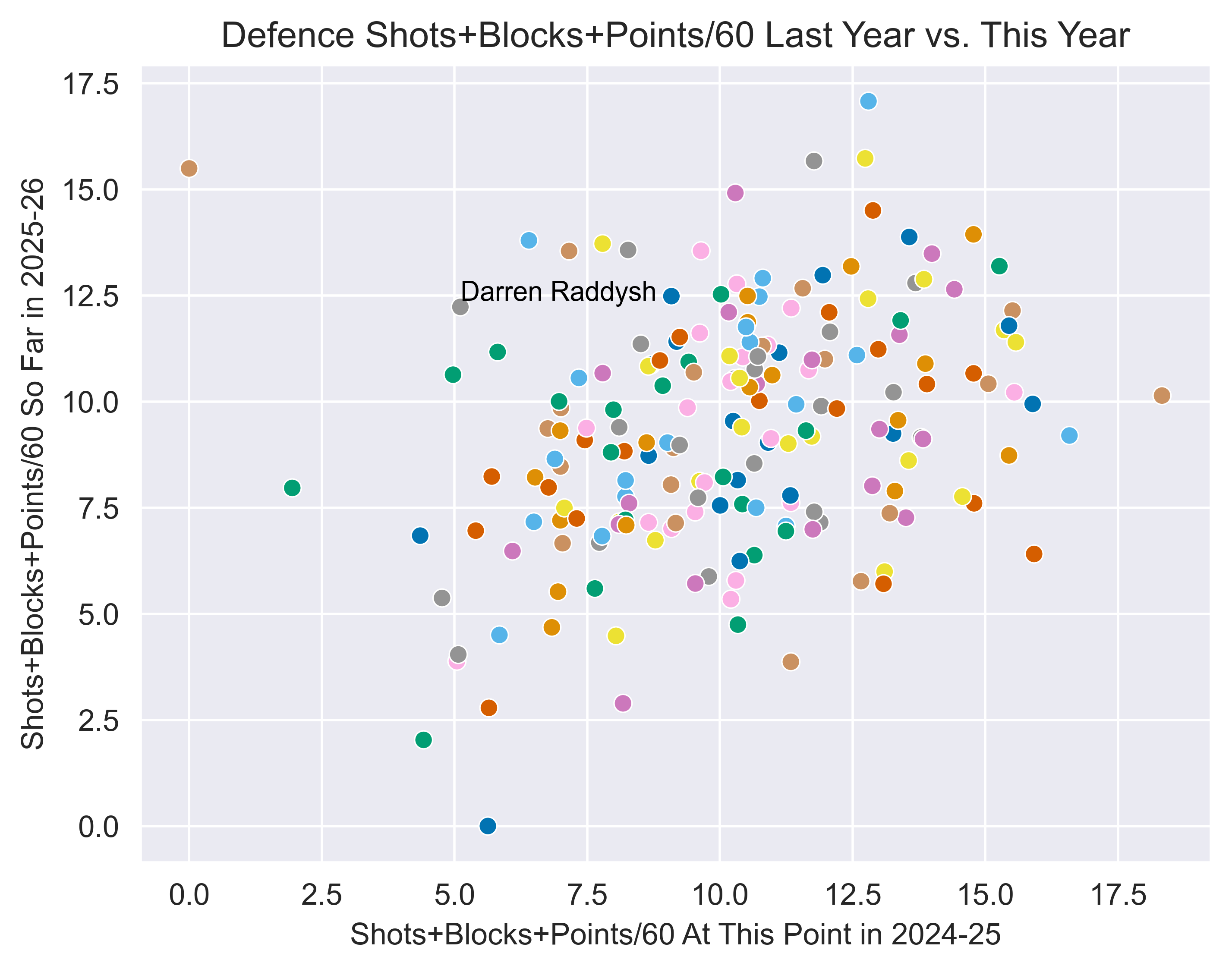
A huge part of this is a massive increase in shot volume as Raddysh is managing more shots per 60 minutes of any defenceman in the league not named Zach Werenski. He has played just six games, so let’s see where he stands after 16 games, but posting two shots per game while averaging just 15:32 of ice time per appearance is a good start.
8 – Thriving Middle Class
Like the defencemen we saw earlier, the middle class of forwards is thriving in their fantasy-relevant stats. Looking at the similar point of the 2024-25 season, more forwards in the middle of the league are seeing relevant levels of shots+points+blocks per 60 minutes (orange/brown bars) compared to last year:
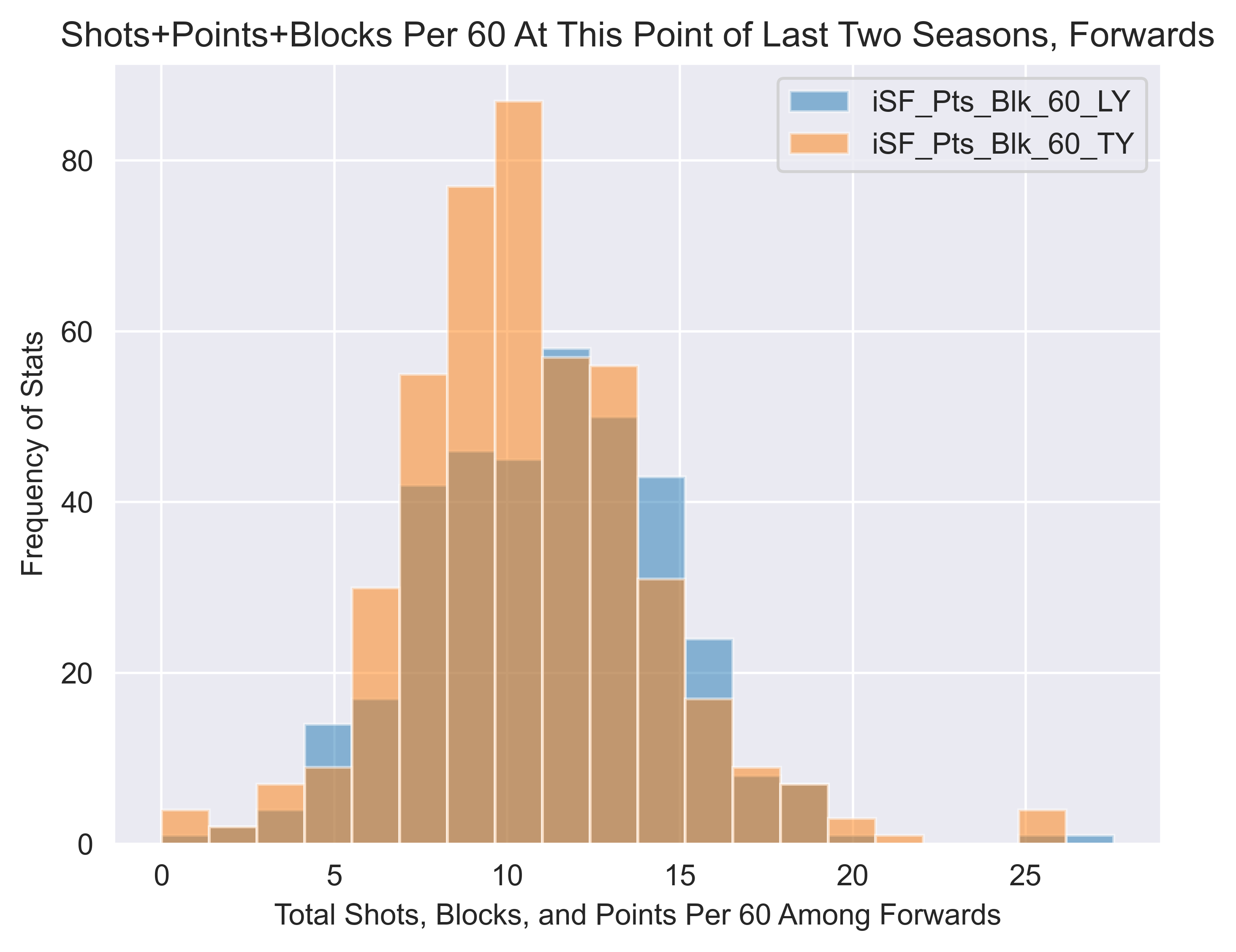
There are some levels where forwards this year are worse off, but there are still a lot of high-end forwards that have seen improvements this year compared to last year (most of the bars between 15-25 on the x-axis).
9 – Cut Man
One of the forwards who has seen a huge jump in his shot+point+block rates compared to last year is Anaheim’s Cutter Gauthier. At this point last season, he was under 12.5 per 60 minutes in those combined stats, a number that has jumped over 20 per 60 minutes so far this year:
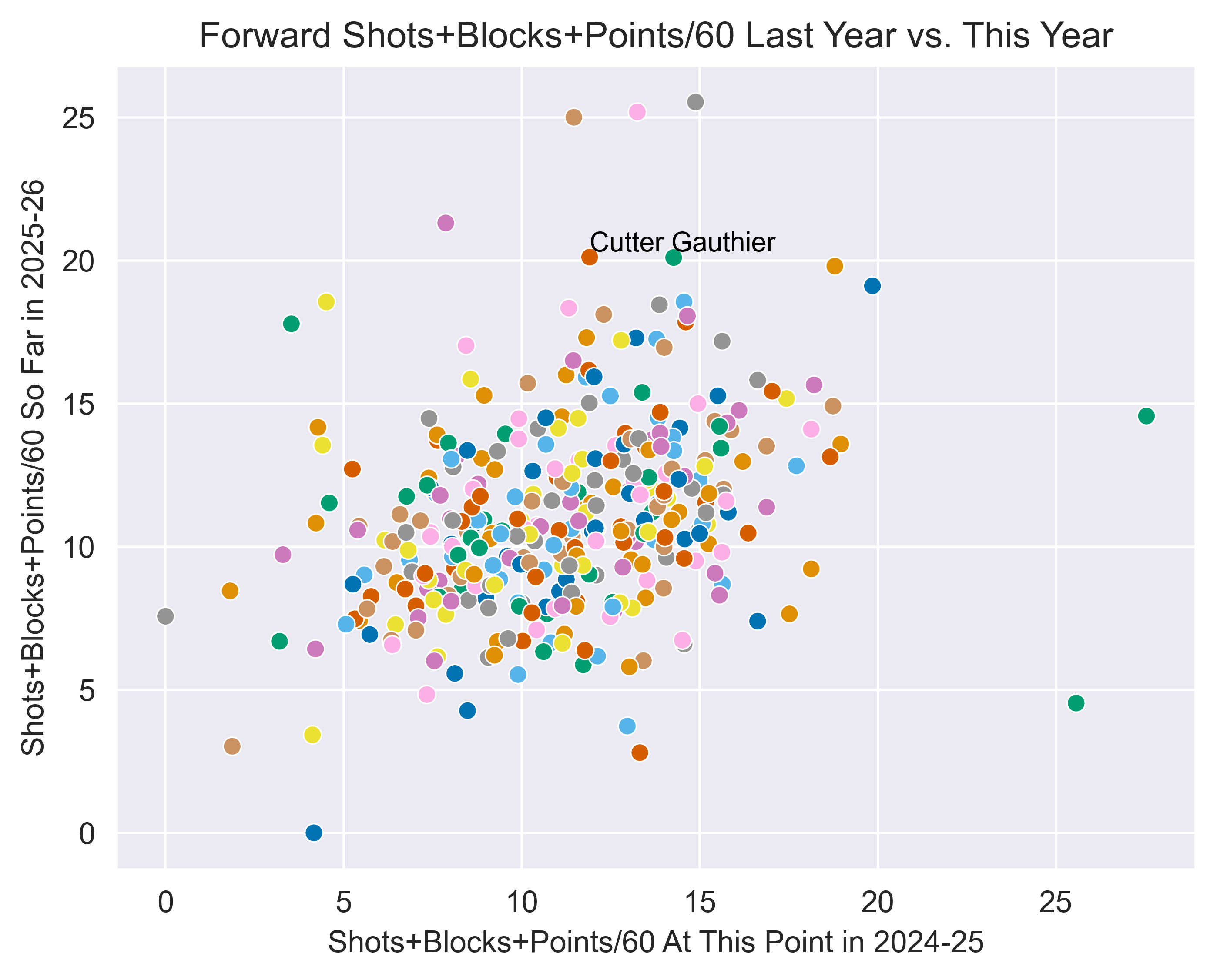
Gauthier has 38 shots in eight games but has registered just two assists. Anaheim has scored 10 goals with him on the ice and he has assisted on just 20% of them; that number was 38% last year. If he keeps scoring the way he is – he has scored 5 of those 10 goals – he may not rack up assists, but I don’t think anyone is really complaining about that.
10 – Mammoth Improvements
Utah went into Monday night second in the league by points percentage and while the top of the lineup has been excellent, a couple of their depth forwards have increased their contributions. Looking at the same shot+point+block rates as we did with Gauthier, both Michael Carcone and Liam O’Brien have seen massive leaps compared to last year:
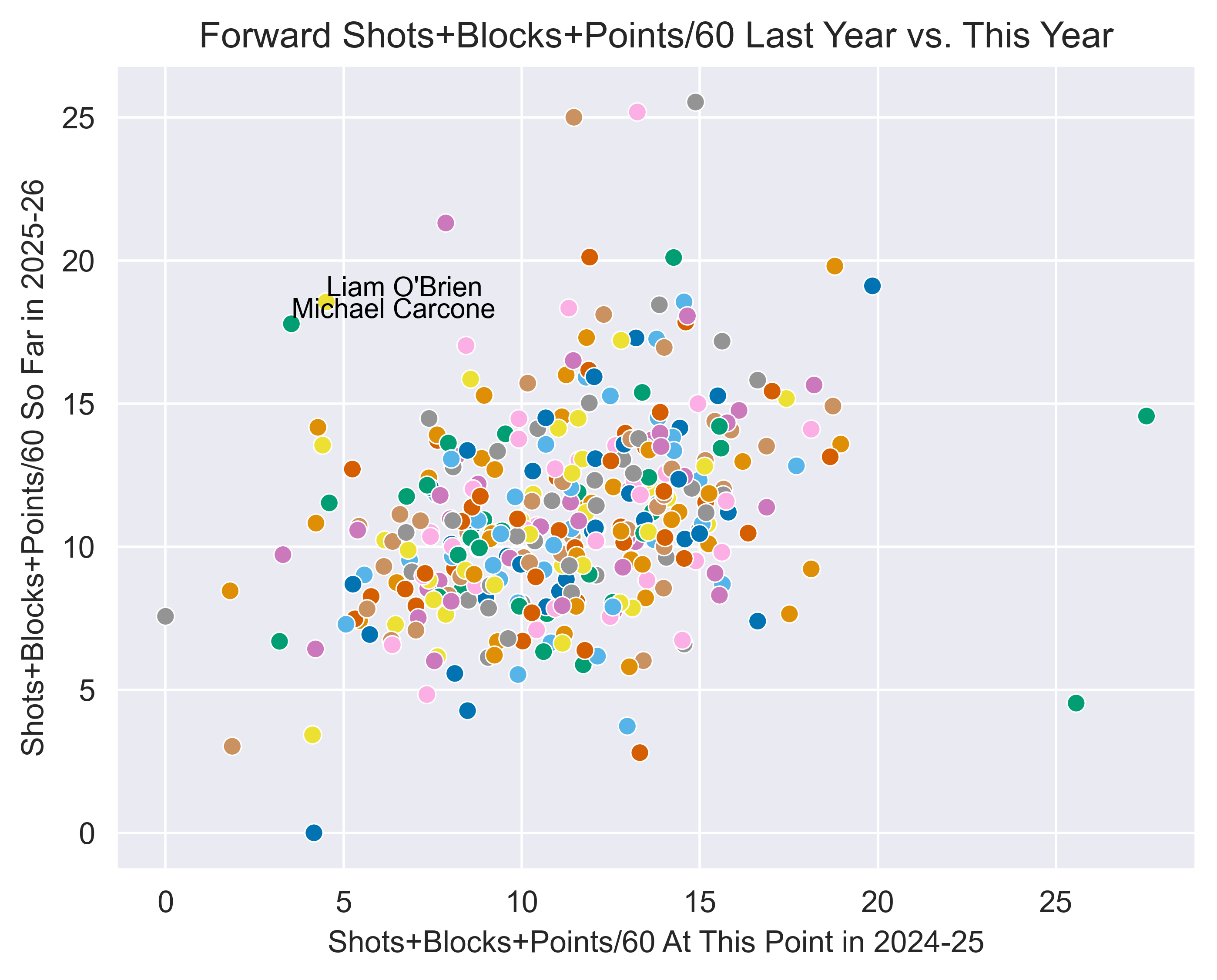
Both have extremely high per-minute shot rates – top-20 among all forwards with at least 45 minutes played – so we’ll see if they can sustain that. Even if they can’t, just staying at 75% of this level would be big for Utah’s scoring depth.
Until next week.