10 Interesting (To Me) Stats For This Week - May 5, 2026
Welcome back for another week of ’10 Interesting (To Me) Stats!’ Before we get too deep into the conference semi-finals, let’s review some of the top performers of the first round. The focus will be 5-on-5 tracking data as collected by All Three Zones to see which forwards and defencemen have good underlying performance to match their results on the ice.
Not every game of the first round has been tracked, so that is a caveat, and we are also going to limit the sample to skaters with at least 25 tracked minutes, which gives us 126 forwards and 78 defencemen. They are small samples, but that is the nature of the postseason.
The red and blue dotted lines in the following graphs represent the league average for that particular stat at that position.
1 – Nathan MacKinnon (Colorado Avalanche)
MacKinnon had just two points at 5-on-5 against Los Angeles, but the Avalanche outscored the Kings 4-1 when he was on the ice. Of the forwards in our sample, MacKinnon finished 7th by scoring chance assists/60 minutes (helpers on teammate chances) and 2nd by total scoring chance contributions/60 (individual chances combined with the chance assists):
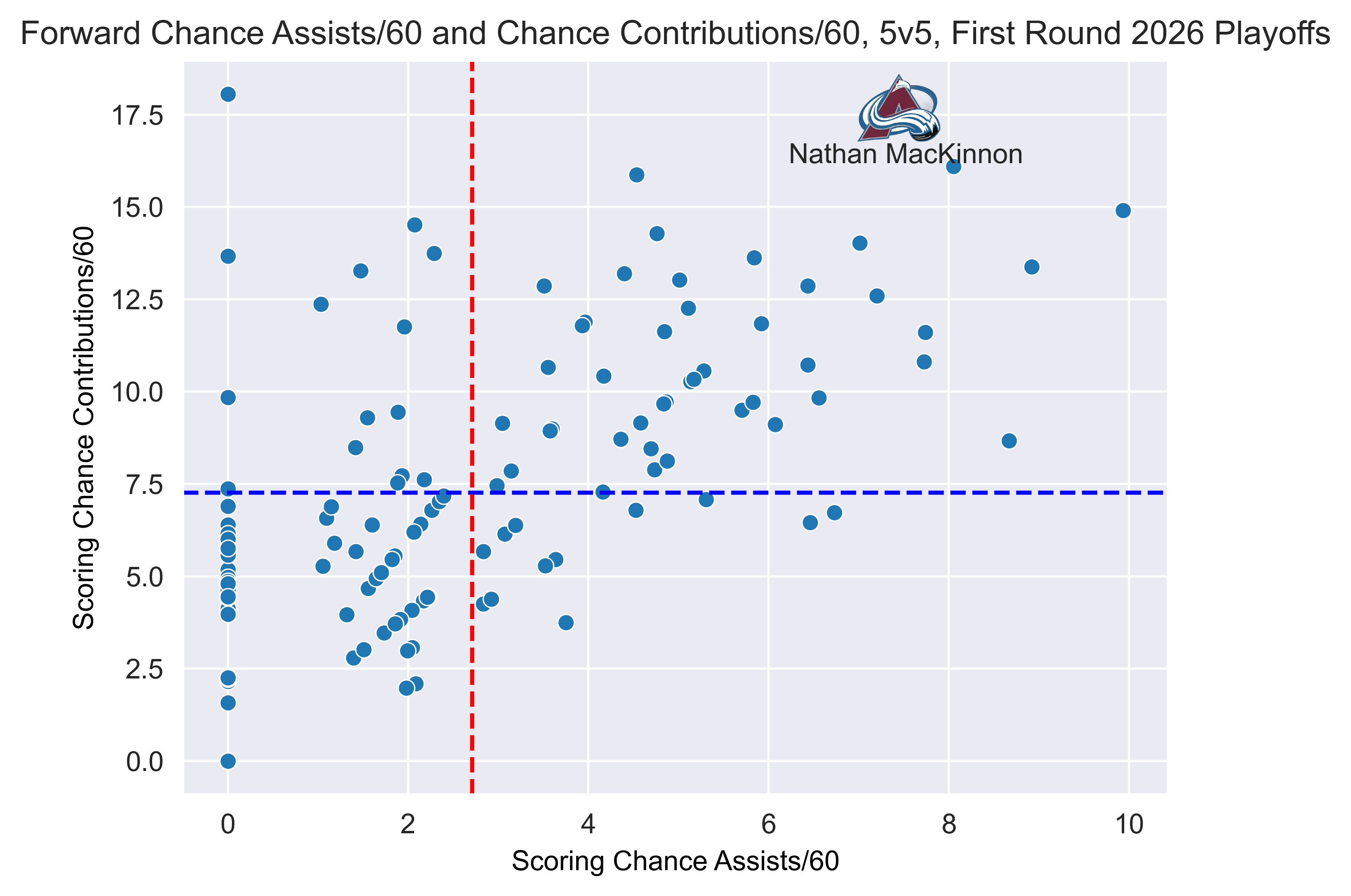
It isn’t much of a surprise that an MVP-calibre player had such a dominant performance in a four-game sweep, but it highlights that despite the modest production (by his standards), he was still exceptional, and a great sign for Colorado’s chances of making a deep playoff run.
2 – Nazem Kadri (Colorado Avalanche)
Like MacKinnon, Kadri didn’t have heavy production numbers, but Colorado outscored Los Angeles 4-0 when he was on the ice, and the underlying process was very good. Overall, Kadri had the fifth-highest rate of chance assists in our sample, finishing around the 80th percentile of forwards by overall rate of chance contributions:
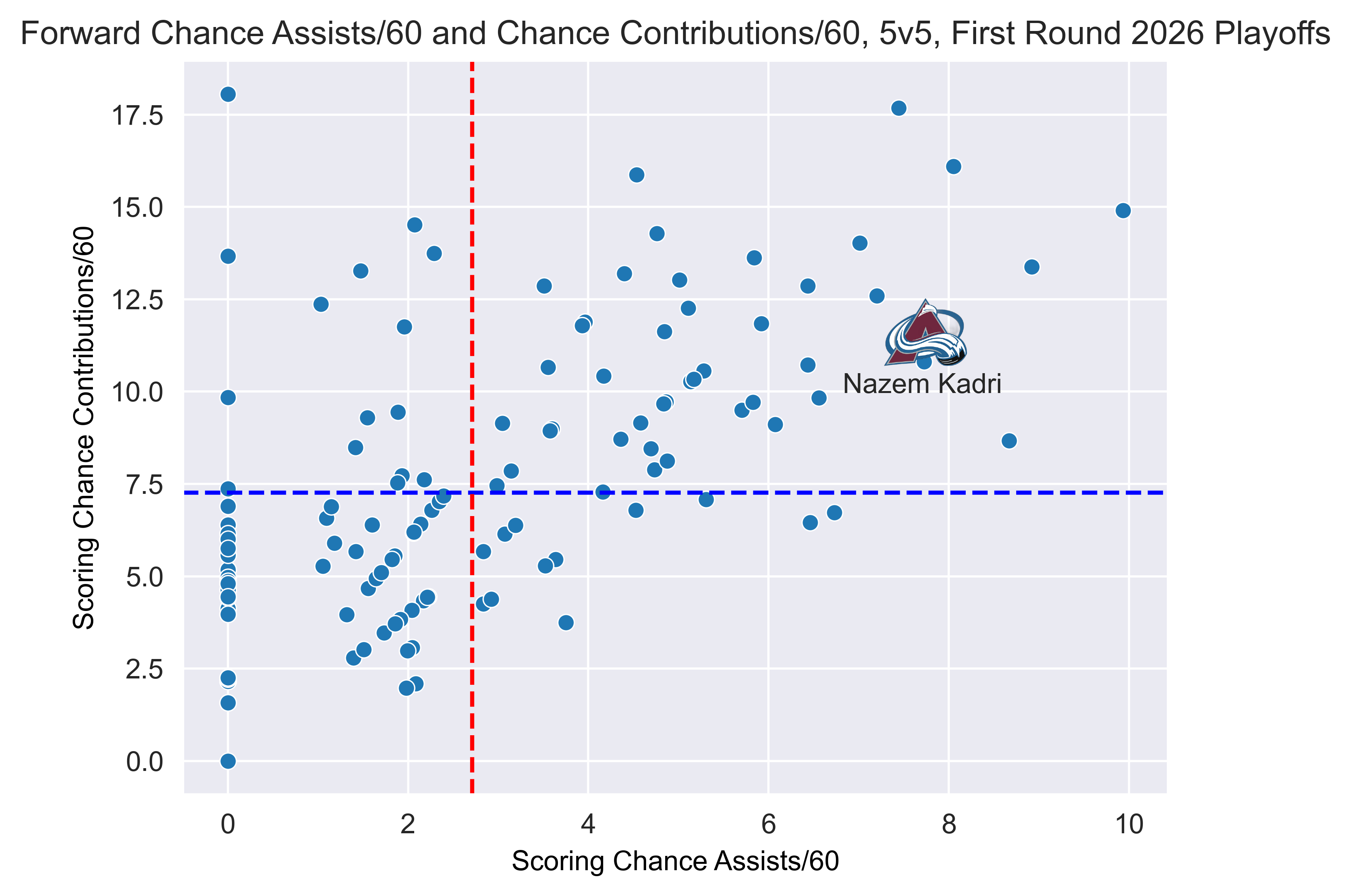
Though he’s not known for being a great playmaker, that Kadri was so involved in setting up his teammates highlights the versatility of this Colorado lineup – guys who can score 30 goals are also looking to elevate their line mates. That kind of versatility in Colorado’s depth, on top of their star power, is what makes them such a formidable opponent.
3 – Matt Boldy (Minnesota Wild)
Boldy tied Kirill Kaprizov for the team lead in total points in the first round, Boldy led Minnesota in goals (6), and was 1 of 2 Wild forwards to score more than once at 5-on-5 (the other was Michael McCarron). Minnesota had a 5-0 goal advantage with Boldy on the ice, and when we see how involved he was in the team’s offence, all this makes sense:
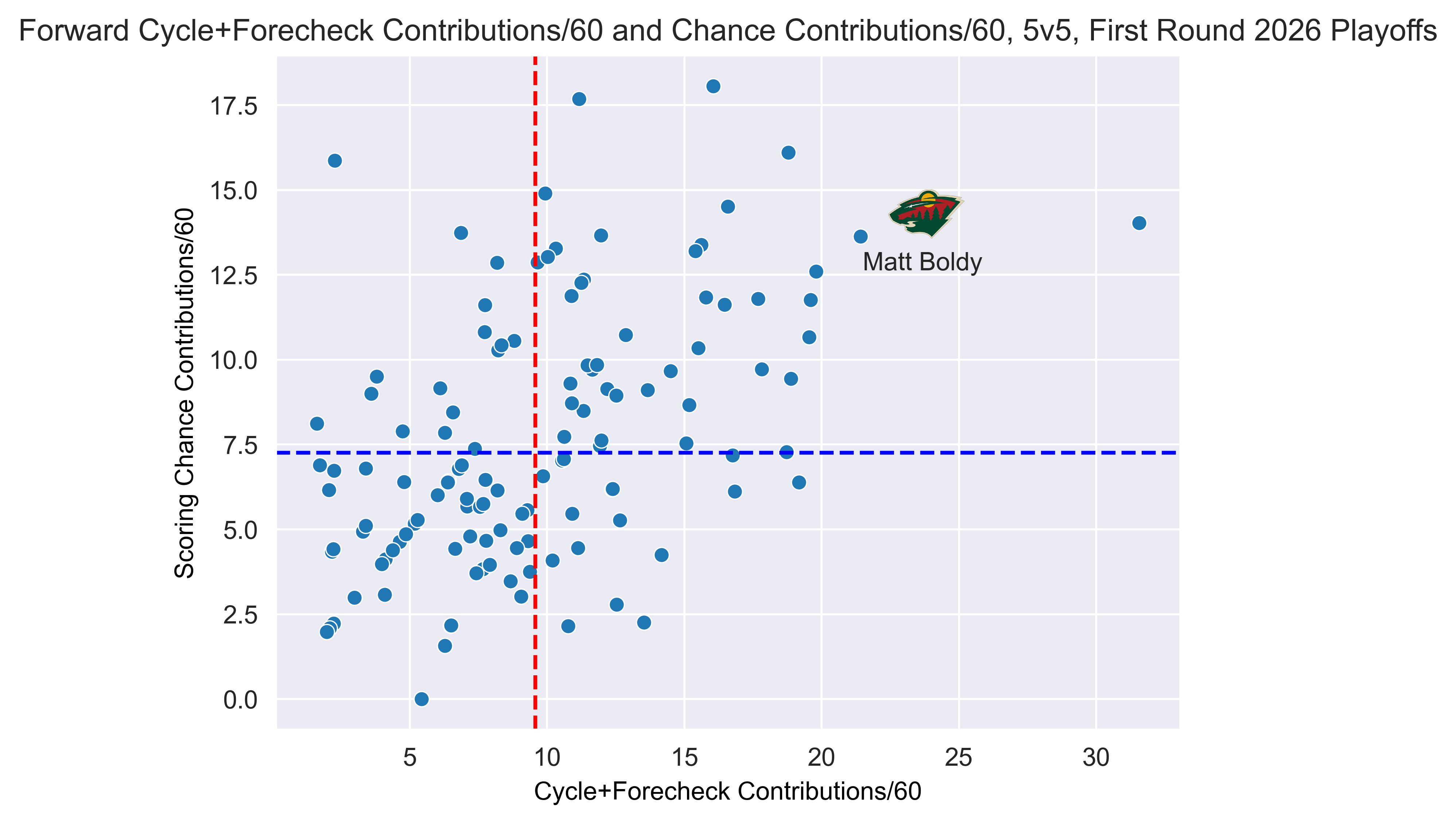
Overall, Boldy ranked 2nd by contributions off the cycle+forecheck (shots and assists) and finished 7th by overall scoring chance contributions. Much of his first-round production came on the power play, but all goals count the same, and it is hard to ignore just how much Boldy was an engine of the offence against Dallas. With everything he’s done in the last eight months, Boldy has arrived as a superstar winger.
4 – Jack Quinn (Buffalo Sabres)
As with others we’ve mentioned, Quinn didn’t have heavy production in the first-round matchup against Boston, posting two points at 5-on-5 in over 73 minutes of ice time. That shouldn’t keep us from acknowledging just how much offence he helped create. In fact, there were just three forwards in our sample who had contribution rates off both the rush and the cycle+forecheck that were in the 90th percentile or higher, and one of them was Quinn:
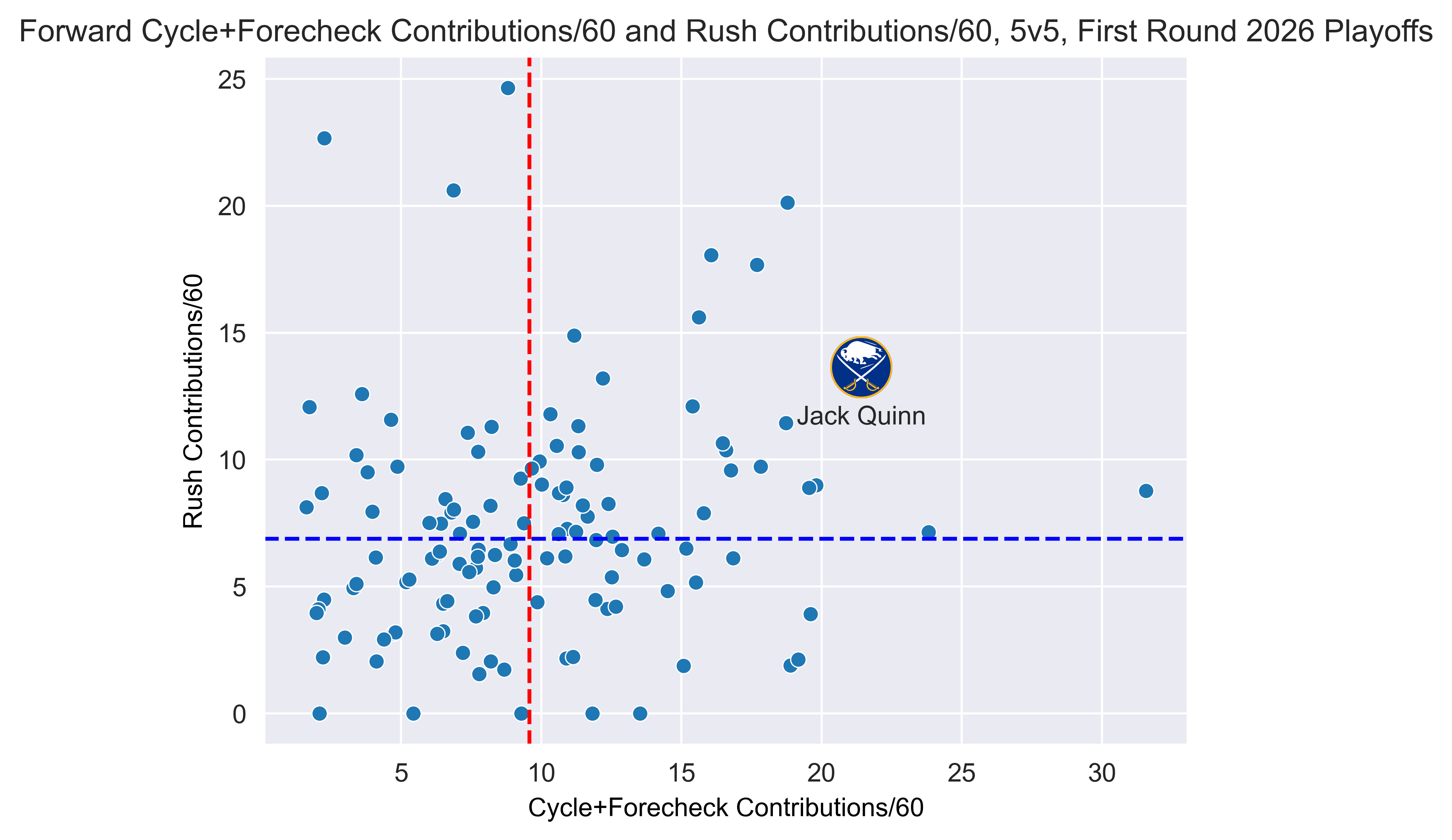
It was a nice bounce-back regular season for Quinn as he was a big part of the scoring depth that helped the Sabres to a division title. His line didn’t have particularly great results at 5-on-5 against Boston, but if Quinn keeps figuring in so heavily in the offence, he can be a difference-maker against Montreal.
5 – Leo Carlsson (Anaheim Ducks)
The Ducks are one of the teams that don’t have a lot of tracking data available, but considering they had a +20 shot differential and +3 goal differential with Carlsson on the ice at 5-on-5, there is some comfort in highlighting what he did in the few games that were tracked. Using the same rush and cycle+forecheck contributions we just saw with Quinn, here is where Carlsson landed:
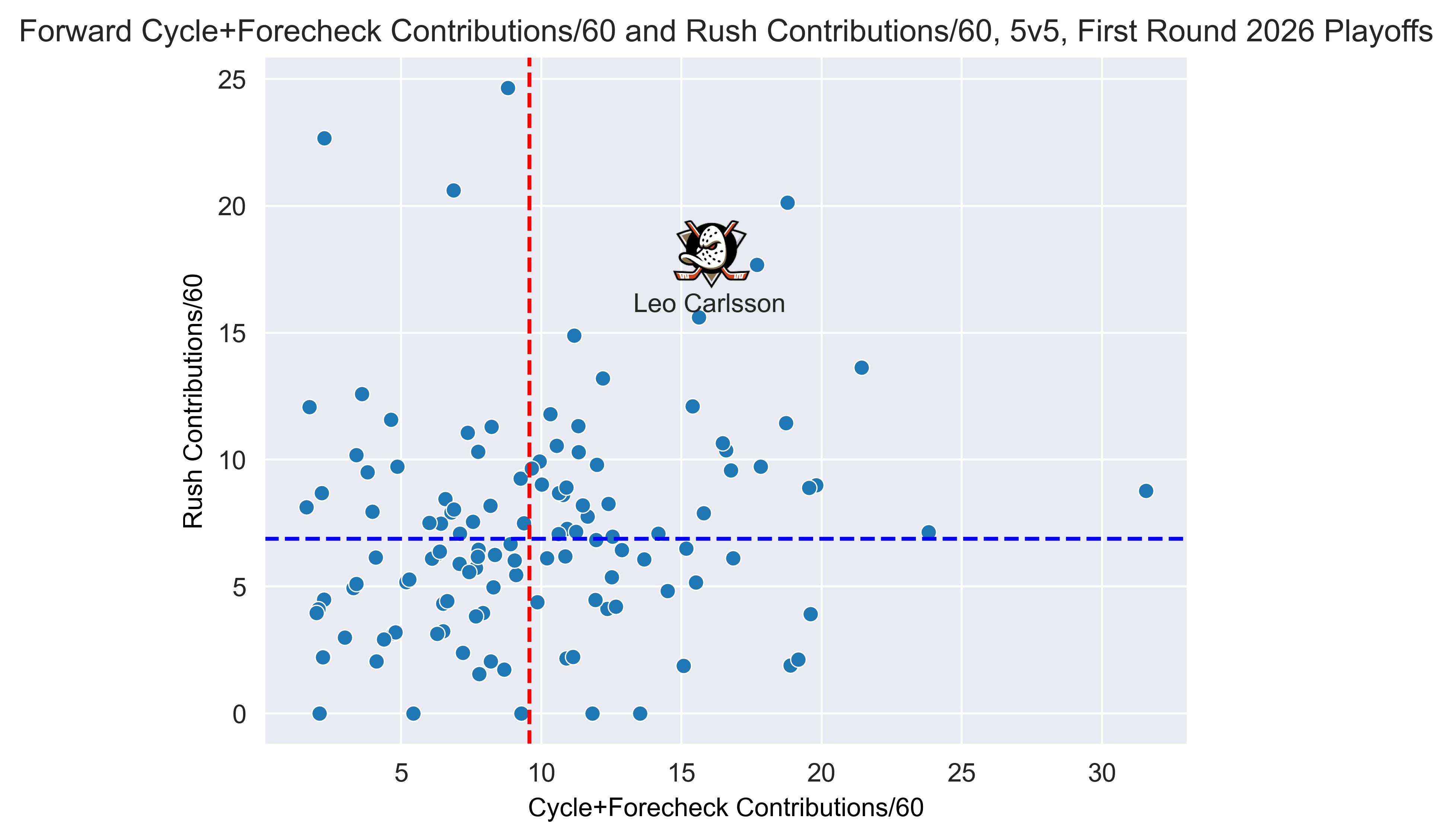
Overall, he had the fifth-highest rate of contributions off the rush and was 17th out of the 126 forwards by contributions off the cycle+forecheck. The best offensive players in the league can create in both situations, and that’s exactly what Carlsson did against the Edmonton Oilers. If this season is Boldy’s ascension to superstar, it is Carlsson’s notice that he’s also knocking on the door.
6 – Nikolaj Ehlers and Taylor Hall (Carolina Hurricanes)
This write-up narrowed down the tracking data for seven stats among forwards. Of the 126 forwards in the sample, just 10 were above average in each of those seven stats. Of those 10 above-average forwards, four of them came from Carolina. We are going to highlight two of them, Hall and Ehlers, as both stood out in overall chance contributions as well as percentage of zone entries being carried in:
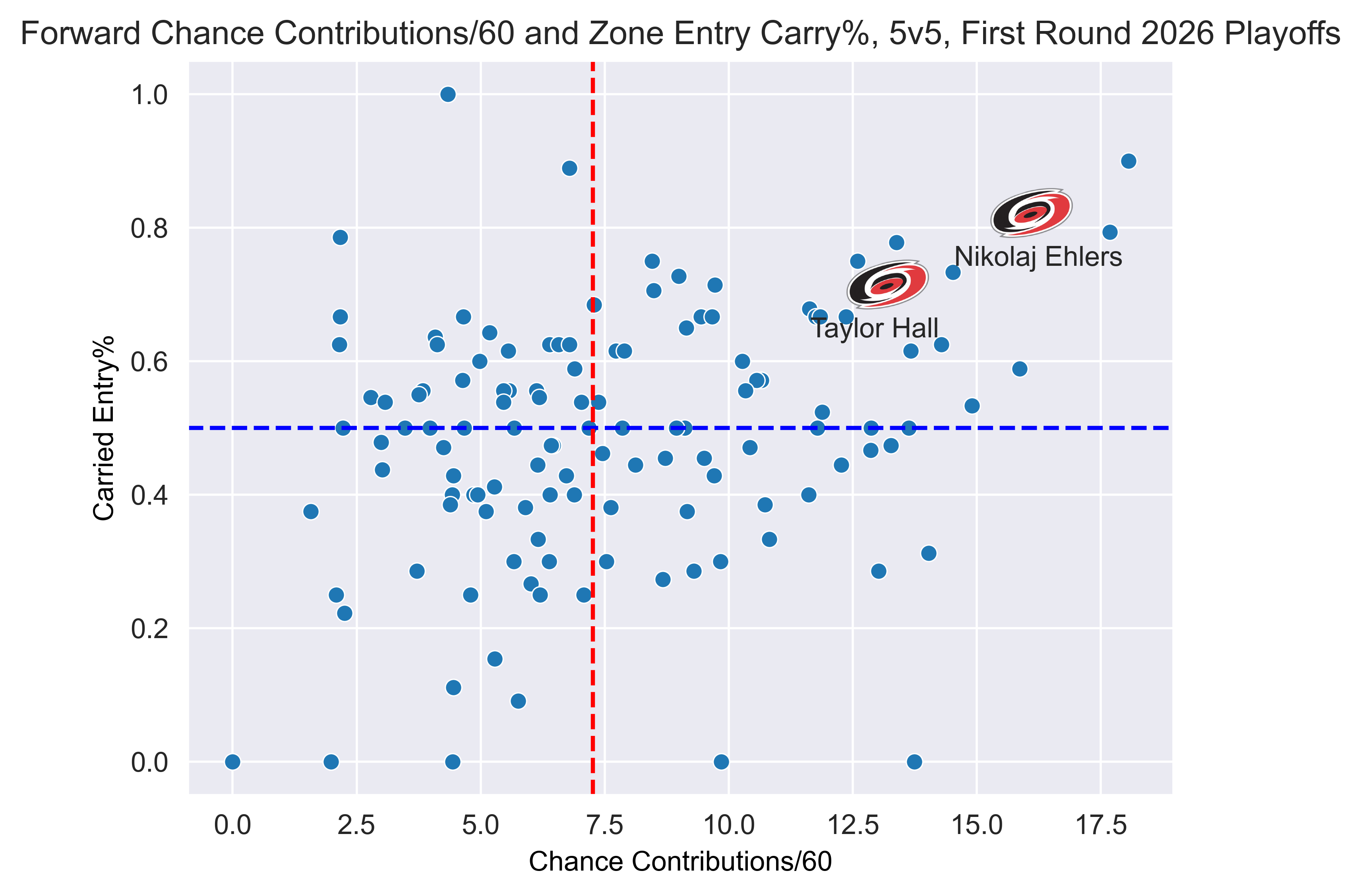
Several Carolina forwards had some good tracking data, which makes sense as the Hurricanes led the first round in shots and expected goals per 60 minutes at 5-on-5. All the same, Ehlers was a transition menace despite a lack of production and the second line, anchored by Hall, was the goal-scoring difference. Like Colorado in the West, this highlights Carolina’s great forward depth.
7 – Jackson LaCombe (Anaheim Ducks)
With nine points in six games, LaCombe led all defencemen in the first round and tied for second with a handful of forwards in the scoring race. Anaheim had a preposterous +36 shot differential with him on the ice at 5-on-5, and when we look at his chance assist rate and botch+fail percentage, those other numbers make sense:
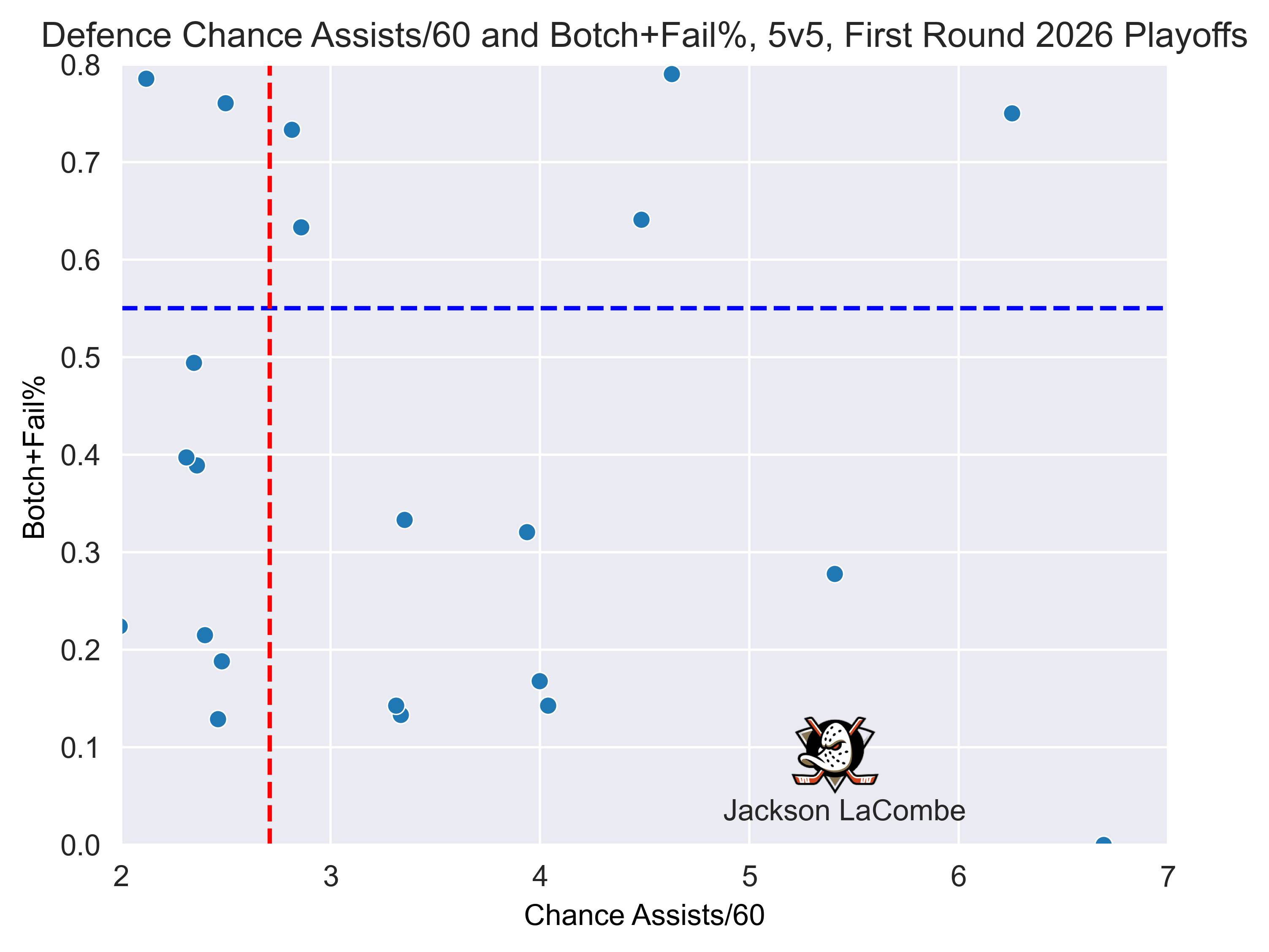
For anyone new here, botch% is how often a defenceman messes up on a defensive zone retrieval and fail% is how often they fail a zone exit. Combining those percentages can point us towards blue liners who help their team generate offence, and lower percentages are better. LaCombe was a great offensive facilitator in the first round and hopefully he’s opening the eyes of the wider hockey audience.
8 – Owen Power (Buffalo Sabres)
Buffalo scored seven goals in Power’s 103 minutes of 5-on-5 ice time, and it’s hard not to draw a straight line from what he did to that excellent offensive performance. Using the same parameters as we did with LaCombe, here is where Power stood among first-round rearguards:
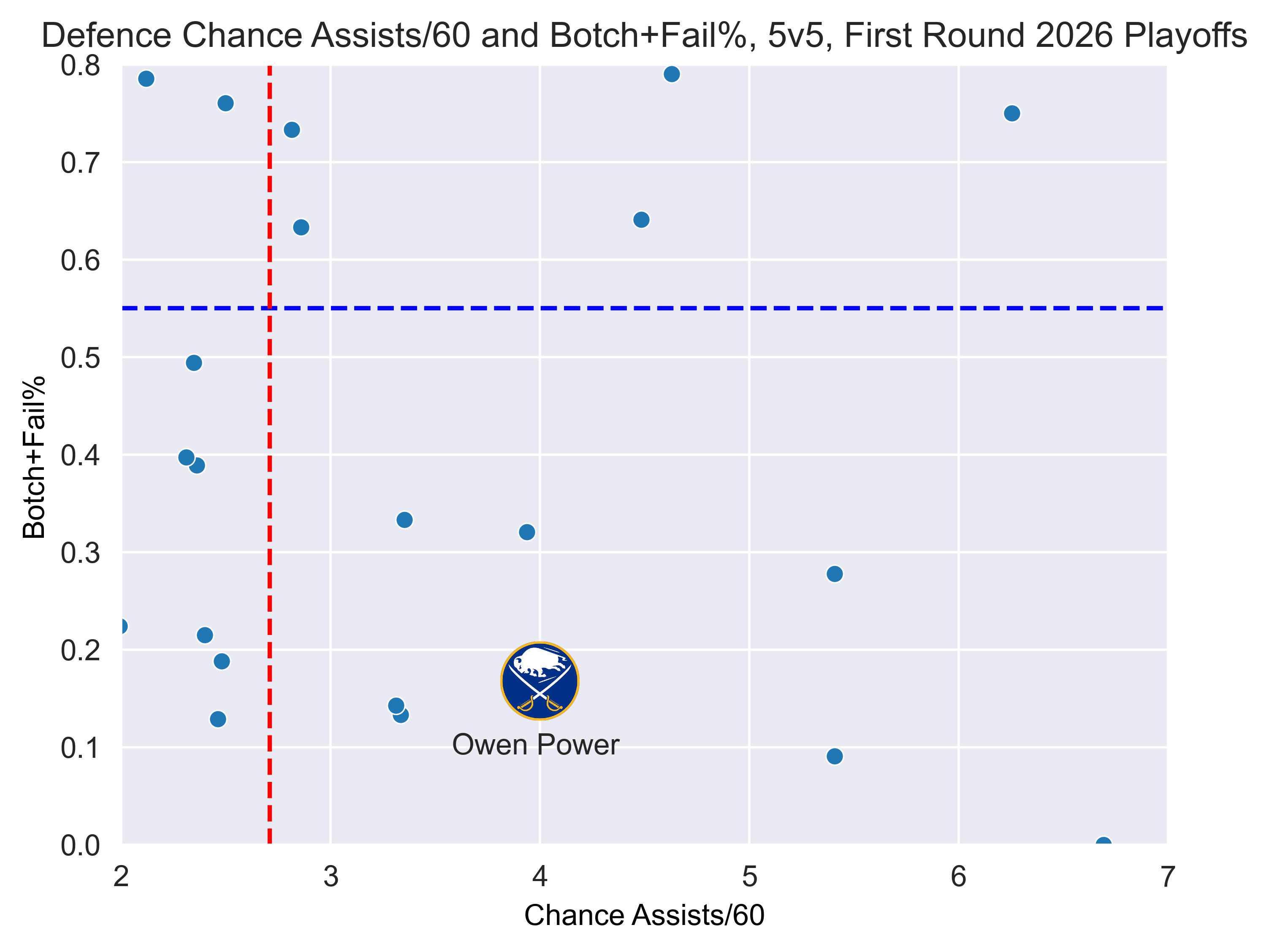
Of the 78 defencemen in our sample, Power was top-12 in both stats. Repeating that performance in the second round (and maybe further) is key to Buffalo being able to sustain that kind of offensive performance. If he can, this may be Power’s statement to the league that he’s rising to his top draft billing.
9 – Brock Faber (Minnesota Wild)
The arrival of Quinn Hughes has helped Faber reach another level offensively, and that was on display against Dallas. Among the blue liners in our data, he had the highest rate of contributions off the cycle and fifth-highest rate of contributions off the rush:
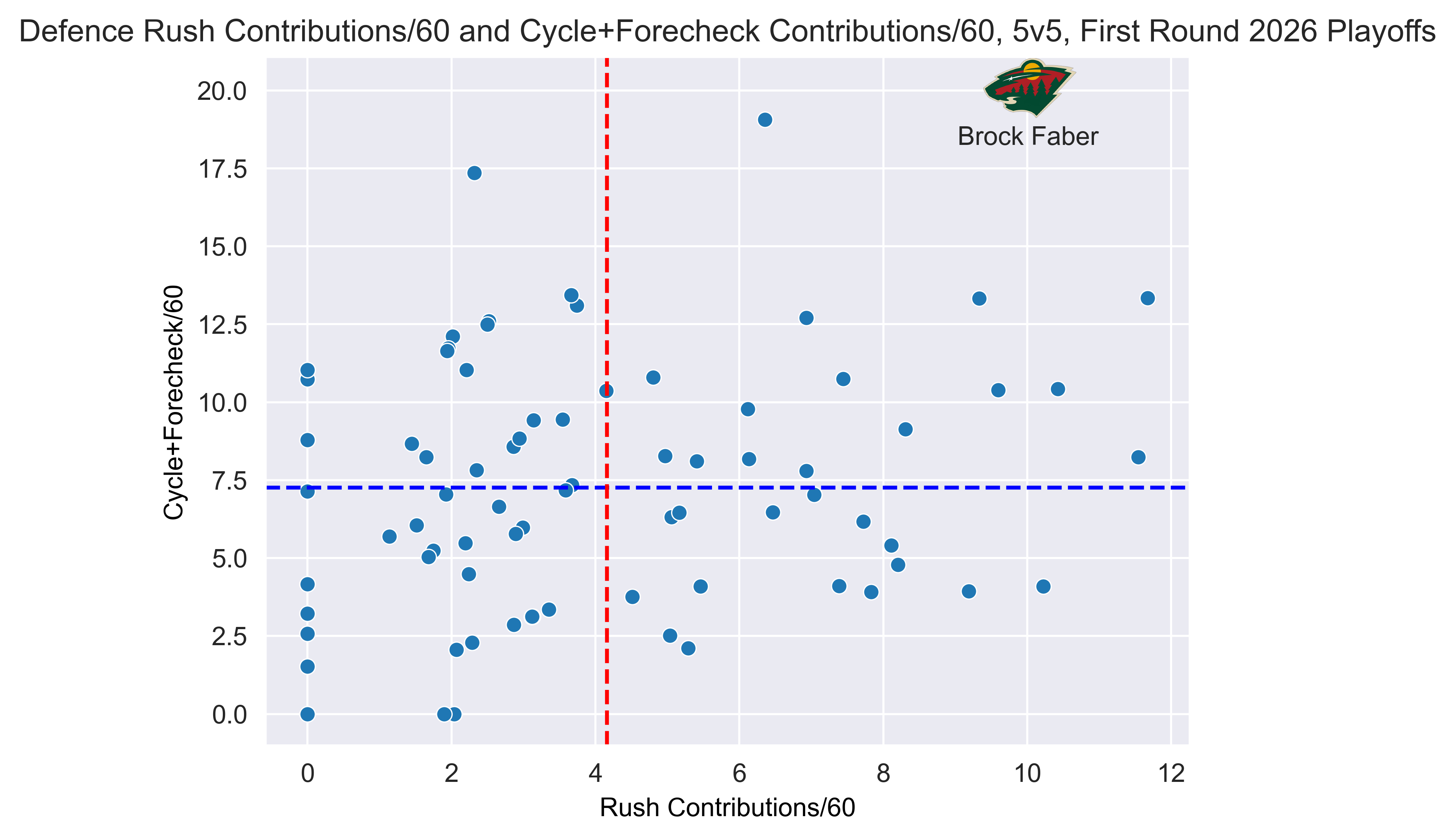
In 122 minutes of 5-on-5 ice time with Hughes and Faber on the ice, the Wild scored seven goals and that led to Faber tallying five points at that strength. The team has a tougher test in the second round with Colorado, and if they want to keep breaking through the Avalanche’s defence and goaltending, they need more of this from Faber. Regardless, a tremendous series from the young defenceman.
10 – Noah Hanifin (Vegas Golden Knights)
At 5-on-5, Hanifin had four points, which led the Vegas blue line, and he tied Ivan Barbashev and Jack Eichel for the team lead in 5-on-5 assists. When we see how good Hanifin’s rates of scoring chance contributions and cycle+forecheck contributions were, that makes sense:
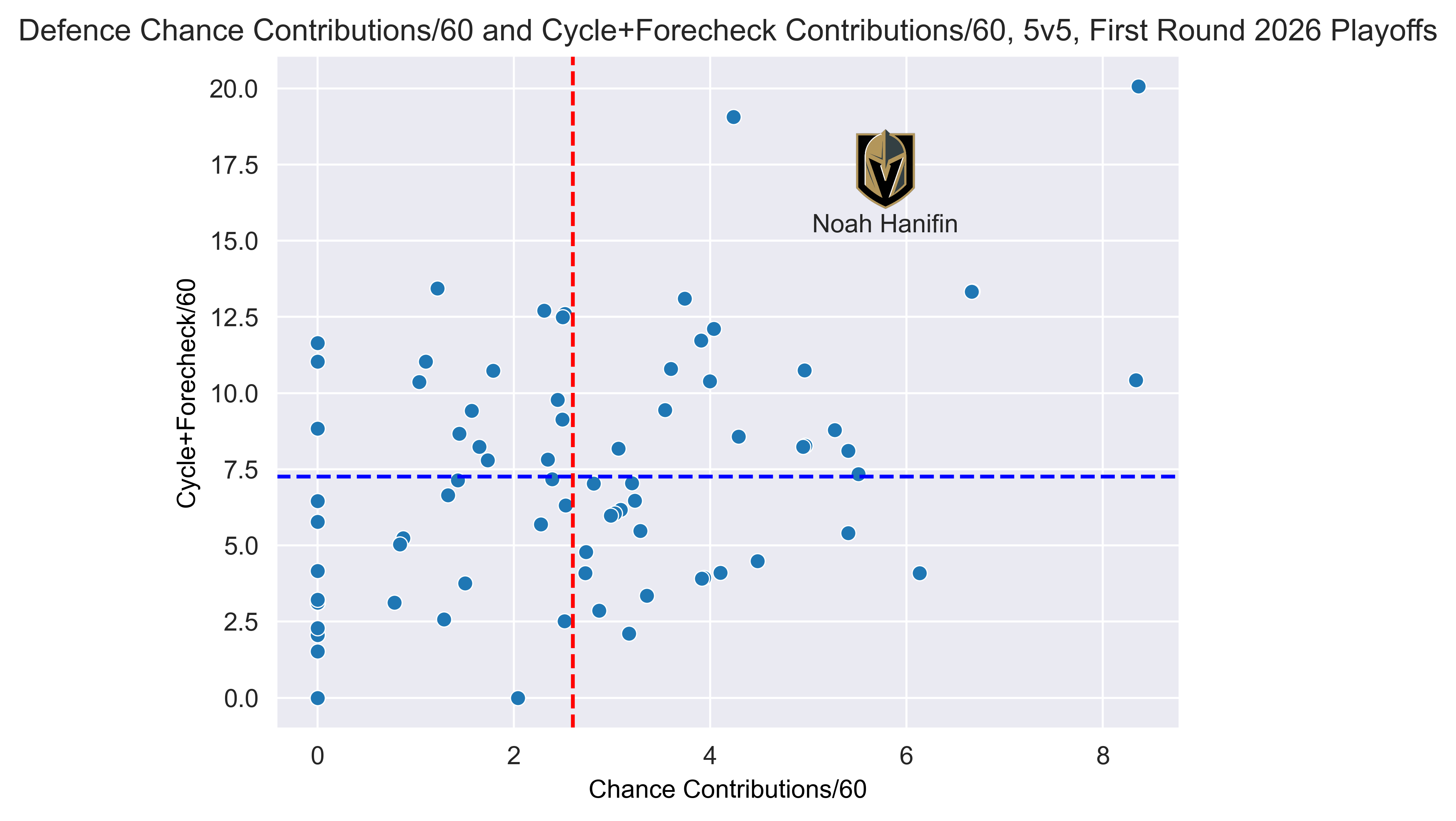
Among our defencemen, he had the third-highest rate on the cycle+forecheck and seventh-highest rate in chance contributions. Vegas was excellent offensively when he was on the ice, he figured in heavily in that scoring, and he’ll need to do it again against the high-octane offence from Anaheim.
Until next week.