10 Interesting (To Me) Stats For This Week - March 17
Welcome back for another week of ’10 Interesting (To Me) Stats’! This newsletter typically focuses on what has happened this season, but today, we’re taking a bit of a longer view. Today, we are looking at the top performers of the last two seasons without using back-of-the-card stats like goals and assists.
Player shot data is from Evolving Hockey, tracking data is from All Three Zones, and this is all at 5-on-5. We are limiting our sample to players with at least 250 tracked minutes over the last two seasons. Data is current as of Monday, March 16th.
The red and blue dotted lines in the graphs represent the league average in that specific stat.
1 – Setting the Bar
One of my biggest ‘what if’ moments of the last 10+ years is what if Mathew Barzal had been drafted by Dallas, Colorado, Florida, or Boston – the teams that drafted ahead of the New York Islanders in 2015 – because he typically has great tracking numbers but the surface stats rarely match because the Islanders are rarely an offensive force. For example, here are the two closest comparable forwards to Barzal over the last two seasons by rate of scoring chance assists (helpers on teammate scoring chances), zone entries, and percentage of zone entries carried in:
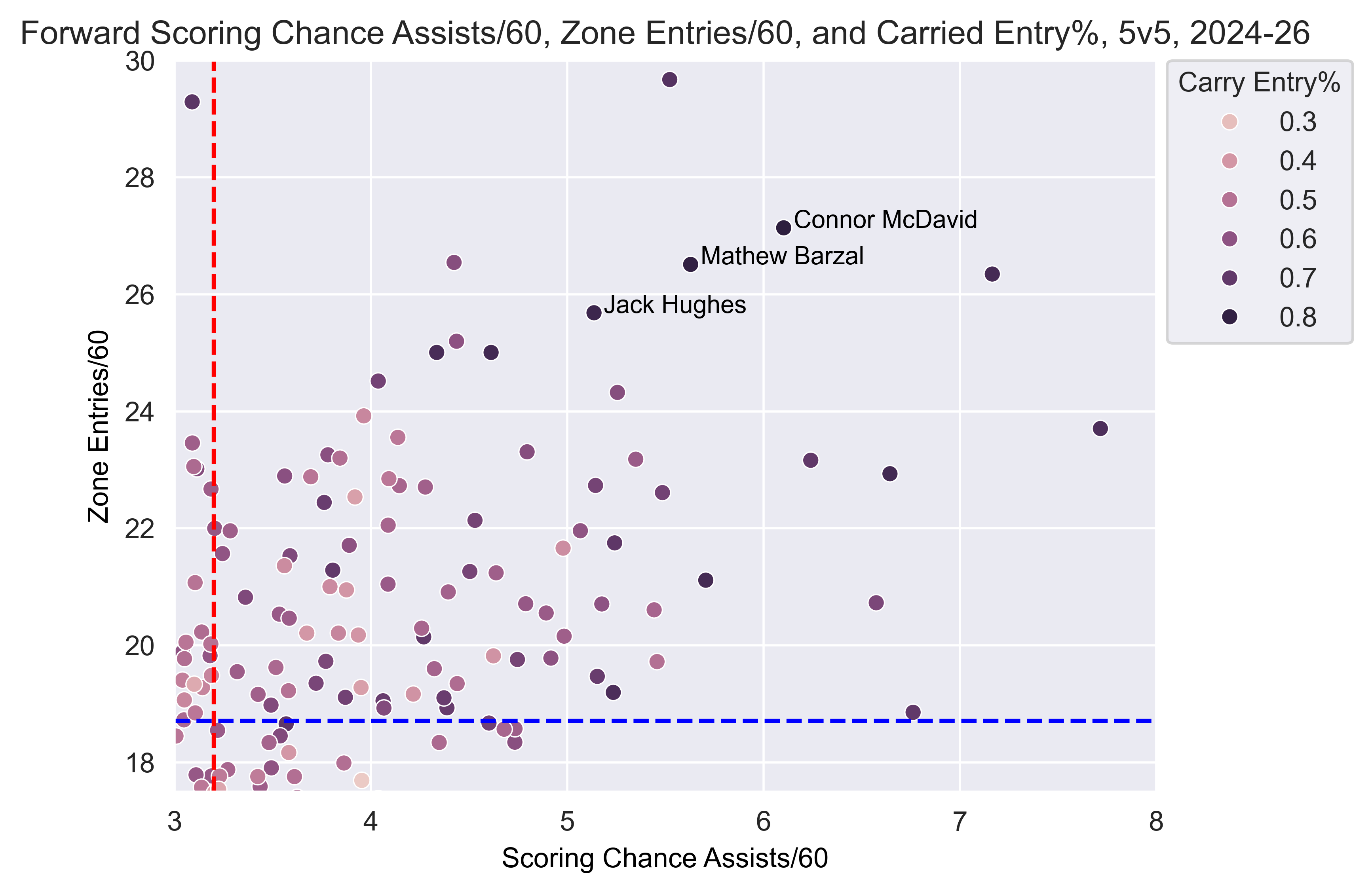
This has been the case for Barzal, give or take, for several years. Imagine what his reputation would be if he was on Nathan MacKinnon’s wing, or was David Pastrňák’s centre, for the last decade.
2 – Fil The Thrill
Another ‘what if’ moment that is more depressing is what if Filip Chytil stays healthy. He has played just 78 games over the last three years because of recurring concussion problems, and while his long-term health is the clear concern, when discussing Chytil’s on-ice contributions, the ‘what if’ becomes clear. To demonstrate, let’s use the same parameters we just used for Barzal and see where Chytil stands:
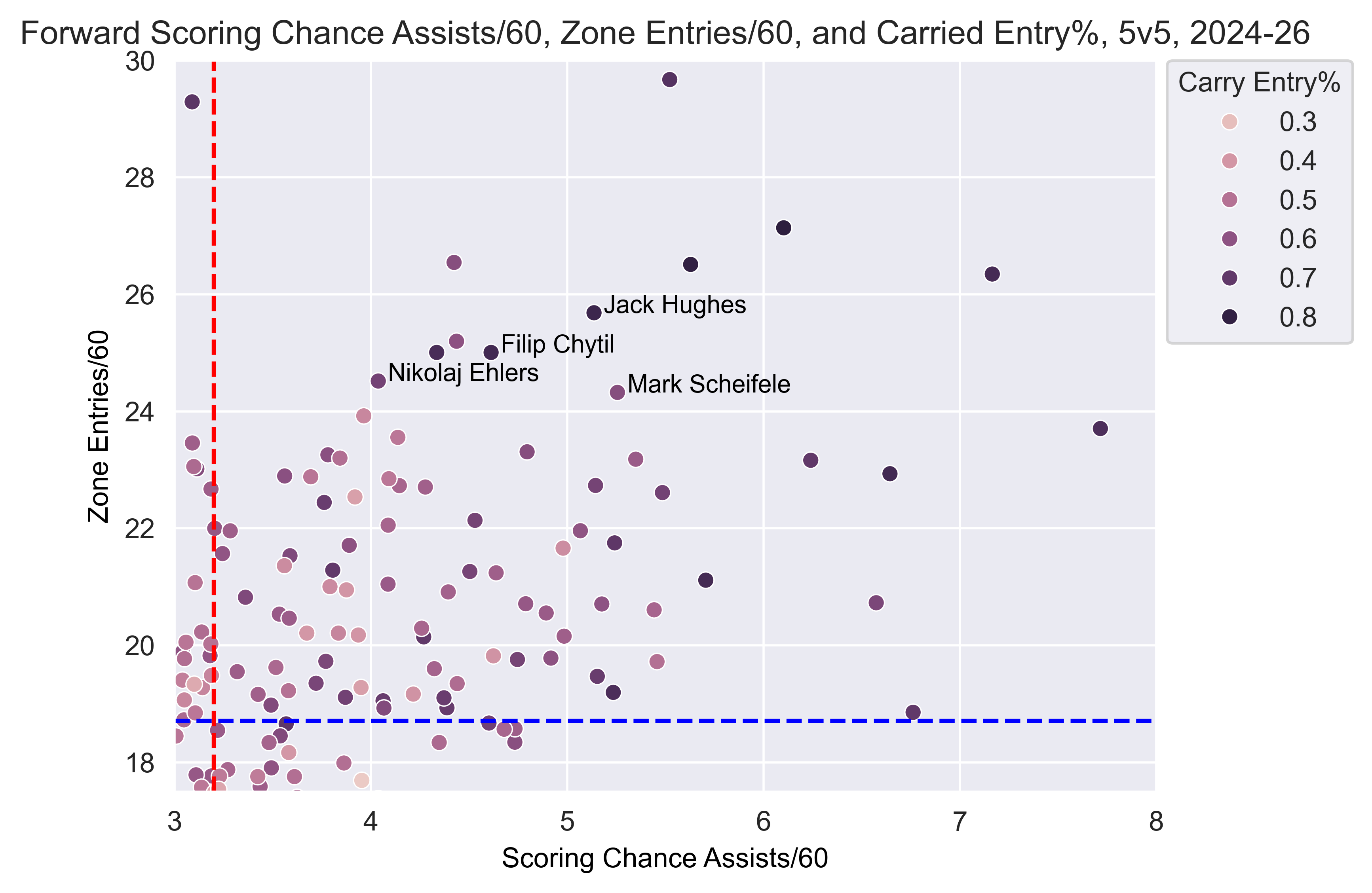
Again, the concern is whether Chytil can live a normal life post-hockey, but it will be a shame if he can’t stay on the ice because he can be a genuine difference-maker.
3 – Hall of Fame
At this point, Taylor Hall is a middle-6 scoring winger and not the top-line star he was 5-6 years ago. That shouldn’t take away from how good he still is in his role, though, because when we use the same stats we used for Barzal and Chytil, here is where Hall stands over the last two seasons:
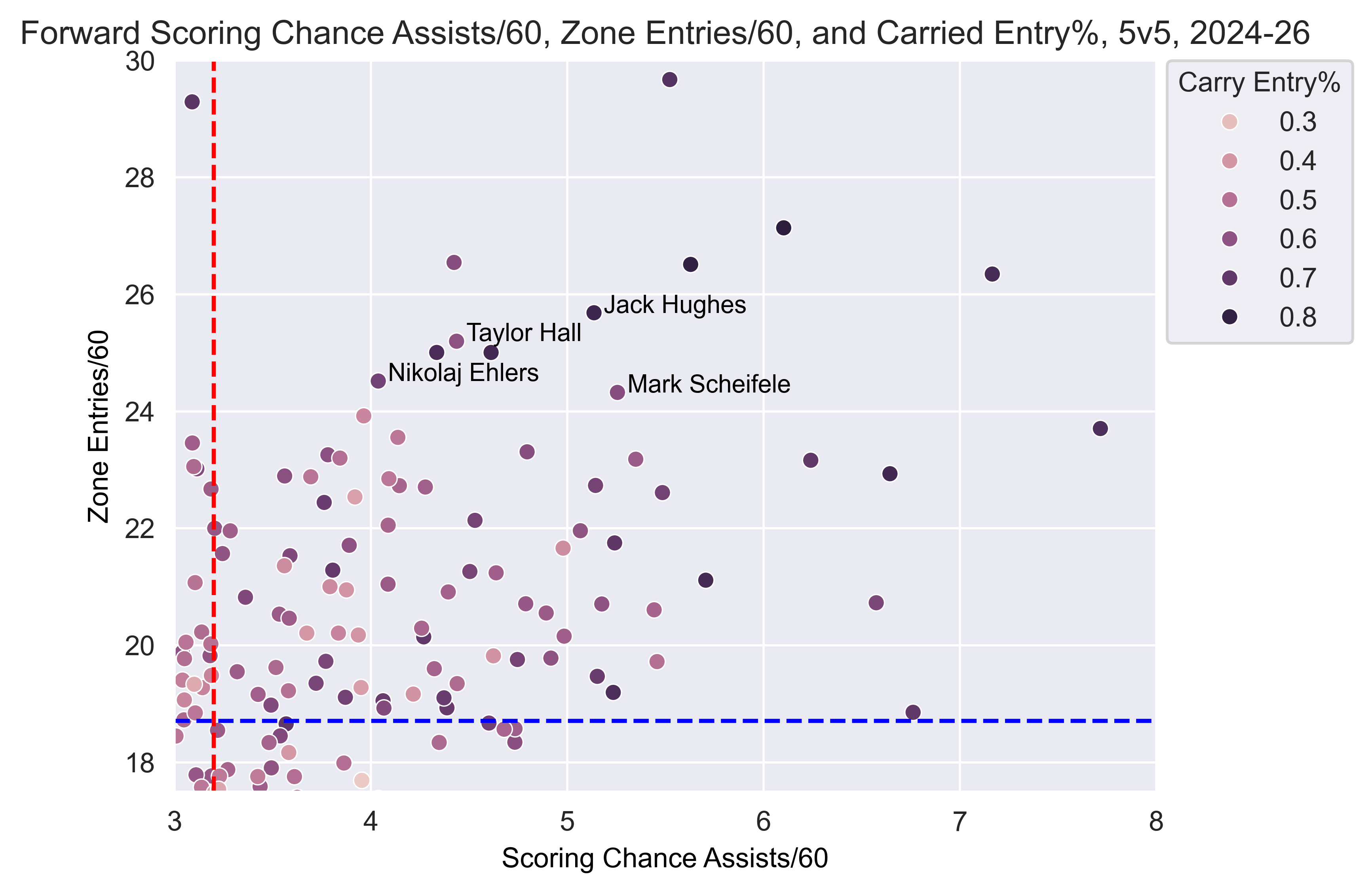
Hall’s point rate is that of a mid-tier second-line forward over that span, and in 2025-26 alone it’s a borderline top-line forward. He isn’t what he was 5-6 years ago, but he’s still very good, and a good contributor for Carolina’s depth scoring.
4 – Mat Trick
There has been no shortage of discussion around Philadelphia’s Matvei Michkov this season, but we’ll set aside all the off-ice stuff. When it comes to what Michkov has done on the ice, he has been a true dual-threat forward. Considering his rate of chance assists, the percentage of team shots he takes when he’s on the ice (shot attempt market share), and low rate of attempts necessary per expected goal, he fits in between a couple of top scoring forwards in the league:
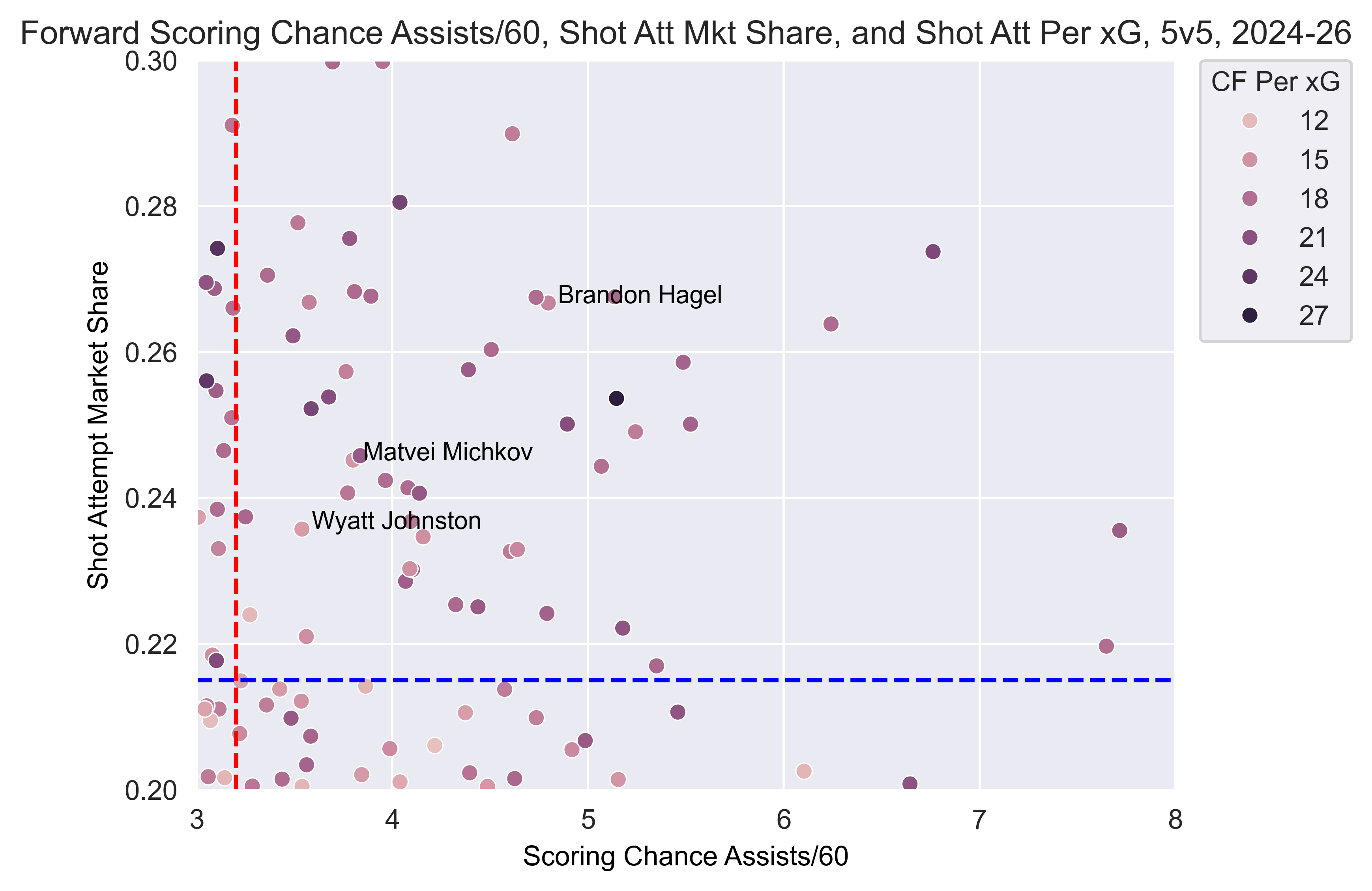
Michkov was a lot better as a rookie than as a sophomore, but a player having a downturn in their second year is not unheard of, and he still has immense offensive talent. Given his dual-threat ability in his first two seasons, this is a player to believe in, not to give up on.
5 – Double Em
Anaheim’s success in 2025-26 has been driven by their young forwards like Leo Carlsson, Cutter Gauthier, and Beckett Sennecke. Mason McTavish has been overshadowed, which makes sense given his sluggish production even leading to a recent healthy scratch. All the same, as with Michkov, McTavish has shown true dual-threat ability by having very good rates of scoring chance assists as well as share of the team’s shots when he’s on the ice:
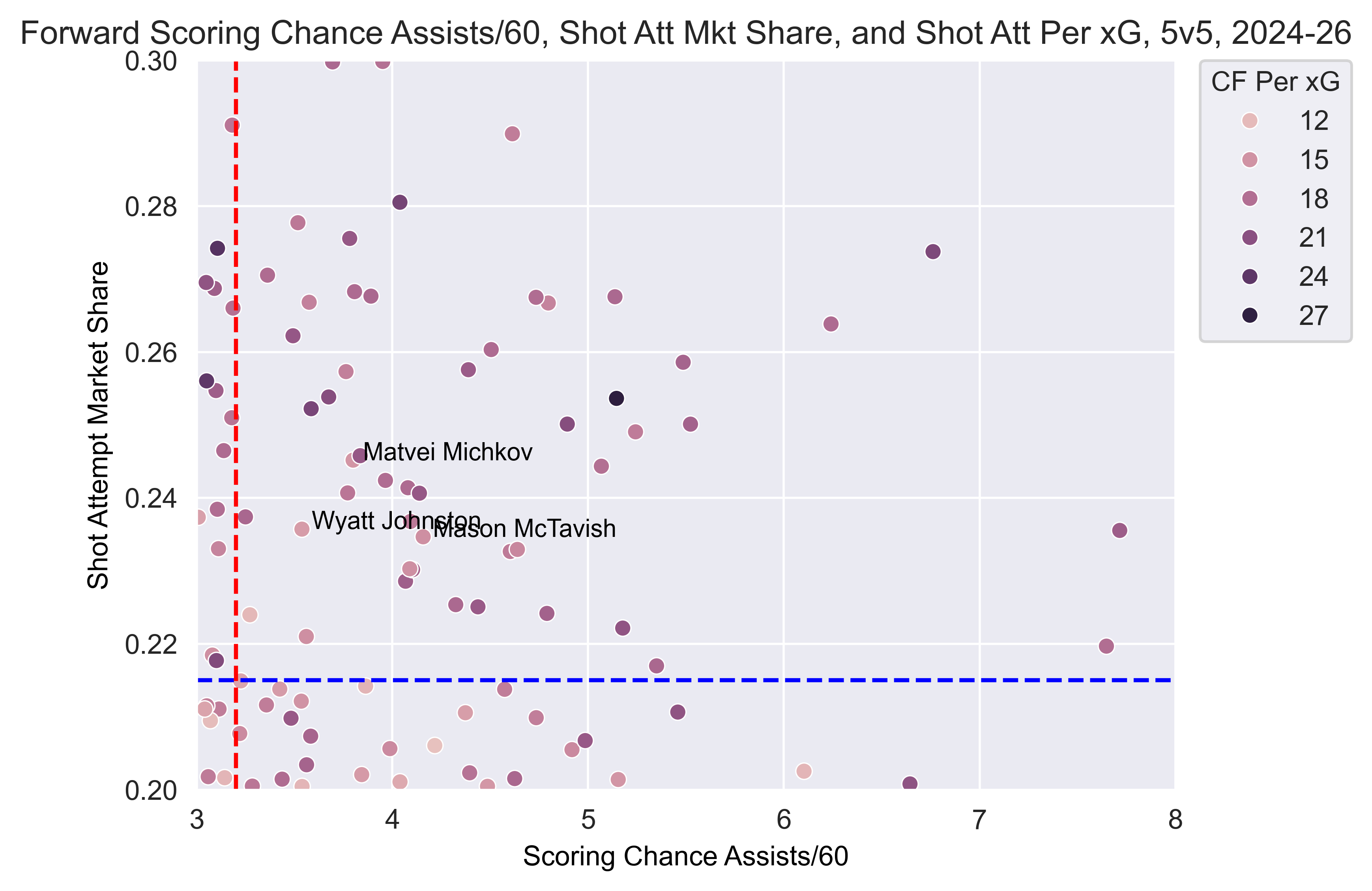
He has a bit higher rate of assists than Michkov, lower share of his team’s shot attempts, and has been similar to Wyatt Johnston in both areas. McTavish has defensive issues to clean up before he’ll be heavily relied upon by his coaches, but the offensive talent is quite evident, and he just turned 23 years old in January.
6 – Auston, Massachusetts
We often try to highlight surprising players in this newsletter, but sometimes, a player is so far ahead of everyone else that they have to be mentioned. That is the case for Auston Matthews when we look at shooting profiles of forwards across the league. By market share of expected goals (percentage of team xG a player takes when he’s on the ice), market share of shot attempts, and fewest attempts needed per expected goal, here is Matthews:
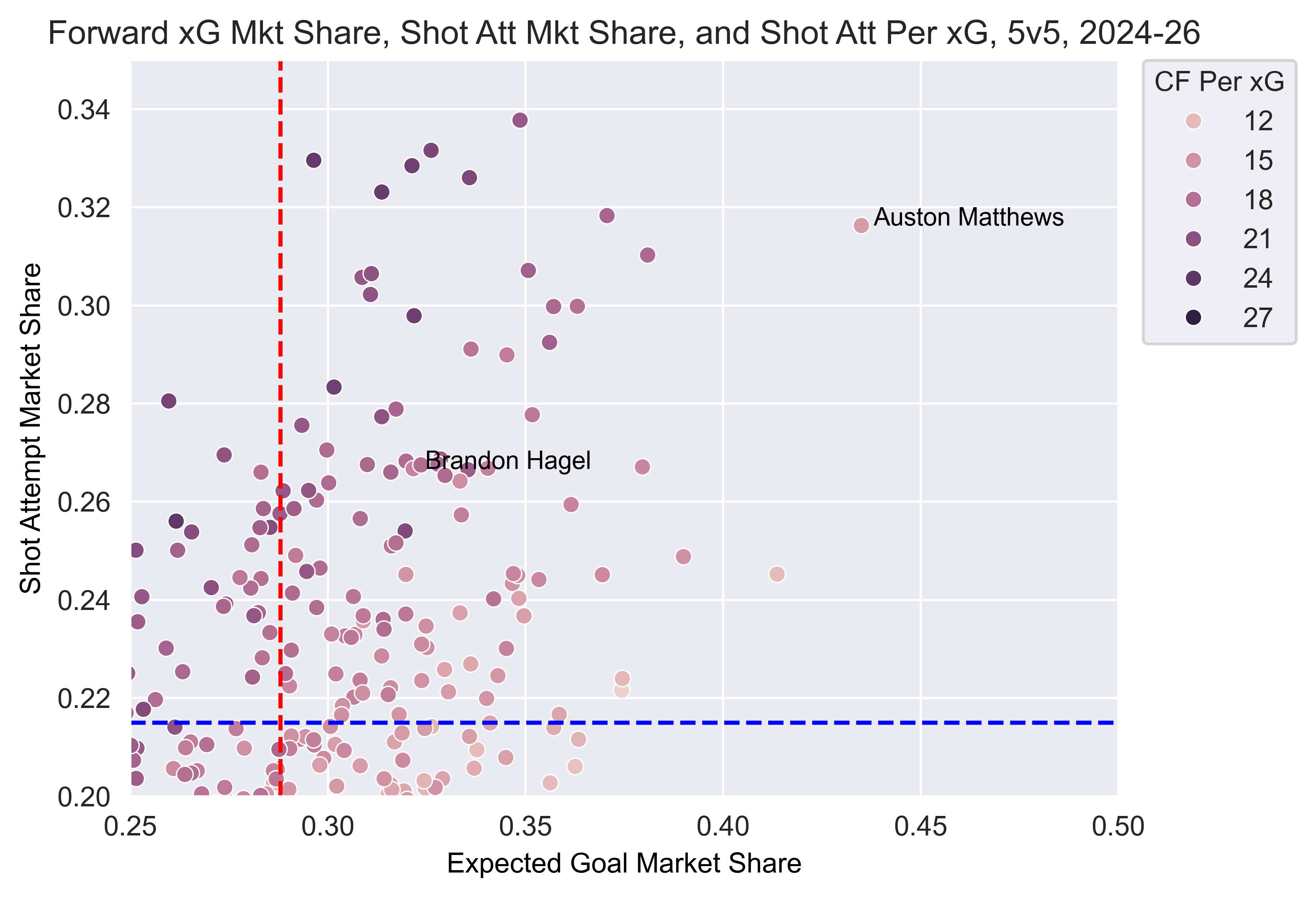
The season-ending knee injury is a big concern, but Matthews’ rate of goals at 5-on-5 this season is 1.11, which is much higher than in 2024-25 (0.94). If Toronto’s power-play were any good, he’d easily be on a 40-goal pace, if not higher. Whatever the problems, Matthews’ scoring at 5-on-5 was not one of them.
7 – Foeghorn Leghorn
Los Angeles traded forward Warren Foegele to Ottawa at the Trade Deadline, and while Foegele may be stuck in a bottom-6 role for this season, he has another year on his deal, and it’ll be very interesting to see what kind of rebound he has in 2026-27. The potential is there because when we use the same shot metric parameters we just used for Matthews, Foegele grades out extremely well:
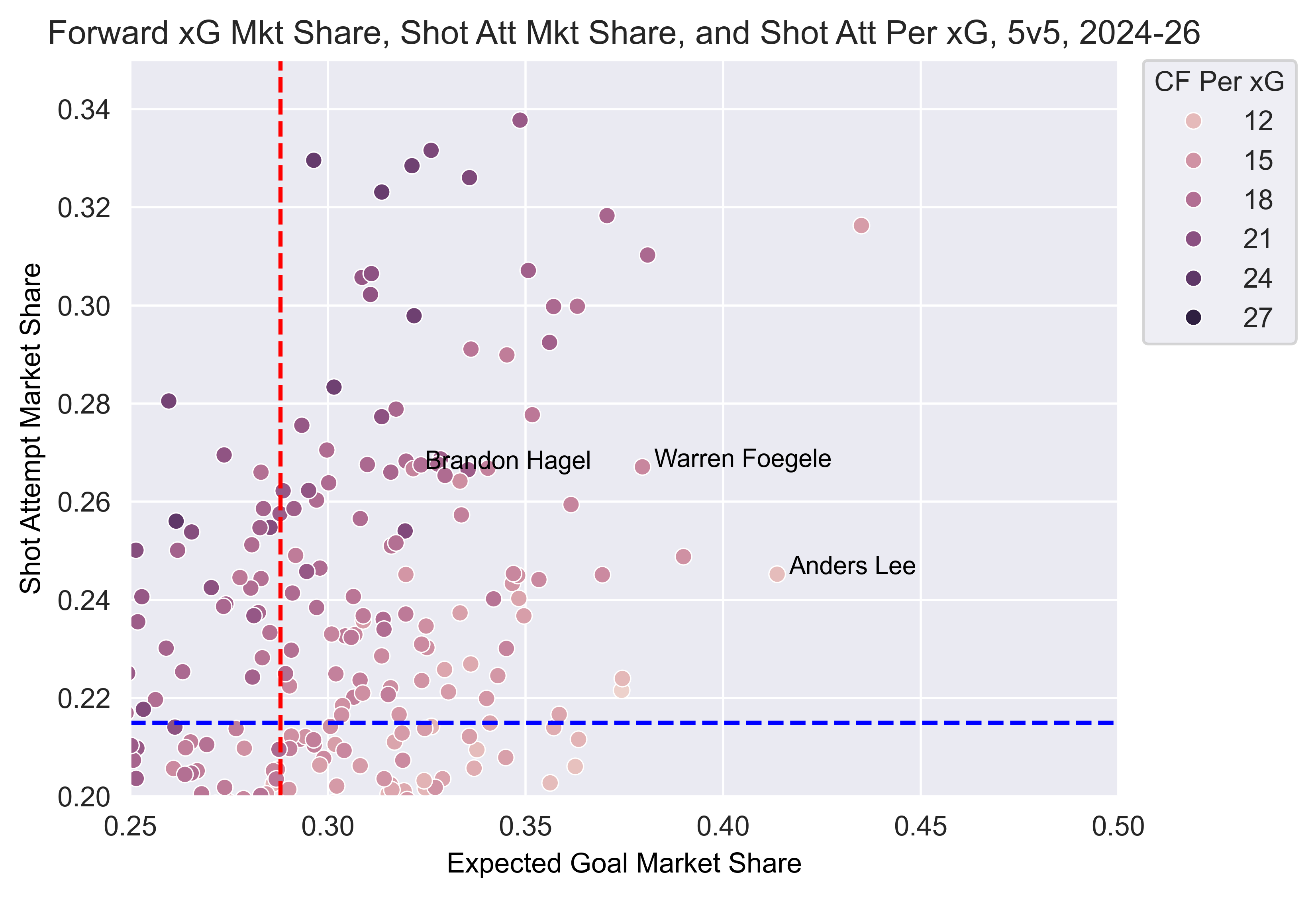
Being somewhere between Brandon Hagel and Anders Lee by share of expected goals and shot attempts, while requiring few shot attempts per xG, is a great place for Foegele. It would be fun to see what he can do in a full season next to Tim Stützle or Dylan Cozens.
8 – Rush Hour
Jordan Kyrou’s name has been mentioned several times in this newsletter this season, so what’s one more? When we look at contributions off the rush (rush shots and assists on teammate rush shots), market share of shot attempts, and scoring chance assist rate over the last two seasons, Kyrou is somewhere between Nikita Kucherov and David Pastrňák:
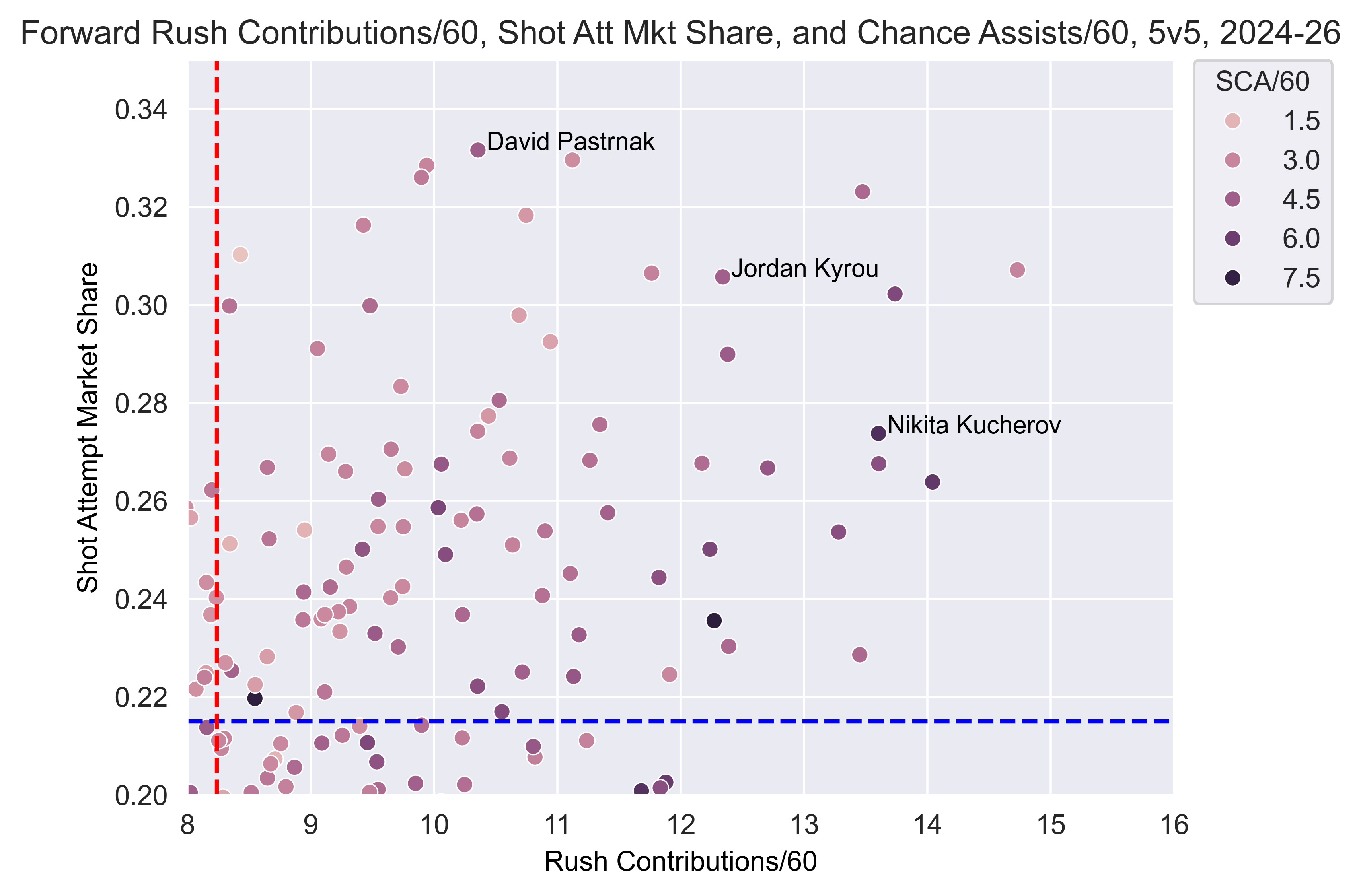
It has been a tough 2025-26 season for Kyrou, but the same can be said of almost any Blues skater. That does make for an intriguing offseason, though, because he has a very high-end offensive skill set that any team would be the better off with.
9 – Last Gasp?
Montreal’s Brendan Gallagher is in his 14th season and turns 34 years old this spring. A recent healthy scratch indicates his age is catching up with him, but let’s highlight the positive here. When looking at contributions off the forecheck and cycle (shots and assists), market share of shot attempts, and shot attempts per xG, we see Hagel’s and Lee’s names again:
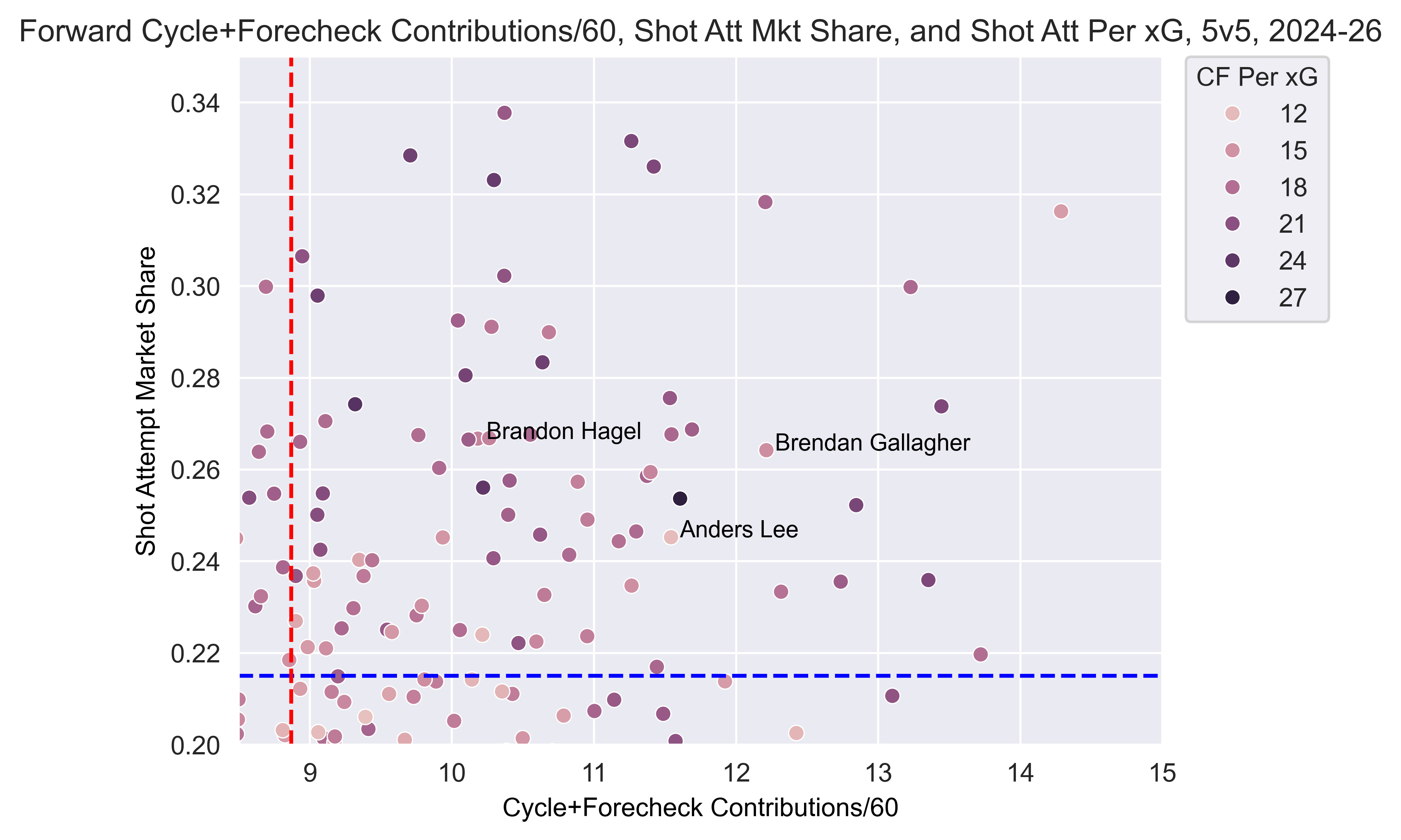
At this point, Gallagher is not suited for much more the fourth line, second power play duties, but he has been a heart-and-soul guy for Montreal for over a decade. A salute to what he’s done over the last couple years, and over the last 14, as the team enters its new era.
10 – What, What?
Lastly, I wanted to look at overall offensive profile. To do that, I isolated forwards who were in the 84th percentile or higher by rate of contributions off the rush, contributions off the cycle, and scoring chance contributions (assists and individual chances) over the last two seasons. All the elite names showed up – McDavid, MacKinnon, Kucherov, Draisaitl, and so on – but in the next tier of forwards, one of them is… Utah’s Michael Carcone?
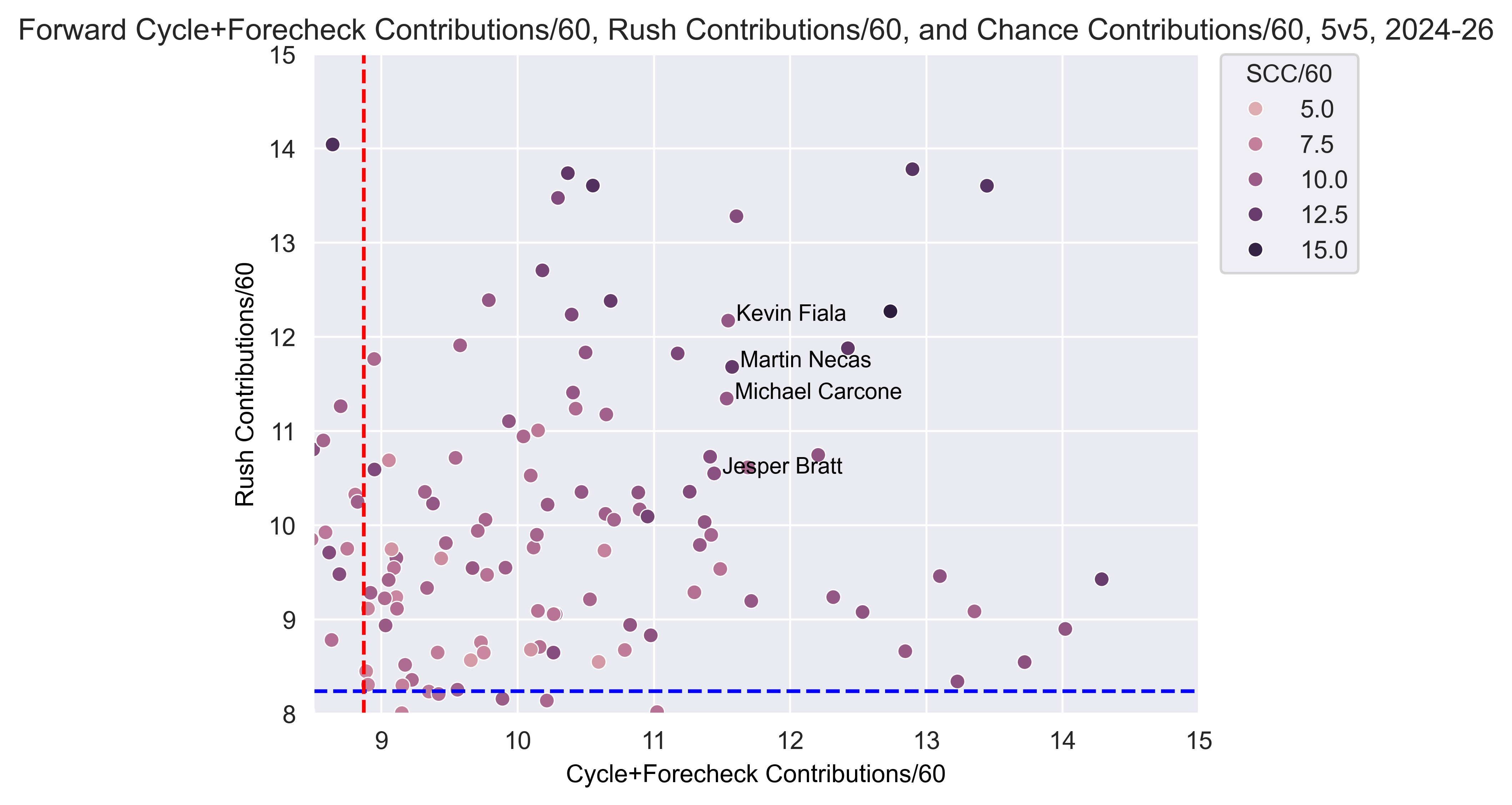
No mistakes there. Carcone’s contributions off the rush, cycle, and to scoring chances compares well to the names shown over the last two seasons. He has genuinely evolved into one of the most impactful bottom-6 forwards in the league.
Until next week.