10 Interesting (To Me) Stats For This Week - August 26
Welcome back to another week of ’10 Interesting Stats’. This week, we are going to look at non-playoff teams from last year. With just six weeks until the regular season starts and training camps around the corner, we need to look at how these teams have genuine hope of taking a step forward into the postseason, or if they’re the Buffalo Sabres. So, let’s look at a path each team can take to get into the 2026 Stanley Cup Playoffs.
Data from Evolving Hockey unless otherwise indicated.
1 – Anaheim Ducks
Anaheim took a huge step in 2024-25, finishing with 80 points, 19 clear of Chicago and 28 points over San Jose, but if the Ducks want to take their next step, there needs to be a huge improvement in their special teams play. For example, Anaheim had the league’s worst goal differential on special teams in 2024-25, and it wasn’t close:
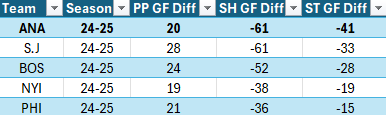
For reference, no franchise with a special team goal differential of -15 or worse made the playoffs, and every team with a special team goal differential of +10 or better reached the postseason. It will be a multi-year process, but if they want to keep the arrow pointing up, fewer goals against on the penalty kill and more goals on the power play are a must.
2 – Nashville Predators
There can be two things that are true about the Nashville’s disappointing season:
1. Their 5-on-5 goal scoring was snakebit, finishing 16th by shot rate and 19th by expected goals, but dead last by actual goal scoring.
2. Their tracking data had the hallmarks of a team that should underperform.
As to that second part, according to tracking data from AllThreeZones, here are the five teams who finished below average by rebounds+deflections per 60 minutes and primary assists per high-danger pass (how often passes leading to a shot was a high-danger pass, and lower numbers are better):
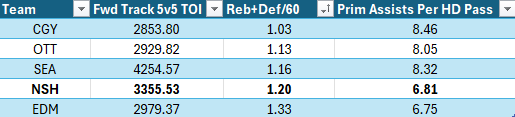
None of those teams were top-12 by goals per 60 minutes at 5-on-5 and three of the five were in the bottom-5. If Nashville wants to regain their form of a couple years ago, that offence needs to get to the net and needs to be more creative.
3 – Seattle Kraken
After being a 100-point team in 2022-23, Seattle declined each of the next two years with 81 and 76 points. Without drilling this down to a single player, they really need to figure out a way to get more from Chandler Stephenson. He led their forwards in total ice time and was given top-line minutes at even strength. Here is how Seattle performed with Stephenson on and off the ice at 5-on-5:

Seattle’s goal differential per 60 minutes at 5-on-5 was over 4x worse with Stephenson on the ice than off it. That just can’t happen for a guy getting top-line minutes. Either he needs to get much better, or his role needs to be greatly reduced.
4 – Utah Mammoth
Utah was a good team last year, just stuck in a tough division that had five playoff teams with at least 96 points. If there is one thing that needs improving, it’s their play with a lead. They managed just a 45.9% goal share at 5-on-5 with a one-goal lead, good for 22nd in the NHL. Here are the points percentages of the top-11 and the bottom-11 teams by goal share with a one-goal lead:

The gap is the difference between the overall finishes by the Carolina Hurricanes and the Pittsburgh Penguins. Utah needs to continue their upward trajectory, but they really need to lock things down with the lead. Giving away points with the lead is a fast track to the golf course in April.
5 – Vancouver Canucks
Healthy, productive years from Elias Pettersson and Thatcher Demko will be the key one way or the other. They also need more from their non-Quinn Hughes defencemen. Of the top-32 defencemen by 5-on-5 ice time per game, Vancouver had the eighth-largest drop in goal share between the minutes of that top defenceman and when they were off the ice:
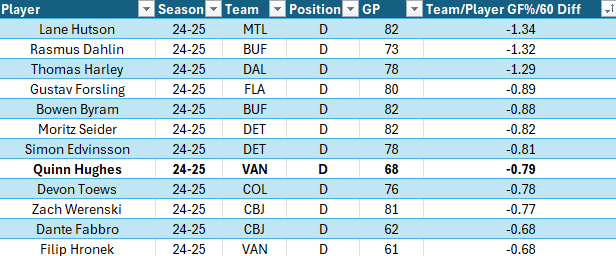
This list basically falls into two groups: pairs from non-playoff teams (Buffalo, Columbus, Detroit, Vancouver) and lone top defencemen from playoff teams (Colorado, Dallas, Florida, Montreal). Having a great top pair is nice, but the team can’t be fighting for survival when they’re getting a rest. Hopefully, a full year from Marcus Pettersson gives Vancouver the second pair they are lacking.
6 – Buffalo Sabres
Buffalo’s issue is identical to that of Vancouver’s: They did a great job winning their top defenceman’s minutes and got ran over when he wasn’t. Here is how the Sabres fared when Rasmus Dahlin was on the ice at even strength and how they fared when he was off the ice:

A 58.1% goal share at even strength would put Buffalo at the top of the league, and a 46.1% goal share would put them among teams like Philadelphia and Pittsburgh. In eight games Dahlin missed in December, Buffalo went 0-6-2 while being outscored 38-21. They need a lot more from their second and third pairs, and that’s where the additions of Michael Kesselring and Conor Timmins can help.
7 – Detroit Red Wings
While Detroit led the league with 64 power play goals, they also gave up seven short-handed goals against, tied for the 6th-most against. They also had a poor penalty kill, being tied for the fourth-most goals against. Put it all together, and despite leading the league in power play goals, the Red Wings didn’t have much of a special team advantage:

Leading the league in power play goals but only having a plus-4 goal differential on special teams shows how much improvement can be made. Things were better under new coach Todd McLellan after he got hired, so if they can keep that momentum going, the special teams differential should be better overall. “Should” being the key word in that sentence.
8 – Columbus Blue Jackets
Columbus finished fifth in the Eastern Conference by even strength goal share (52.1%) trailing only Toronto, Tampa Bay, Washington, and Florida. While the power play wasn’t awful – 22nd by goals per minute – it was a chasm between the top PP unit and the second unit. Here is how Columbus fared on the power play with Zach Werenski on the ice and Zach Werenski off the ice:
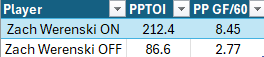
Secondary PP units are almost always worse than the primary unit, but New Jersey’s second PP unit was nearly 5.5 goals per 60 minutes, Vegas’s was hovering around 8.0, and Winnipeg’s was well over 10.0. To make matters worse, the Jackets were dead last in drawing power play opportunities. They need a better second unit or, preferably, they need to draw a lot more power plays.
9 – New York Rangers
To finish off the trifecta, the Rangers had the same problem as the Canucks and Sabres: Getting crushed in minutes with their top defenceman off the ice. Here are the on- and off-ice numbers for Adam Fox at even strength:

An even-strength goal share of 56.9% would be a top-3 mark in the league. An even-strength goal share of 47.2% would be in the bottom-10 of the league and in in the Boston/Vancouver range. The Rangers have overhauled their blue line over the last eight months or so, and we’ll see if it’s enough to get them back to the postseason.
10 – Philadelphia Flyers
My belief is that new coach Rick Tocchet will change the Flyers’ offence, and those changes will make them better defensively at even strength. But there needs to be a big special team improvement, particularly on the power play. The Flyers have been a bottom-3 team by PP goals per minute in each of the last three seasons, and are the only team in the league with under 100 power play goals in those three years:
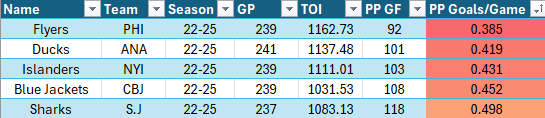
Notice that four of those five teams have not made the playoffs in any of those three years, and the Islanders made it twice but did not get past the first round. If the Flyers really want to take a step in their team rebuild, that power play cannot be bottom-5 in the league again.
Until next week.