10 Interesting (To Me) Stats For This Week - June 10
Welcome back for another week of ’10 Interesting Stats’. The Stanley Cup Final is through three games, and it looks like a series destined for seven games. We have discussed the Oilers and Panthers at length over the last few weeks, so let’s do something different. Let’s look at some of the top playoff performers from the other 14 eliminated teams using tracking data from All Three Zones and player data from Evolving Hockey.
1 – Luck Was Not in His Favour
At 5-on-5, Vegas was minus-8 with Jack Eichel on the ice in the postseason (6 goals for, 14 goals against). That differential was the second-worst mark in the first three rounds, and second-worst on a per-game basis (Eichel only played 11 games). That belies how good he was at 5-on-5 as he was 1 of 2 forwards to be at least one standard deviation above the league average playoff forward by rate of assists on teammate scoring chances (SCA/60), overall scoring chance contributions (SCC/60), offence off the rush (Rush/60), offence off the cycle/forecheck (Cycle/60), and zone entries (Entries/60):

Whenever a player performs similarly to Connor McDavid across a variety of key tracking stats, but has awful goal differentials, it’s probably safe to say he ran into some bad luck. Eichel didn’t have a productive postseason, but it wasn’t for lack of trying.
2 – Big Nick Energy
Montreal made it back to the postseason for the first time since 2021 and a big reason was the performance of Nick Suzuki. He carried over a very strong regular season into the playoffs by facilitating for his line mates: Suzuki was 1 of 4 forwards to be at least one standard deviation above the average playoff forward by rate of scoring chance assists, high-danger passes, zone entries, zone entries carried in, and lowest rate of zone entries being dumped in:

That is Suzuki alongside two MVPs and the winger playing next to one of those MVPs. After his improvements over the last couple of seasons, and now this playoff performance, Suzuki has gone from de facto top-line centre to bona fide top-line centre.
3 – The Bold and the Shoot-iful
Minnesota was bounced out of the postseason in a six-game loss to Vegas, but it wasn’t for lack of production from Matt Boldy, who scored five of Minnesota’s 14 goals at 5-on-5. He got lucky, shooting 33.3% at 5-on-5, but that was backed up by very good play as he led Minnesota forwards by rate of scoring chance contributions, offence off the rush, and offence off the cycle:
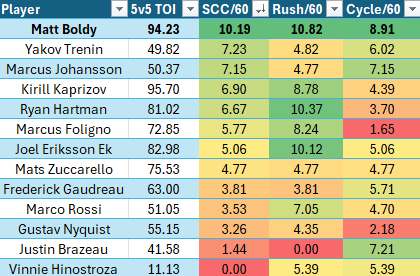
In the regular season, Boldy set a career-high with 73 points and did it with a career-low shooting percentage (10%). It seems he was saving his shooting percentage luck of the postseason, and though that performance may have been in vain, it certainly is a good sign for an even more productive season in 2025-26.
4 – The Truffle Scheifele
Despite missing 2 ½ games after a hard hit from Radek Faksa, Winnipeg centre Mark Scheifele tied for the team lead with five goals and was second with 11 points. Efficiency was the name of his game as among the forwards at least one standard deviation above the league average playoff forward by assists on teammate scoring chances, Scheifele was 1 of 4 forwards to have half those passes be of the high-danger variety (from behind the net or a seam pass across the slot) while also being one standard deviation above the league average in percentage of zone entries carried in:
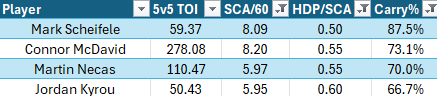
There are some games missing from the tracking data, but Scheifele was similarly efficient with his passing in the regular season. He helped the team make the most of their opportunities, and was a big reason they were able to get out of the first round for the first time in three playoff runs.
5 – Jake ‘n’ Bake
Tampa Bay was eliminated from the playoffs in five games, but Jake Guentzel did his part by leading the team in goals (3) and registering one-third (2) of the primary assists (6) totaled by Lightning forwards. In the section on Eichel, we found that Eichel and McDavid had similar performances at 5-on-5 across a variety of tracking data. If we remove the zone entry component, then we add one name to the list, and that is Guentzel’s name:

Guentzel didn’t do a lot of work on the zone entries for his line, but he did a lot of other things for the team, which is probably why he was the only Lightning forward with more than one primary assist at 5-on-5. It was a letdown of a playoff run for Tampa Bay, but Guentzel more than did his part.
6 – Gabriel Landes-god
After missing nearly three full calendar years, Colorado captain Gabriel Landeskog returned in Game 3 of Colorado’s seven-game loss to Dallas. He ended up leading the team in points per 60 minutes at 5-on-5 and had a lot of good stuff under the hood. When looking at rates of offence created off the rush and cycle, assists on scoring chances, and total scoring chance contributions, Landeskog appears as 1 of 9 names on the list:
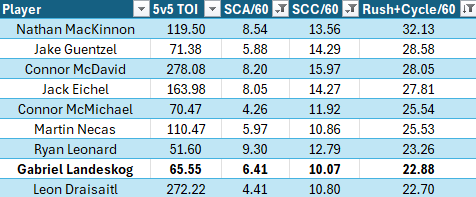
There are a couple of young Washington forwards, but most of that list is a who’s-who of top performers at their position. Colorado wants a Stanley Cup, so the season is a failure, but it’s hard to look at it like that when Landeskog returns after three years away and doesn’t just contribute but is one of their top forwards again.
7 – Sandinpaper
One thing that made the Washington Capitals so successful in the regular season was how often their defencemen got involved offensively; Washington defencemen led the league in primary assists at 5-on-5 and was second in overall assist rate at 5-on-5. While defenceman Rasmus Sandin had just one point (a secondary assist) in 10 postseason games at 5-on-5, like Eichel earlier, it wasn’t for lack of trying: among playoff defencemen who were above average by rate of scoring chance assists, total chance contributions, and zone entries, Sandin was 1 of 3 blue liners to carry the puck into the offensive zone on at least half his entries:

Washington really struggled to score at 5-on-5 overall, managing just 1.8 goals per 60 minutes in the playoffs after managing 2.84 goals/60 in the regular season. Sandin did his job trying to get the offence going, but sometimes it just doesn’t work out.
8 – Colton Par-yay-ko
Given that Cam Fowler had 10 points in seven games, he got a lot of the attention in the playoffs. That is why it’s important to highlight that Colton Parayko had five (!) primary assists at 5-on-5, which led the team, not just the defencemen. In fact, at time of writing, Parayko’s five primary assists at 5-on-5 still leads NHL playoff defencemen, even though St. Louis was eliminated five weeks ago. He was stellar at both ends, being 1 of 3 defencemen to be at least one standard deviation above league average by assists on scoring chances, offence off the rush and cycle, as well as denying zone entries to the opponent:

Had it not been for one of the all-time late-game playoff comebacks by Winnipeg in Game 7, St. Louis would have made it at least to the second round, with Parayko having a big hand in it. What happened happened, so here we are, but a great effort from Parayko nonetheless.
9 – Wonder Why They Call You Bicsh(el)
We have discussed Dallas’ third pair extensively in the postseason, but here’s one last entry for defenceman Lian Bichsel. He and partner Alex Petrovic had the lowest expected goals against rate at 5-on-5 among Dallas defencemen, Bichsel had the third-lowest goals against rate, and a lot of it is backed up by solid defensive work as he was 1 of 3 playoff defencemen to allow opponent zone entries to be carried in less than 40% of the time while also denying the blue line to opponent zone entries at least 10% of the time:

Bichsel was often kept away from the opponent’s top competition, but doing this as a 20-year-old rookie on a Conference Final team is impressive no matter the role.
10 – Jake ‘n’ Bake 2: Electric Boogaloo
The issue that plagued Ottawa defenceman Jake Sanderson in the regular season – Ottawa struggled to score with him on the ice at 5-on-5 – persisted in the playoffs as the Senators scored just one goal at that strength in Sanderson’s 118 minutes. He certainly was trying to do a lot better than that as he ended up as 1 of 3 defencemen to finish at least one standard deviation above league average by offence created off the rush and cycle, total zone entries, and percentage of zone entries carried in:

Toronto stifled Ottawa’s offence, but this is great work from Sanderson. He doesn’t turn 23 years old until July so he’s still a couple years away from really hitting his stride. That he’s doing this well at this stage of his career is nothing but a sign of greatness to come.
Until next week.